A Sociological Analysis of Education in the UK: Perspectives and Challenges
This work has been verified by our teacher: 15.01.2026 at 21:13
Homework type: Analysis
Added: 15.01.2026 at 20:38
Summary:
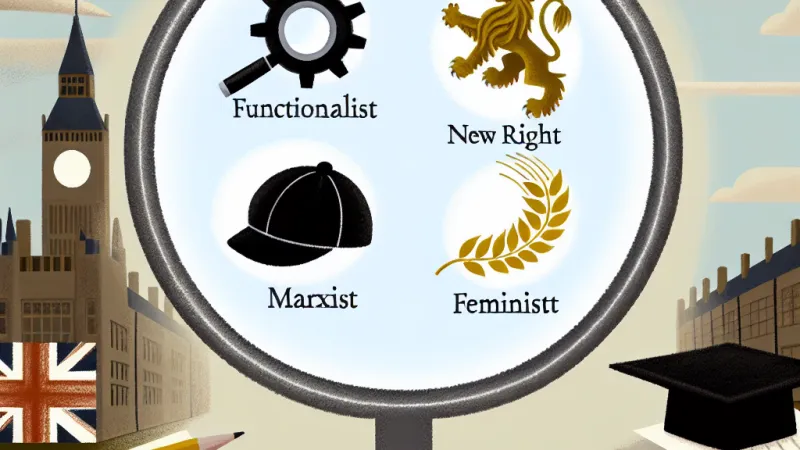
The essay analyses UK education through Functionalist, New Right, Marxist, and Feminist lenses, highlighting its roles, debates, inequalities, and future challenges.
Education: A Critical Sociological Analysis
Education stands as one of the cornerstones of modern British society. More than the transmission of facts or acquisition of qualifications, it is the principal institution through which young people are socialised, equipped with skills, and prepared for their roles as citizens and workers. However, the aims, outcomes, and fairness of education in the United Kingdom remain the subject of intense sociological debate. From traditional consensus views to conflict-driven critiques, theorists have advanced markedly different explanations for education’s functions and effects. This essay examines the major sociological perspectives on education—mainly Functionalist, New Right, Marxist, and Feminist—considering how each explains the system’s role, achievements, and persistent issues. Recent challenges and contemporary policy debates will also be addressed to underline education’s continuing evolution and significance.Functionalist Perspective: Education as the Foundation for Social Order
Among the earliest and most influential approaches, Functionalism positions education at the heart of social cohesion and stability. Drawing from Emile Durkheim’s seminal work, education is seen as a vital agent of socialisation, taking over from the family’s formative influence. Whereas family life typically operates with ‘particularistic standards’—rules and expectations tailored to each child—schools introduce ‘universalistic standards’ that apply equally to everyone. This facilitates the gradual transition from private familial norms to public societal rules.Durkheim believed that history, religious education, and civic studies cemented a collective conscience, teaching children shared values such as fairness, respect, and punctuality. The annual rituals of Remembrance Sunday or assemblies celebrating national events exemplify how British schools nurture a sense of social solidarity beyond the academic curriculum. For Durkheim, such initiatives foster belonging and unity, which are essential for social stability.
Talcott Parsons further developed this idea, describing schools as ‘bridges’ between the insular world of the family and broader society. Through standardised assessment and universal codes of behaviour—Uniform policies and the GCSE grading system serve as concrete examples—schools inculcate an appreciation of meritocracy. Ideally, everyone has the opportunity to achieve based on ability and effort, regardless of social background.
Functionalists Davis and Moore (1945) added an economic dimension with their theory of role allocation. By means of tests, streaming, and differentiated curricula, education “sifts and sorts” pupils so that the most talented advance to positions of responsibility, while others are prepared for skilled or manual work. For instance, the traditional split between academic and vocational tracks in secondary education—exemplified by A Levels versus BTEC qualifications—organises young people according to their aptitudes, thus maximising productive efficiency and meeting workforce needs.
Functionalist perspectives are lauded for their optimism and faith in social order: schools are seen as the antidote to chaos, imparting essential skills and ensuring fair competition. However, this approach is not without significant criticisms, which will be explored through contrasting theories.
The New Right: Market Principles in Education
In the closing decades of the twentieth century, New Right thinkers injected a new logic into debates about education—one rooted in market competition and the language of consumer choice. Unsatisfied with what they saw as the stultifying bureaucracy of state-run education, they argued that introducing market mechanisms would incentivise better teaching, greater innovation, and higher standards.A landmark reform in this direction was the Education Reform Act 1988, which introduced league tables, Ofsted inspections, and the National Curriculum. The theory was that, much like consumers in any marketplace, parents would choose the best schools for their children, thereby forcing underperforming institutions either to improve or face closure. Chubb and Moe (1990) further argued that state education was simply not responsive enough to the needs of the public, and that consumer choice mediated through vouchers, for example, would drive up standards.
The New Right’s faith in competition echoes policies such as the expansion of academies and free schools in England, where greater autonomy and parental involvement are believed to underpin excellence. There is scope for genuine achievement here: many highly sought-after schools have indeed prospered under this regime. The focus on accountability, results, and value for money has become virtually unchallenged in mainstream political discourse.
Nevertheless, significant concerns persist. Critics point out that not all families are equally equipped to make or act on informed choices—an issue compounded by socio-economic background, language barriers, or even geographic constraints in rural areas. The risk is the emergence of a two-tier system, where the best-resourced families cluster in high-performing schools, leaving the disadvantaged to struggle elsewhere. As such, marketisation, for all its rhetoric of opportunity, can exacerbate existing inequalities in opportunities and outcomes.
Conflict Theories: Inequality and Power in the Classroom
Functionalist and New Right accounts tend to underplay the realities of persistent social inequality in British schooling. Conflict theories—chiefly Marxism and Feminism—place these inequities centre stage, arguing that education in its current form largely reproduces rather than remedies social divisions.Marxism: Class Reproduction Under the Guise of Meritocracy
The Marxist perspective, rooted in the works of Karl Marx and later sociologists such as Pierre Bourdieu and Louis Althusser, contends that education chiefly serves to preserve the dominance of the ruling class. While schools may appear to operate on meritocratic lines, they covertly transmit the cultural values, tastes, and habits of the middle and upper classes.Bourdieu’s concept of ‘cultural capital’ is crucial here. Middle-class children generally arrive at school already conversant with the expectations, speech codes, and cultural references favoured in the classroom—Shakespeare, classical music, or certain forms of dress. As a result, they find it easier to succeed in an environment that validates their background while alienating working-class students. The standardisation of assessment, whether in the form of essay-based exams or selective universities’ interview techniques, often compounds this bias.
Althusser, meanwhile, introduces the notion of the ‘Ideological State Apparatus’, arguing that education subtly conditions individuals to accept their lot in life as natural or deserved. Through formal curriculum and the so-called ‘hidden curriculum’—punctuality, obedience, competitiveness—schools mirror and legitimate the inequalities found in the workplace and broader society, a point explored further by Bowles and Gintis (1976) in their correspondence theory.
Feminism: Gender Inequality and the School Experience
Feminist theorists, for their part, foreground the experiences of girls and women, contending that education has been central in perpetuating gendered inequalities. Historically, girls were often steered towards subjects and careers considered ‘appropriate’ for their sex—domestic sciences rather than engineering, for example. Even with the notable reversal of the gender attainment gap at GCSE and A Level in recent decades, old inequalities persist in the persistent gender segregation of university degree selections and employment outcomes.Subject choices remain heavily gendered in the UK: boys dominate in maths, physics, and computing A Levels, while girls outnumber boys in English, art, and psychology. Careers talks, subtle teacher expectations, and peer pressure all contribute to these patterns, demonstrating how gender roles are reinforced not just in the classroom, but at every stage of a young person’s development.
Feminist theorists also highlight the wage gap and the underrepresentation of women in senior leadership positions, both in schools and the wider workforce. Although considerable progress has been made, occupational and economic segregation is still alive and well.
Critical Evaluation and Contemporary Challenges
While Functionalist and New Right theorists focus on the positive contributions of education or the efficacy of reforms, they are often blind to the everyday realities of inequality—appalling child poverty rates in cities such as London, or the persistent underperformance of pupils from certain ethnic minority backgrounds. In England, summer 2023 A Level results revealed a 23-percentage-point difference between pupils eligible and not eligible for free school meals achieving grades A*-C.Furthermore, so-called ‘negative experiences’—bullying, racism, or the immense pressure of high-stakes testing—are often minimised in theoretical debates, yet they shape pupil well-being and future, fostering alienation rather than engagement.
At the same time, Conflict theories, especially early Marxism, can be overly deterministic, overlooking moments when education does function as a vehicle for social mobility—witness, for example, the rise in university participation rates among working-class and first-generation students, especially following widening participation policies in the late 1990s and early 2000s. Feminism, too, has sometimes been critiqued for focusing on systemic disadvantages without adequately acknowledging shifting gender norms, intersectionalities, and the dynamic achievements of young women in education.
Newer approaches, including Interactionism and postmodern thought, challenge the idea that education operates in a linear or monolithic fashion. Classroom interactions, teacher expectations, and the complex interplay of ethnicity, gender, and class produce highly variable outcomes. In a diverse multicultural Britain, these nuanced, micro-level dynamics often prove as significant as broad structural forces.
Contemporary Issues and Future Directions
The landscape of British education continues to shift. The increasing diversity of the student population—a consequence of migration and cultural change—demands curriculums that are inclusive and reflective of many traditions. Technological change, seen in the rise of online learning and AI-driven innovations, opens up new possibilities but also risks deepening the ‘digital divide’ for less wealthy families.Debates rage over whether the aims of education should foreground equality of opportunity, individual choice, or wider social cohesion. The return of grammar schools as a policy issue, disputes over the National Curriculum’s ‘decolonisation’, and arguments about university fees all reveal how education remains deeply intertwined with questions of justice, democracy, and the future of British society.
Conclusion
Education in the UK is far more than a means of acquiring knowledge or qualifications: it is a battleground where longstanding social divisions and collective hopes are played out day by day. Functionalist and New Right perspectives illuminate the system’s integrative and aspirational aspects; Marxist and Feminist theories lay bare its role in reproducing or challenging inequalities. Neither set of theories offers an unproblematic map, but together they force us to reckon with education’s immense complexity and significance.Critically evaluating these perspectives reveals education as both a source of hope and a site of contention, reflecting patterns in British society at large. The evolution of education policy must seek not only to reward merit and drive excellence, but also to ensure fairness, embrace diversity, and continually strive to reduce barriers to opportunity. The conversation remains ongoing, and rightly so—for in understanding education, we confront fundamental questions about who we are, and what kind of society we wish to be.
Rate:
Log in to rate the work.
Log in