Evaluating Sociological Theories on Family Diversity in Modern Britain
This work has been verified by our teacher: 15.01.2026 at 20:06
Homework type: Essay
Added: 15.01.2026 at 19:39
Summary:
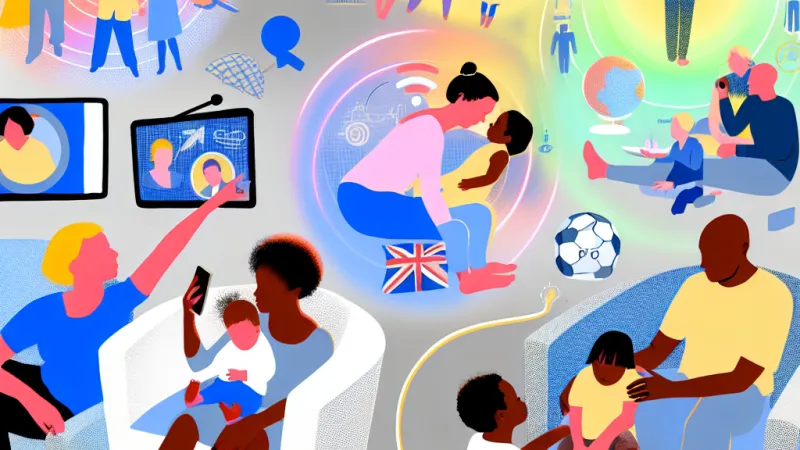
The diversity of British families today stems from shifting norms, personal choice, demographics, technology, economics, and cultural variety.
Assessing Sociological Explanations for the Diversity in Family Forms Found in Britain Today
In sociological discourse, the concept of ‘family’ is a profoundly contested one. Traditionally, definitions have often fixated on the nuclear family: two heterosexual parents married and living with their biological children. This model was long upheld as the norm within British society, underpinned by what theorists term the ‘family norm’—an idealised life trajectory involving courtship, marriage, childrearing, and ultimately empty-nest retirement and widowhood. However, the lived realities of family life in contemporary Britain stand in stark contrast to this once-dominant ideal. The plurality of visible family structures—from cohabiting couples and lone-parent households to same-sex partnerships, stepfamilies, extended kin networks, and intentionally childfree arrangements—demands a critical appraisal of how and why such diversity has flourished.
This essay aims to critically evaluate the various sociological accounts for the emergence and persistence of diverse family forms in Britain today. Analysing a range of theoretical viewpoints and drawing on empirical research and British social context, I will examine the interplay of social norms, individual agency, demographic changes, technological advances, economic conditions, and cultural diversity. In doing so, the essay will demonstrate that no single explanation is sufficient; instead, it is the complex interrelationship of these factors which best explains the diversity evident in British family life.
---
1. Sociological Perspectives on Family Diversity – Theoretical Approaches
To understand how and why family diversity has become such a significant feature of British society, it is instructive to begin with key sociological theories.Functionalism and Its Critics
Functionalist sociologists such as Talcott Parsons traditionally viewed the nuclear family as ideally suited to meet the needs of modern, industrial society. The ‘functional fit’ theory posited that as societies became more technologically advanced and geographically mobile, the nuclear family’s relative compactness allowed it to thrive. From this point of view, diversity is at best an anomaly, at worst a threat to social stability. This perspective, however, faces mounting criticism: not only does it overlook historical and cultural variety in family forms, but it also downplays the agency of individuals and the structural factors underlying change.Postmodern and Late-Modern Perspectives
A more contemporaneous approach emerges with postmodernism and late-modern theorists such as Anthony Giddens and Ulrich Beck. Here, the certainty and universality championed by functionalists are rejected. Instead, families are regarded as fluid, negotiated, and multifaceted, influenced by individual choice, changing identities, and an erosion of rigid social norms. In this ‘risk society’, as Beck suggests, relationships are increasingly unstable and families take on myriad forms as individuals pursue personal fulfilment.Interactionism and the Life Course
Interactionist perspectives, as illustrated by David Morgan, locate the meaning of ‘family’ in the everyday routines and negotiated meanings of its members. Here, diversity is an outcome of how people actively construct family life within their own contexts. The contrast between ‘life cycle’ and ‘life course’ thinking is also central: whilst the former posits universal, linear stages, the latter foregrounds unique trajectories shaped by varied circumstances, producing a tapestry of family patterns.Before proceeding, it should be noted that these sociological frameworks—though sometimes contradictory—each illuminate aspects of the reality of family diversity in Britain today.
---
2. Changing Social Norms and Cultural Acceptance
A significant driver of family diversity has been the transformation of social norms and attitudes. Over the past several decades, certain conventions—such as the necessity and permanence of marriage, the stigma attached to childbirth outside wedlock, and the illegitimacy of same-sex relationships—have dramatically weakened.Research by the British Social Attitudes Survey reflects a consistent liberalisation in public opinion: support for cohabitation, divorce, and same-sex partnerships has risen markedly since the 1980s. The legalisation of same-sex marriage (2014) and earlier recognition of civil partnerships (2004) illustrate how societal and institutional change can reinforce and reflect shifts in common values.
Secularisation—a declining influence of organised religion—has also loosened doctrinal constraints on personal relationships and reproductive choices. Yet, it would be remiss to overlook persistent resistance in particular communities, often along generational, religious, or local lines. For example, some conservative faith groups or close-knit rural communities continue to prize traditional marital and gender roles, and stigma against ‘alternative’ family forms has not vanished completely.
---
3. Increased Individual Choice and Agency
Anthony Giddens’ concept of the ‘transformation of intimacy’ is pivotal in explaining how greater individual agency is reshaping the family. He argues that modern relationships are increasingly based on satisfaction, equality, and negotiation rather than obligation or fixed roles. The growing willingness to leave unfulfilling partnerships—and the legitimacy of doing so—has not only normalised divorce and re-partnering, but also supported the formation of blended and stepfamilies.The widespread availability of reliable contraception since the 1960s has further increased individual autonomy over reproduction. Women and couples can postpone, space, or forgo childbearing, giving rise to childfree families and later-life parenthood. Domestic arrangements are now highly varied: some households share childcare equally; others consist of lone parents or three-generational units.
Still, it is important not to exaggerate freedom of choice. Real options are shaped by economic resources, social support, and lingering societal expectations. For example, while middle-class women may combine careers and family life, others might lack affordable childcare or secure employment, constraining their options.
---
4. Impact of Demographic Changes and Life Events
Demographic shifts have had profound consequences for British family structures. The population is ageing, with increasing numbers of older adults living either independently or with family. This has led to so-called ‘beanpole families’—longer, thinner structures with more generations alive but fewer in each. The proliferation of reconstituted families results largely from high rates of divorce and separation; almost half of marriages in England and Wales now end before the 20th anniversary.Variations in fertility further shape family forms: some households are childless by choice or circumstance; others, especially within certain cultural groups, have larger numbers of children. There are notable regional and class divides: affluent retirees concentrate in certain ‘sunbelt’ areas like the South West, while higher proportions of lone-parent households feature in parts of the North and inner cities, reflecting employment and housing patterns.
Ethnic groups too display distinctive trends—explored further in section seven.
---
5. The Role of Technology and Globalisation
Technological innovations, especially in reproductive medicine, have enabled entirely new family forms. IVF, donor insemination, and surrogacy facilitate parenthood for same-sex couples, single women, and others previously excluded from biological parenthood. Communication technologies help maintain ties among family members separated by migration, fostering ‘transnational families’ in which emotional and practical support can cross borders virtually.Meanwhile, globalisation and migration have brought with them practices from across the world: for instance, extended family households are common among British South Asian communities, who may preserve kinship networks often overlooked in white British families. Still, access to and acceptance of these technological possibilities varies—sometimes by class, sometimes by culture.
---
6. Socioeconomic Factors and Material Conditions
Material circumstances underlie much family diversity. The expansion of female education and access to paid employment has enabled many women to avoid economic dependence on a spouse, resulting in delayed marriage, increased cohabitation, and a rise in single-person and lone-parent households.State policy undeniably plays a role: the availability of social housing, child benefit and tax credits support those raising children alone, particularly women. But since austerity measures following 2010, many such provisions have been scaled back, making family life more precarious, especially among less affluent households.
Class shapes both the likelihood and experience of family diversity. Middle-class families might enjoy more stable partnerships and dual incomes, whereas working-class families often bear greater risks of relationship breakdown, single parenthood, and associated hardship. Thus, economic context both enables and constrains the practical options from which families are formed.
---
7. Cultural Diversity and Ethnicity
The diverse ethnic makeup of Britain is a major contributor to family variety. Research demonstrates that family forms often reflect the cultural values and historical experiences of particular groups. For instance, South Asian communities frequently retain multi-generational households and close kinship ties, with comparatively low divorce and lone parenthood rates. In contrast, Black Caribbean families in Britain have comparatively high rates of lone motherhood, a pattern shaped partly by migration history, patterns of employment, and structural disadvantage.Intergenerational solidarity remains crucial in many groups—sometimes, as in Carol Vincent’s study of African-Caribbean families, the grandmother is a pivotal figure providing economic and emotional support. Nevertheless, all groups are subject to internal change: second and third generations may adapt their family practices in response to wider British norms, leading to hybrid forms.
---
8. Critical Evaluation of Explanations
While each of the above factors—theoretical perspectives, social norms, agency, demography, technology, economics, and ethnicity—provides insight into family diversity, none alone suffices. Rather, it is their intersection and interplay which create the conditions for such diversity to emerge.Questions remain as to the genuine freedom individuals possess in shaping family lives: are today’s ‘choices’ meaningful, or are they heavily circumscribed by social class, gender, ethnic background, and available resources? While Giddens celebrates reflexive, negotiated families, Silva and Smart caution there is often a gap between expectation and reality, with factors like austerity, housing costs, and childcare provision heavily circumscribing possibilities.
Traditional family norms may not have vanished so much as fragmented or been renegotiated; old ideals coexist uneasily with new models. As Beck’s ‘risk society’ thesis suggests, the unpredictability and precarity of modern relationships both liberate and unsettle.
---
Conclusion
The diversity of family forms in 21st-century Britain arises from a complex constellation of factors: shifting social norms, expanded personal agency, demographic transitions, technological and policy innovations, economic change, and the multiplicity brought by cultural and ethnic diversity. To grasp this diversity, sociologists must move beyond single-factor explanations, instead recognising the interplay of both structure and agency, possibilities and constraints.Understanding these dynamics is not merely of academic interest—it carries importance for policymaking, education, and the wellbeing of families themselves. As Britain’s society continues to evolve, it is likely that definitions of family will become ever more inclusive and complex, reflective of the dynamic and differentiated lived realities of its people.
In sum, there is no final, singular story to tell about family in Britain—only an ongoing process of negotiation, adaptation, and transformation, marking families as as diverse as the society itself.
Rate:
Log in to rate the work.
Log in