Transport Systems in Plants and Animals
This work has been verified by our teacher: 16.01.2026 at 10:58
Homework type: Essay
Added: 16.01.2026 at 10:30
Summary:
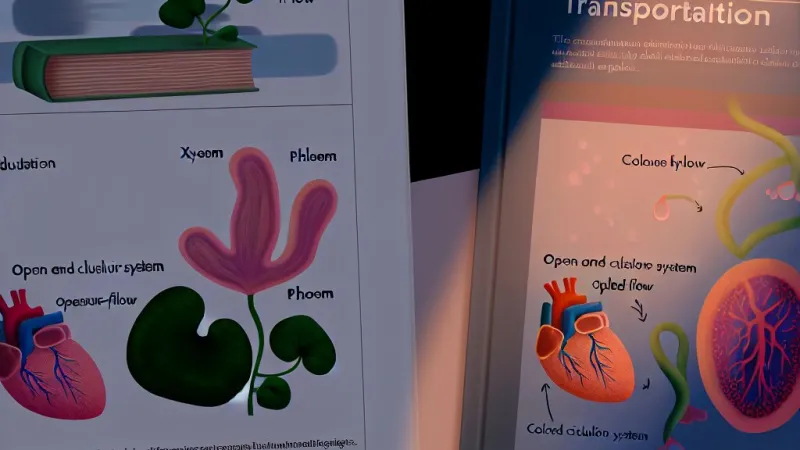
Transport in plants and animals: diffusion vs bulk flow; xylem (cohesion-tension) and phloem (pressure-flow); animal closed/open circulation, blood and heart.
Transport in Animals and Plants
Transport within living organisms is fundamental to life, ensuring that essential substances such as water, minerals, food molecules, and gases reach every cell to sustain metabolism and growth. In biology, “transport” denotes the collective mechanisms by which organisms move these materials within their bodies: from the humble uptake of water by a daffodil’s roots, to the ceaseless pulsing of blood through a human’s veins. As multicellular organisms have evolved larger sizes and greater tissue specialisation, so too have their transport systems become more intricate, surpassing what passive diffusion alone could achieve. The following essay will explore these transport systems in both plants and animals, examining their organisation and underlying mechanisms, and evaluating the structural adaptations that enable them to surmount the constraints of size, environment and internal demand.
---
General Principles of Transport
Central to all transport systems are two principal modes of movement: diffusion and bulk flow (or mass flow). Diffusion depends on the random movement of particles from areas of high concentration to low, and whilst effective over microscopic distances, it rapidly becomes inefficient in organisms of larger size due to the dramatically increasing time taken as distance grows—a limitation articulated by Fick’s law. Fick’s law, simply put, states that the rate of diffusion is proportional to (surface area × concentration difference) and inversely proportional to the diffusion distance. For instance, a single-celled Paramecium relies entirely on diffusion, but a hedgehog or an oak tree cannot—substances must be transported rapidly across considerable distances.Bulk flow circumvents the slowness of diffusion by moving fluids en masse, driven by pressure differences: in animals, muscular hearts create pressure to push blood along vessels; in plants, tension in xylem draws water from roots to leaves. The physics of flow in tubes, qualitatively described by the principles of Poiseuille’s law, tells us that even small increases in vessel radius can cause large increases in flow rate—a consideration visible in both wide xylem vessels and animal arteries. The choice of medium matters as well: blood, sap, and other fluids serve as solvents, allowing the transport not just of water but of solutes, gases, and metabolites.
Another essential principle is compartmentalisation. In plants, the movement of substances can occur through apoplast (cell walls), symplast (living cytoplasm), or transmembrane pathways. In animals, exchange with tissues happens at thin-walled capillaries, balancing hydrostatic and oncotic (protein-driven) pressures to facilitate nutrient delivery and waste removal.
---
Transport in Plants
Vascular Organisation: Xylem and Phloem
Plants, rooted and often sessile, face unique challenges as they must transport substances from soil and atmosphere to every cell. Higher plants have developed vascular tissues—xylem and phloem—bundled into discrete strands running through roots, stems and leaves. Xylem is formed mainly from vessels and tracheids, elongated cells with tough, lignified walls, providing both support and a continuous, hollow passage for water. It is notable that these cells are dead at maturity, minimising resistance to flow and allowing them to withstand negative pressures. By contrast, phloem is made up of living cells: sieve tube elements lined with perforated sieve plates, their functions closely tied to adjacent companion cells, which supply energy and maintain cellular function via plasmodesmata (cytoplasmic connections).Xylem Transport: The Cohesion–Tension Theory
The cohesion–tension theory underpins our understanding of water movement through xylem. Root cells actively uptake minerals, lowering water potential and facilitating the passive influx of water from the soil. This water ascends the plant as an unbroken column, pulled upwards by the negative pressure created by evaporation at the leaf surfaces—transpiration—principally through open stomata. Here, water molecules stick together (cohesion) and to the walls of the xylem (adhesion), preventing column collapse even under considerable tension. Stomatal behaviour is highly responsive to light, humidity, wind, and temperature; thus, the environment tightly regulates plant water loss and uptake.At the root’s interface, the endodermis, bolstered by the Casparian strip, ensures water and minerals are selectively admitted, safeguarding homeostasis and protecting the plant from unwanted substances. Variation in xylem vessel structure—narrow tracheids in ferns versus wide vessels in oak—reflects evolutionary responses to differing water demands and risks such as cavitation (formation of air embolisms that disrupt water flow).
Evidence for these processes abounds from classic experiments: potometers measure transpiration rates, while pressure chambers (the Scholander bomb) have demonstrated the negative pressures in xylem. The ascent of coloured dyes and radioactive tracers through plant stems further illustrates the continuous water pathway.
Phloem Transport: Pressure-Flow Mechanism
The pressure-flow (or mass flow) hypothesis describes how organic substances—mainly sugars produced by photosynthesis—are distributed. Sucrose is actively loaded into phloem at source regions (e.g. leaves), increasing the osmotic concentration and drawing in water, thereby raising turgour pressure. This pressure difference pushes phloem sap towards sink regions (e.g. growing roots, fruits), where sucrose is unloaded, reducing local turgour and maintaining flow. Companion cells are vital, supplying ATP and helping to maintain concentration gradients.Experiments such as the use of aphid stylets to sample phloem sap, and “ringing” (removing a strip of bark to interrupt phloem but not xylem), have provided definitive insights. Tracer studies using labelled carbon dioxide (^14C) track the movement of newly fixed sugars, revealing rates and directionality.
Adaptations and Variation
Plants inhabit a wide range of environments, demanding specific adaptations in their transport systems. *Xerophytes* (e.g. marram grass) exhibit traits to conserve water: sunken stomata, thick cuticles, or crassulacean acid metabolism (CAM). Hydrophytes (e.g. water lilies) may have reduced xylem and air-filled tissues (aerenchyma) to survive in flooded conditions. Even within temperate wood, xylem development reflects the seasons: wide, thin-walled vessels for rapid spring transport (earlywood), denser wood in summer (latewood).---
Transport in Animals
Diversity of Animal Circulatory Systems
Animals demonstrate a spectrum of transport systems, scaled to their complexity. Single-celled euglenas and flatworms rely on diffusion, their shapes optimised for minimising diffusion distances. Larger animals face greater challenges, met through the evolution of circulatory systems—either open or closed.Open Circulatory Systems
In invertebrates such as insects and many molluscs, open circulatory systems bathe the body’s cells in haemolymph within a body cavity (haemocoel). The dorsal heart pumps haemolymph but not under high pressure, limiting speed and control. Notably, in insects, oxygen delivery is handled separately via the tracheal system (a network of air tubes), so the haemolymph does not carry respiratory gases, illustrating the importance of not conflating circulatory and respiratory roles.Closed Circulatory Systems and Their Variants
Vertebrates and a few invertebrates (e.g. earthworms) possess closed systems, wherein blood is confined to vessels. This allows for higher pressures, precise distribution, and rapid transport—key to higher metabolic demands. Systems can follow single (e.g. most fish) or double circulation (e.g. mammals, birds):- Single Circulation (Fish): Heart pumps blood to gills (for oxygenation) and then around the body. As pressure drops after passing through gill capillaries, activity is somewhat limited, but fish compensate with counter-current exchange at the gills for maximal oxygen uptake. - Double Circulation (Mammals, Birds): Heart is divided into separate circuits for lungs and body, allowing maintenance of high pressure and efficient oxygen delivery. This separation enables sustained endothermy (warm-bloodedness) and greater levels of activity.
Special cases include amphibians and reptiles, whose hearts allow partial mixing of blood, reflecting a link between metabolic needs and system complexity.
Blood: Composition and Roles
Blood is a complex fluid: plasma (the liquid phase, carrying dissolved nutrients, hormones, and waste), erythrocytes (red blood cells containing haemoglobin, a cooperative oxygen carrier), leukocytes (immune cells), and platelets (clotting). The oxygen dissociation curve describes how haemoglobin binds and releases oxygen, and the Bohr effect shows how this curve shifts at different carbon dioxide concentrations and pH levels, enabling efficient delivery to metabolically active tissues.Blood also transports waste such as carbon dioxide (mainly as bicarbonate) and urea, distributes hormones, and facilitates temperature regulation. The oncotic pressure generated by plasma proteins draws water back into capillaries, balancing hydrostatic pressure which pushes fluid out.
Blood Vessels and Circulation
Arteries, with muscular and elastic walls, withstand and smooth out the pulsating force of the heartbeat, conveying blood at high pressure. Arterioles, much narrower, are the main site of resistance and thus control blood flow to tissues via vasodilation or vasoconstriction—under neural or hormonal control. Capillaries, with a single epithelial cell wall, are sites of exchange. Their immense total surface area slows blood, facilitating nutrient and gas transfer by diffusion and filtration.Veins, with thinner walls and valves, return blood at low pressure, aided by muscle contractions and low thoracic pressure during inhalation. The lymphatic system scavenges excess tissue fluid, returning it to the circulation and playing a vital immune role.
Heart Structure and Regulation
The human heart, divided into four chambers, operates through the cardiac cycle: atrial contraction, ventricular contraction, and relaxation (diastole). Electrical impulses from the sinoatrial node coordinate contractions, with delays at the atrioventricular node and propagation through the Bundle of His and Purkinje fibres—a sequence observable on an ECG as P, QRS, and T waves. Heart rate and force are modulated by the autonomic nervous system and hormones such as adrenaline.Pressure and Flow
Blood pressure is highest leaving the heart and falls across the system. The strong r^4 relationship in Poiseuille’s law means vasoconstriction has a dramatic effect on pressure and flow, a principle harnessed by the body for rapid adjustments.Special Adaptations
- Fish: Efficient gills and streamlined circulation for aquatic life. - Birds: Lungs with unidirectional airflow, air sacs, and a powerful heart—differences underpinning high energy demands during flight. - Earthworm: Closed system with multiple pseudohearts. - Mammals: Sophisticated mechanisms for thermoregulation and diving in marine mammals.---
Comparative Analysis and Adaptive Significance
Both plants and animals have evolved transport systems that reconcile the twin forces of physics and biology with their environmental and metabolic constraints. Plants employ passive, tension-driven rise of water in xylem and active, pressure-driven flow in phloem, largely dictated by environmental factors. Animals, by contrast, have harnessed muscular pumps to generate bulk flow, paired with flexible systems of vessel control and highly sophisticated exchange surfaces. Convergent features, like valves (in plant phloem arrangements and animal veins), reflect parallel solutions to the challenge of directional movement. The ability to maintain elevated metabolic activity (as in endothermic birds and mammals) is inextricably tied to the evolution of closed, double circulatory systems, with all the associated energetic trade-offs.---
Methods of Investigation and Evidence
Our knowledge of these complex systems rests on ingenious experimentation. Transpiration potometers, dye tracing, and radioactive isotope studies track movement in plants; whilst pressure chambers and microscopy reveal cellular adaptations. Animal systems are probed with blood pressure cuffs (sphygmomanometers), ECGs, capillary video microscopy, and tracer dyes, alongside haemoglobin binding studies. Each technique has strengths—ECGs allow real-time cardiac monitoring—but limitations: invasive methods may disrupt natural function, and artificial conditions rarely replicate the full suite of environmental influences.---
Rate:
Log in to rate the work.
Log in