Circadian Rhythms Explained: Biological Clocks and Daily Health
This work has been verified by our teacher: 16.01.2026 at 18:06
Homework type: Essay
Added: 16.01.2026 at 17:15
Summary:
Explains circadian rhythms: SCN and clock genes create ~24‑hr cycles, synced by light and social cues; impacts sleep, health, shift work, chronotherapy.
Biological Rhythms: Circadian Rhythms
Circadian rhythms are patterns of biological activity that cycle approximately once every 24 hours, playing a crucial role in human physiology and behaviour. Classic examples include the sleep–wake cycle, daily fluctuations in body temperature, and the regular secretion of hormones such as melatonin. In this essay, I will examine the mechanisms governing circadian rhythms, focusing particularly on the interplay between internal biological clocks and environmental cues. I will evaluate key empirical studies, address methodological issues and competing explanations, and highlight the real-world significance of understanding circadian timing for health, education, and society more broadly.
---
Types of Biological Rhythms
To situate circadian rhythms within a broader context, it is useful first to distinguish between types of biological rhythms. Ultradian rhythms, such as the stages of sleep (including regular cycles of REM and non-REM sleep), repeat multiple times within a 24-hour period. Infradian rhythms, by contrast, last longer than a day—examples include the human menstrual cycle, which typically spans around 28 days, and various annual (circannual) rhythms seen in other species, such as seasonal breeding or hibernation. While these phenomena showcase the diversity of biological timing, this essay will centre on circadian rhythms, which characteristically repeat every 24 hours, intimately linking our physiology to the environmental day–night cycle.---
Endogenous Pacemakers: Internal Basis of Circadian Rhythms
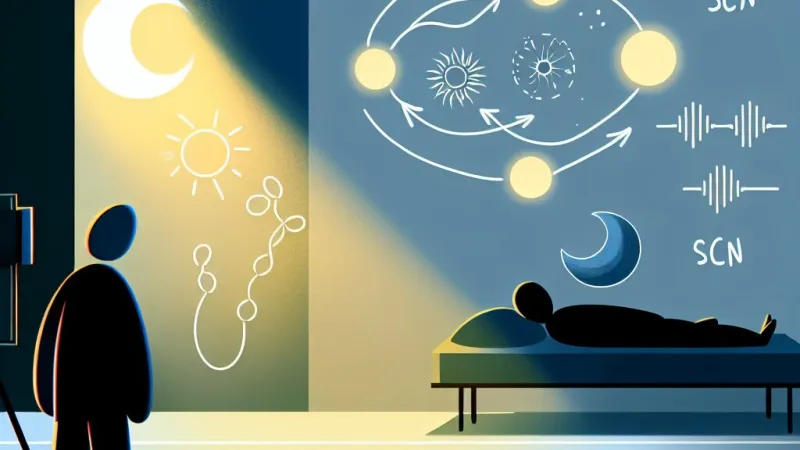
Central to the generation of circadian rhythms are the body's endogenous pacemakers—internal, physiological timekeeping systems. The suprachiasmatic nucleus (SCN), located in the hypothalamus just above the optic chiasm, is recognised as the master circadian clock in mammals. The SCN comprises groups of specialised nerve cells that exhibit rhythmic activity independent of external cues, maintaining a near-24-hour cycle through coordinated genetic and biochemical feedback.The ‘molecular clock’ underpinning SCN activity operates via the expression of specific 'clock genes', such as PER and CLOCK, which produce proteins accumulating over time and then inhibiting their own synthesis in a feedback loop, thereby generating rhythmicity at the cellular level. Importantly, the SCN communicates with peripheral oscillators (body clocks in organs such as the liver and heart) to synchronise bodily functions.
An additional player is the pineal gland, which secretes the hormone melatonin under SCN control. As night falls, the SCN stimulates melatonin release, signalling darkness to the body and promoting sleep preparation. This cascade constitutes the body’s internal mechanism for maintaining regularity in sleep and wakefulness even in the absence of environmental time cues.
---
Exogenous Zeitgebers: Environmental Cues for Synchronisation
Endogenous clocks are not entirely self-sufficient; they require synchronisation with external time cues—known as exogenous zeitgebers. The most potent zeitgeber by far is environmental light. Light information, detected via specialised photoreceptors in the retina, is conveyed directly to the SCN, enabling it to reset daily and keep bodily timekeeping in step with the natural day–night cycle. For instance, exposure to light in the morning can advance the rhythm (promoting earlier waking), while light in the evening can delay it.Other zeitgebers exist but exert weaker influences compared to light. These include social factors such as meal timing, work schedules, patterns of physical activity, and social interaction. For example, fixed meal times may help entrain the liver clock, although in the absence of light cues, their effect is limited. The interaction between endogenous and exogenous factors is vividly evident during experiences like shift work or crossing time zones, where abrupt changes in external cues can lead to a misalignment between internal rhythms and the external environment, manifesting as jet lag or sleep disturbances.
---
Empirical Evidence of Endogenous Control
The importance of internal clocks has been demonstrated in both human and animal studies. Classic human ‘cave’ experiments, such as those conducted by Michel Siffre in the 1960s and later at the Mammoth Cave in Kentucky, involved isolating participants from natural light and social cues for extended periods. Under these ‘free-running’ conditions, participants maintained a regular sleep–wake cycle, though often slightly longer than 24 hours, demonstrating an inherent biological rhythm. However, over time, these rhythms showed variability, indicating a need for external calibration.Supporting these findings, animal research has pinpointed the SCN as crucial. Rodent studies, for example, reveal that surgical destruction of the SCN results in the loss of regular sleep–wake cycles and rhythmic behaviour. Even more strikingly, transplantation of SCN tissue from a donor animal restores rhythmicity, and the recipient’s rhythm matches the donor’s endogenous period. This evidence powerfully suggests that the SCN is necessary and sufficient for circadian organisation.
On the positive side, such studies provide compelling causal evidence for endogenous pacemakers and are underpinned by sound experimental control. However, one must acknowledge notable limitations: extreme deprivation studies in humans raise ethical questions, and extrapolating findings from animal models to humans always invites caution due to differences in complexity and life history.
---
Empirical Evidence: Zeitgebers and Interactions
Research also shows the profound capacity of zeitgebers to reset or adjust biological clocks. Laboratory experiments in controlled settings demonstrate that exposure to bright artificial light can shift the timing of melatonin release, thus phase-advancing or delaying sleep-onset in participants. Furthermore, field observations from aircrew, shift workers, and those travelling across time zones reveal the practical importance of light: careful timing of light exposure can help resynchronise the circadian clock after ‘jet lag’.While non-photic zeitgebers such as scheduled feeding and social activities can entrain rhythms (as seen in shift work adaptation programmes), their effects are noticeably less robust than those of light, especially when light cues are available. This hierarchy points towards a sophisticated, interacting system: internal clocks set the pace, but environmental signals keep them on track.
In application, light therapy—a targeted use of timed artificial light—has been deployed to treat mood disorders with seasonal patterns (such as Seasonal Affective Disorder (SAD)) and to aid adaptation in shift workers. Nevertheless, not all findings are consistent; the impact of factors such as brief flashes of light during sleep or the influence of electronic screens, for instance, is an area of ongoing debate and individual responses vary significantly.
---
Methodological Strengths and Weaknesses
Appraising the evidence, several methodological points deserve attention. Laboratory and animal studies benefit from tight experimental control, enabling researchers to isolate specific variables and establish clear cause–effect relationships. The convergence of findings across different techniques—behavioural observations, neurophysiological recordings, and genetic analysis—bolsters the strength of conclusions drawn.Conversely, such research is not without drawbacks. Conditions in caves, bunkers, or hospital labs are often artificial, which may yield behaviours unlike those seen in real life. Human studies frequently involve small samples or single-case designs, limiting generalisability. Animal experiments, while informative, often entail invasive procedures and raise ethical considerations about welfare and humane treatment. Furthermore, measurement of rhythms sometimes relies on subjective sleep logs rather than objective devices like actigraphy or hormone assays, making rigorous quantification challenging. Each strength, therefore, is often balanced by a corresponding caveat.
---
Alternative Perspectives and Recent Developments
Recent advances have added layers of understanding in this field. Genetics, for example, has illuminated the integral roles of clock genes in setting the ‘speed’ of the biological clock, accounting for why some individuals are naturally early risers (morning chronotypes) while others prefer late nights. Social and technological factors prevalent in modern Britain—such as irregular work hours, round-the-clock screen use and artificial lighting—now serve as contemporary zeitgebers, at times clashing with biological predispositions and leading to phenomena like social jet lag or sleep disorders.Crucially, most current theorists view circadian rhythms as products of interaction: neither internal pacemakers nor environmental cues alone can fully explain the complexities observed. New interventions have capitalised on these insights—for example, combining light therapy with behavioural scheduling or administering melatonin at specific times (a practice known as chronotherapy) for patients with sleep phase disorders or shift workers.
---
Real-World Applications and Implications
Knowledge of circadian rhythms has arguably never been more relevant. In healthcare, aligning hospital staff rotas with circadian principles has reduced mistakes during night shifts, while the timing of medicines (chronotherapy) can optimise their efficacy and minimise side-effects. In occupational settings, employing strategic light exposure and protective nap schedules helps mitigate errors and health risks among those working unsocial hours.For travellers, practical guidelines based on circadian science (involving timed light exposure, controlled sleep and melatonin supplements) are routinely used by frequent flyers and professional athletes to reduce jet lag. Additionally, there is an emerging call for UK schools to adjust start times, especially for adolescents, whose circadian clocks are naturally ‘delayed’—a policy supported by research linking later start times to improved mental health, attendance and academic performance. These examples demonstrate the wide-ranging societal and personal benefits from understanding and applying circadian science.
---
Rate:
Log in to rate the work.
Log in