Understanding Biological Classification: Key Concepts from AQA AS Unit 2
This work has been verified by our teacher: 29.03.2026 at 13:38
Homework type: Essay
Added: 26.03.2026 at 6:35
Summary:
Explore key concepts of biological classification from AQA AS Unit 2. Learn about species, taxonomy, evolution, and molecular tools for exam success.
The Importance of Classification in Modern Biology: A Critical Exploration from Species to Molecular Evidence
The natural world is a tapestry of ceaseless variety, with millions of living organisms woven together across time and space. Yet, for biologists to make sense of this immense diversity, a systematic method of ordering life is essential: this is the science of classification. From Darwin’s finches on the Galápagos to the common blackbird in British gardens, organising species into meaningful groups tells us not only about their differences, but more profoundly, about their shared history and connections. This essay will critically examine key ideas from the AQA AS Biology Unit 2 specification, beginning at the concept of classification and progressing through the intricacies of species definition, hierarchical taxonomy, evolutionary relationships, molecular tools, courtship behaviour, and genetic variation. Throughout, I will draw on examples and references relevant to the United Kingdom context, demonstrating the ways in which these themes underpin not just examination success, but our broader comprehension of life’s continuity and change.---
1. Defining Species: The Cornerstone of Classification
One of the most fundamental – yet persistently debated – questions in biology concerns the species: what, exactly, constitutes a species? At school, we are first taught the simple definition: "a group of organisms capable of interbreeding to produce fertile offspring." This focus on reproductive compatibility is reinforced by British field guides and textbooks, using everyday examples such as the hedgehog (_Erinaceus europaeus_) or the humble frog (_Rana temporaria_). However, closer study soon reveals the complexity lurking beneath the surface.First, exceptions abound. There are ring species, such as the larus gulls stretching in a circle around the Arctic, where adjacent populations can breed, but the ends cannot. Some organisms, especially bacteria or certain plants like dandelions, reproduce asexually, making the concept of "fertile offspring" moot. Hybridisation presents further challenges: when a donkey and a horse produce a mule, fertile offspring are impossible, but the creatures involved remain recognisably related. These edge cases highlight the limitations of the biological species concept, and underscore the need for flexible yet rigorous classification.
Species boundaries are not perfectly clear-cut; evolutionary processes like speciation and gene flow reveal themselves in blurred edges and transitional forms. The complexity does not render classification futile, but rather makes it all the more valuable and necessary as a framework for studying biodiversity in structured, reproducible ways.
---
2. The Binomial Nomenclature System: Giving Names to Nature
To communicate effectively about the natural world, biologists require a universal naming system. Internationally, the binomial nomenclature – first systematised by Carl Linnaeus in the 18th century – provides this. Each organism is given a two-part Latin name: the genus (which is capitalised) and the species (which is not), for example, _Homo sapiens_. These names are conventionally italicised or underlined in handwritten text.A simple, but illuminating, British example is the domestic cat, _Felis catus_. Compare this with its untamed relative, the wildcat, _Felis silvestris_; the shared genus illustrates their close relationship. In contrast, common names can mislead: the "robin" in Britain (_Erithacus rubecula_) is quite distinct from the American "robin" (_Turdus migratorius_), showing the advantage of consistent scientific naming.
Despite some seeing Latin names as unnecessarily obscure, their use eliminates confusion across regions and languages, enabling scientists from Manchester to Mumbai to speak plainly. The specificity and universality of the binomial system is therefore essential both for scientific progress and for avoiding the misunderstandings that bedevil vernacular usage.
---
3. Taxonomy: Principles and Practices of Classification
Classification, or taxonomy, is more than mere labelling; it is a dynamic science that seeks to reveal the natural relationships between organisms. Two main approaches exist in constructing classification schemes: artificial and natural classification.Artificial vs Natural Classification
Artificial systems group organisms using a few simple, observable traits. An everyday British example might involve categorising plants by their flower colour or leaf shape. This method is practical, but can group together distantly related species while separating close relatives, overlooking hidden evolutionary connections.Natural classification, in contrast, seeks to express the evolutionary history of organisms – grouping those that share recent common ancestors. Modern British wildlife guides, for example, now place birds and reptiles closer together due to discoveries about their shared ancestry, despite apparent differences. The grouping of badgers (_Meles meles_) with otters in the family Mustelidae, rather than with moles, reflects not just similarity in appearance or habit but true evolutionary kinship.
Hierarchical Taxonomic Ranks
Biological classification is structured as a hierarchy: Kingdom, Phylum, Class, Order, Family, Genus, Species. British students employ mnemonics, such as "King Philip Came Over For Good Soup," to memorise this sequence. Each rank is nested within the higher one, ensuring no overlap and providing clarity (e.g., every dog, _Canis lupus familiaris_, is also a mammal and a chordate).However, taxonomy is not free from problems. Convergent evolution – where unrelated species, such as dolphins and sharks, develop similar features due to analogous lifestyles – can mislead taxonomists relying solely on appearance. Incomplete fossil records, especially acute in the long geological history of Britain, mean some ancestral relationships are permanently obscure.
---
4. Phylogeny: Tracing the Tree of Life
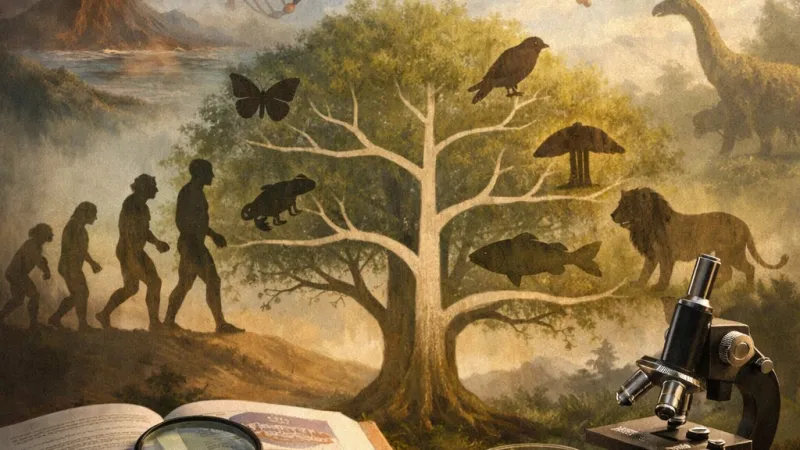
Phylogeny, the study of evolutionary history and relationships among organisms, forms the backbone of modern taxonomy. Unlike simple classification by visible traits, phylogeny attempts to chart the actual branching patterns of descent, the "family tree" of life.Phylogenetic Trees
These trees are not just metaphors, but precise diagrams in which lines, or branches, represent lineages, and points where they split (nodes) indicate common ancestors. The closer two species are on the tree, the more recently they shared a common ancestor. For example, a phylogenetic tree might show that the red fox (_Vulpes vulpes_) and the Arctic fox (_Vulpes lagopus_) are more closely related than either is to the domestic dog.Interpreting these trees allows us to make inferences about evolutionary history, but there are challenges. Many British species, such as the nightjar, have sparse fossil records, making their placement on the tree uncertain. Furthermore, asexual organisms or those forming sterile hybrids (like some orchard trees) do not fit neatly into the branching system, reminding us that nature resists tidy categorisation.
Modern taxonomy increasingly relies on molecular evidence – such as nucleotide or amino acid sequences – to construct phylogenies that reflect actual descent rather than superficial resemblance.
---
5. Molecular Evidence: Revolutionising Classification
The advent of molecular biology transformed the science of classification. By comparing DNA, RNA, or protein sequences directly, taxonomists gain insight into the true relatedness of species. Unlike anatomy, genetic material is not subject to environmental modification and provides a ‘molecular clock’ of accumulated changes.DNA Hybridisation and Sequencing
DNA hybridisation is a technique in which DNA strands from two species are denatured into single strands, mixed together, and allowed to re-anneal. The greater the similarity, the tighter the hybrid strands bond, reflected in higher melting temperatures. This method was famously used, including by UK scientists, to clarify relationships between British birds like the warblers.Today, DNA sequencing and barcoding are increasingly accessible in UK laboratories and A-level projects. Students may be familiar with techniques such as comparing the cytochrome c gene or striking differences in haemoglobin sequences. Protein analysis, such as comparing the amino acid sequences of insulin from sheep and cattle, has been used historically to support or revise classifications.
These sophisticated techniques enable far finer discrimination than morphology alone, but are not without issues. Recent horizontal gene transfer (especially in bacteria) or convergent evolution at the genetic level can occasionally obscure true relationships.
---
6. Behavioural Aspects: The Importance of Courtship in Maintaining Species Boundaries
The behaviour of living organisms factors importantly in classification. Courtship behaviour, in particular, acts as a robust mechanism preventing the interbreeding of species, maintaining genetic integrity and thus clear classification.British wildlife is rich in examples: the distinctive mating dance of the great crested grebe, described in vivid detail by British naturalist Julian Huxley, or the chirping duels of the grasshopper warbler. Courtship display ensures that only individuals of the same species mate, preventing wasteful crosses with related but incompatible species.
Courtship typically follows a species-specific "stimulus-response chain", where one action prompts another, synchronising reproduction. Such rituals not only prevent hybridisation, but also serve to evaluate mate quality – aspects such as health, fertility, and readiness. Natural selection refines these rituals, favouring those leading to the most successful offspring.
Some exceptions exist. A handful of British species, notably certain fish, breed with little or no overt courtship. Even here, subtle behavioural or chemical cues may enforce species boundaries, illustrating the complexity and subtlety of nature’s checks and balances.
---
7. Genetic Variation and Adaptation: Lessons from Microbial Populations
Variation is the raw material of evolution, underpinning both adaptation and, as we have seen, complicating classification. In bacteria, genetic diversity arises swiftly due to rapid reproduction, mutation, and horizontal gene transfer via plasmids.In the UK, antibiotic resistance in hospital-acquired infections (e.g., MRSA in NHS hospitals) is a prime example of genetic adaptation resulting from selective pressure. Plasmid exchange between bacterial cells swiftly spreads resistance genes, dazzlingly illustrating both the power and the dangers of genetic variation.
Variation is not confined to prokaryotes. All organisms, from bluebells to red squirrels, rely on genetic diversity to adapt, persist, and evolve. Yet, such variability can make classification more challenging, particularly as populations diverge, form sub-species, or hybridise.
---
Conclusion: Towards an Integrated Understanding of Biological Classification
From the definition of species to the subtleties of molecular data and courtship behaviours, classification is both a science and an art. Each method – from morphological observation to genetic sequencing – brings its own strengths and challenges. As new technologies emerge, such as affordable genome sequencing, biological classification will become even more precise, but also potentially more complex.Understanding classification is not merely a matter of passing AQA AS Biology; it is a lens through which students and researchers alike perceive the unity and diversity of life. In an age of biodiversity loss and environmental change, a rigorous grasp of these concepts is essential for conservation, medical research, and the stewardship of the living world.
---
Tips for Students
When writing essays or answering exam questions on this topic, remember:- Define all key terms clearly and succinctly. - Use British examples to ground abstract concepts. - Draw diagrams or interpret phylogenetic trees where appropriate. - Always explain the significance, not just the process. - Critically evaluate each method, noting both advantages and limitations. - Relate each concept to the grander theme of evolution.
By integrating historical, behavioural, and molecular perspectives, a student not only secures examination marks but, more importantly, cultivates a deeper appreciation of life’s endless forms most beautiful.
Rate:
Log in to rate the work.
Log in