Analyzing Power and Identity in Angela Carter’s The Bloody Chamber
This work has been verified by our teacher: 3.04.2026 at 14:39
Homework type: Essay
Added: 1.04.2026 at 9:54
Summary:
Explore power and identity in Angela Carter’s The Bloody Chamber, uncovering gothic themes, gender dynamics, and transformation in this insightful essay analysis.
Exploring Power, Identity, and Transformation in Angela Carter’s *The Bloody Chamber*
Angela Carter’s *The Bloody Chamber* remains a seminal text in the landscape of modern British literature, interrogating the darker corners of fairy tale tradition through a distinctly feminist lens. First published in 1979, this collection of short stories transforms well-trodden narratives into unsettling, gothic explorations of power, sexuality and metamorphosis. Using heightened imagery, unreliable narrators and richly symbolic motifs, Carter not only retells but systematically unpicks the cultural assumptions embedded in familiar stories. This essay examines how Carter reimagines canonical fairy tales to challenge gender dynamics, employing gothic techniques and narrative innovation to navigate the boundaries of innocence, experience, and personal transformation. The analysis is structured around her depiction of power and gender, the use of gothic and fairy-tale symbolism, the significance of voice and storytelling, and, finally, the recurring theme of transformation and its implications for agency and selfhood.
---
I. Background and Context
Carter’s Literary and Historical Context
Angela Carter wrote during an era of significant social and literary upheaval. The 1970s and early 1980s in Britain witnessed the flourishing of second-wave feminism, a movement intent on exposing and dismantling the structures underpinning women’s oppression. Carter was both a participant in and a chronicler of this shift: her essays, including those collected in *The Sadeian Woman*, show her fascination with how myths and stories perpetuate (or disrupt) power dynamics. Alongside this, Carter was part of a broader literary revival of gothic forms, characterised by a blend of the fantastical and the transgressive, which had come back into vogue as writers sought to interrogate social mores through horror, the uncanny, and the surreal.Overview of the Collection’s Structure and Narrative Approach
The stories in *The Bloody Chamber* operate as fractured, reassembled fairy tales, borrowing motifs from Perrault, Grimm, and traditional folklore — yet always twisting expectations. Rather than a safe land of make-believe, Carter’s fairytale world is fraught with eroticism, danger, and psychological complexity. Stories are often rendered in the first-person, drawing the reader into the consciousness of young, frequently unnamed heroines. There is a strong tendency towards intertextuality; tales do not exist in isolation, but as playful, irreverent rewritings of well-known narratives — resulting in a sense of both the familiar and the powerfully strange.---
II. Gender and Power Dynamics
The Portrayal of Female Protagonists
Carter’s young heroines are almost always introduced on the precipice of transformation, suspended between innocence and worldly knowledge. For instance, the eponymous narrator of “The Bloody Chamber” is, at the outset, marked by naivety, the “maidens” described as “lambs” led unwittingly towards slaughter — a motif echoed across the collection. Yet, this apparent passivity is not final. Through their experiences, Carter’s women discover latent capacities for self-determination and rebellion. In “The Tiger’s Bride,” the protagonist transitions from object of exchange to an agent who embraces her own desire, while the girl in “The Company of Wolves” negotiates with the wolf on her own terms. This evolution from frightened innocence to self-aware resilience provides the collection with its subversive energy; the heroines’ growth undermines, rather than fulfils, expectations of passivity enshrined in traditional tales.Male Figures as Symbols of Patriarchal Control and Violence
Male characters in *The Bloody Chamber* often evoke the sinister authority prevalent in gothic tradition. The Marquis in the title story is both protector and predator, his lavish gifts and “choker of rubies” suggesting a blend of seduction and impending doom. Similarly, the wolf in “The Company of Wolves” morphs between the roles of threat and temptation. Carter’s men are not wholly monstrous, but their ambiguity is precisely what makes them unsettling — embodying both the allure and danger of patriarchal desire. The interplay between lover and captor, rescuer and destroyer, reflects the way patriarchal power is exercised and maintained.The Dynamics of Consent and Coercion
A central tension in the collection is the collapse of boundaries between violence and desire, consent and coercion. Seduction is rarely free from power play; for Carter, the process of sexual awakening is often entangled with danger. Locked doors, forbidden chambers, and surveillance extend beyond mere plot devices, serving as gothic metaphors for the limitations imposed on women’s autonomy. In “The Bloody Chamber,” the heroine’s consent to marriage is ambiguous, shaped as much by social expectation and financial need as by desire. Yet Carter resists simple victimhood — moments of resistance, however small, disrupt the totality of male control, suggesting that even within constraints, agency is possible.---
III. Symbolism and Imagery: Gothic and Fairy Tale Motifs
The Role of Jewellery and Objects as Symbols
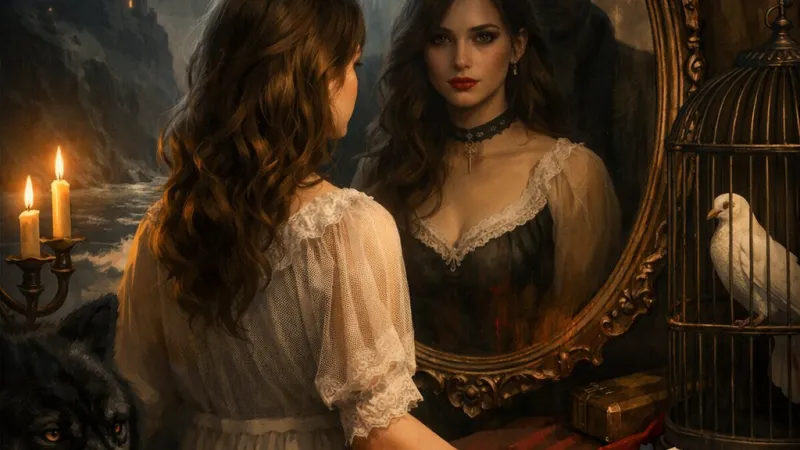
Objects in Carter’s stories are rarely inert: jewellery, keys, mirrors, and cages acquire a symbolic charge. The “choker of rubies” in “The Bloody Chamber” visually evokes a slit throat, foreshadowing the danger that encircles the bride’s neck. Cages and mirrors recur across the collection, linking themes of entrapment and self-reflection. Mirrors, in particular, foreground questions of identity — the heroines catching glimpses of their transformed selves, sometimes with shock, sometimes with recognition. Colour symbolism is notably pronounced: red for violence and passion, white for innocence tinged with mortality, and black for the depths of the unknown.The Forest and Nature as Liminal Spaces
Carter’s landscapes are never neutral. The forest, a classic space of fairy tale peril, operates as both a domain of threat and discovery. In “The Company of Wolves” and “Wolf-Alice,” the forest is ambiguous — a place where monstrous beings lurk, but also a realm where heroines can shed social constraints. Nature’s indifference underlines the limits of human control — yet, paradoxically, it is often within the wild that Carter’s women experience transformation and freedom, a theme reminiscent of the green world tradition in Shakespearean comedy, though overlaid with gothic darkness.Animals and Hybrid Creatures as Metaphors for Identity and Otherness
Throughout the collection, animal imagery abounds: lions, tigers, wolves repeatedly blur the line between human and beast. These metamorphoses destabilise categories upon which social order relies. Stories like “The Courtship of Mr Lyon” and “The Tiger’s Bride” employ the beast as both a metaphor for otherness and a means of self-realisation. By embracing the animal within, Carter’s heroines reject passive humanity for a fuller, if more precarious, sense of being. This echoes Victorian anxieties about the tension between civilisation and instinct, while reopening questions about the constructed nature of gender roles.---
IV. Narrative Voice and Perspective
Use of First-Person Narratives
Carter’s frequent use of first-person narration invites intimacy while foregrounding the limits and unreliability of personal experience. The young women in stories such as “The Bloody Chamber” and “The Tiger’s Bride” oscillate between naivety and knowingness, their interior conflicts shaping — and distorting — the stories we read. Such subjectivity encourages the reader to question inherited narratives: is the wolf only a villain? Is the Marquis merely a monster? This ambivalence resonates with the gothic tradition of unstable perspectives, as seen in the works of Emily Brontë or Ann Radcliffe.The Role of Storytelling and Metanarrative Awareness
Carter’s narrators are often aware of their roles within stories, toying with the conventions of fairy tale and warning the reader against uncritical acceptance — “now, my mother had told me…”. Irony and self-reference abound, as the text exposes and undermines the moral messages of the original tales. The creation and telling of stories themselves becomes an act of assertion, reframing the boundaries of possibility. In this way, *The Bloody Chamber* embodies a self-conscious literary postmodernism, challenging the fixity of narrative and the authority of tradition.---
V. Themes of Transformation and Liberation
Sexual Awakening and the Loss of Innocence
At the heart of most tales in the collection is a journey through danger and uncertainty towards sexual knowledge. Carter’s coming-of-age stories are seldom reassuring; the crossing of thresholds (into a forbidden room, a forest, or a wolf’s den) signals not just sexual initiation but a traumatic encounter with one’s own desires and fears. Yet, Carter endows these transitions with a sense of ambivalence — liberation is precarious, shadowed by the risk of violence or betrayal. She neither sentimentalises nor demonises sexual awakening, but locates female empowerment in the honest negotiation of ambivalent experience.Female Agency and Reclamation of Power
Important moments of resistance punctuate the collection: the mother bursting in to rescue her daughter in “The Bloody Chamber,” the girl calmly undressing before the wolf in “The Company of Wolves,” or the protagonist in “The Tiger’s Bride” choosing to embrace her animal self. These acts are not simplistic reversals of fortune but symbolic gestures of self-definition. Agency is hard-won and contingent, achieved by rewriting the “script” handed down by tradition. Storytelling itself becomes an act of rebellion, a means by which women claim their own narratives.The Ambiguous Nature of ‘Happily Ever After’
Carter systematically toys with the notion of the fairy tale ending. Happily ever after, if it arrives at all, is tinged with irony or left open to question. Liberation might mean embracing one’s difference rather than assimilating; love is often as dangerous as it is redemptive. Perhaps the most striking aspect of the stories’ conclusions is their refusal to offer closure or easy morality. Carter’s world is one where transformation is always partial, always ambiguous.---
VI. Critical Perspectives and Interpretations
Feminist critics have long hailed *The Bloody Chamber* for its unsparing exposure of patriarchal violence and its assertion of female sexual agency. Carter interrogates the binaries — virgin and temptress, victim and survivor — which structure both fairy tales and wider society. Psychoanalytic readings have noted Carter’s depiction of repressed desires and primal fears, especially in stories where the “beastly” is intimately connected to the erotic. Meanwhile, postmodern theorists draw attention to the collection’s intertextual play, hybridising folklore, gothic, and romance to undermine the authority of any single version of the story. The collection’s refusal to settle upon a singular “truth” remains a provocation, asking readers to navigate its ambivalences rather than absorb a fixed message.---
Conclusion
In *The Bloody Chamber*, Angela Carter orchestrates a dazzling re-envisioning of fairy tales that interrogates power, gender, and identity with wit and subversive energy. Her stories, steeped in gothic atmosphere, rich with symbols, and alive to the ambiguities of voice and perspective, remap familiar narratives as sites of struggle, negotiation, and possibility. The collection’s ongoing resonance lies in its refusal to idealise or vilify; instead, it offers a vision of transformation which is always unfinished, always haunted by the contradictions between desire, fear, and self-making. Carter’s work remains essential reading, not only for its relevance to ongoing debates on agency and sexuality, but for its celebration of the creative power to rewrite — and reclaim — our stories.---
*Word Count: c. 1700*
Rate:
Log in to rate the work.
Log in