Critical Analysis of Willy Russell’s Blood Brothers and Its Themes
This work has been verified by our teacher: 9.04.2026 at 15:47
Homework type: Essay
Added: 8.04.2026 at 6:10
Summary:
Explore a critical analysis of Willy Russell’s Blood Brothers and uncover its key themes of social class, identity, fate, and family for GCSE success.
A Critical Exploration of Willy Russell’s *Blood Brothers*
Willy Russell’s *Blood Brothers* is a foundational piece of modern British theatre, renowned for its blend of tragic storytelling and musical flair. Premiering in 1983, the play swiftly secured its place as a staple of the GCSE English Literature curriculum, not only for its memorable characters and gripping narrative, but also for the astute social commentary it offers. Russell’s Liverpool upbringing and affinity for working-class voices resonate throughout the play, with its unflinching exploration of poverty, opportunity, and destiny. The story follows the divided lives of Mickey and Edward, twin brothers separated at birth who grow up worlds apart, shaping the play as both a personal tragedy and a wider critique of the British class system.In this essay, I will critically examine the core themes of *Blood Brothers*: the impact of social class on identity, the battle between fate and free will, the central role of motherhood, and the bonds of friendship tested by love and hardship. Through close analysis of characterisation, language, and dramatic techniques, I shall show how Russell’s play not only tells a compelling tale but exposes larger truths about British society—truths that remain strikingly relevant to this day.
Social Class and Its Impact on Identity
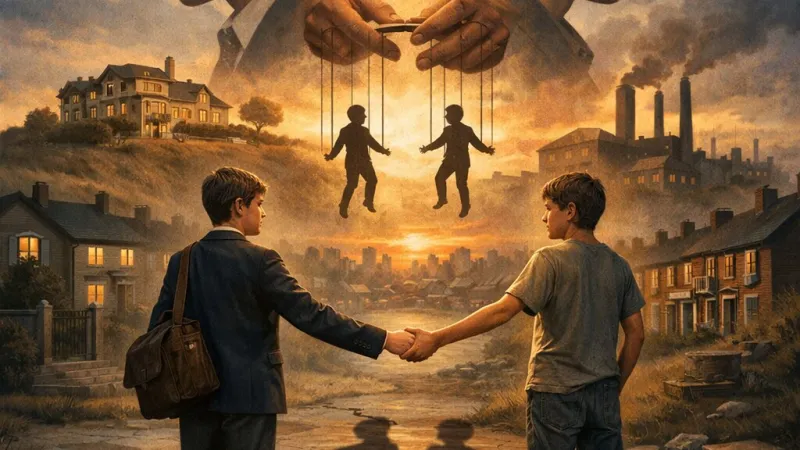
Perhaps the most powerful force at work in *Blood Brothers* is the divide between rich and poor. The Johnstones are emblematic of working-class struggle: Mrs Johnstone, left alone to support a bustling brood, lurches from debt to heartbreak with dogged resilience. Her home life is painted in shades of deprivation—bare cupboards, absent fathers, and the ever-present threat of the “credit man” knocking at the door. The family’s Liverpudlian dialect forms part of their identity, marking them as outsiders to wealth and power.In sharp contrast stands the Lyons family. Mrs Lyons, privileged yet anxious, lives in a home marked by silence and order—a house big enough for secrets but not, ironically, for happiness. Edward, the twin she raises, is granted the trappings of middle-class life: a good education, security, and the unspoken promise of a bright future. Russell’s stage directions and dialogue quickly establish how these contrasting environments sculpt Mickey and Edward from the outset. Edward’s polished vocabulary and naivety clash with Mickey’s streetwise slang and sharp wit, making evident the differences that education and expectation can bring.
This contrast, however, is not so much about innate worth as about circumstance. Mickey’s life spirals into unemployment, depression, and criminality, not because of some intrinsic flaw, but because he is a victim of limited options. Edward, by luck rather than virtue, flourishes. Through their trajectory, Russell interrogates whether social mobility is ever truly possible in Britain, or whether birth alone decides one's path—a question painfully resonant in a society still wrestling with entrenched class divisions.
Fate, Superstition, and Free Will
From the opening lines, *Blood Brothers* leaves no doubt about its tragic conclusion—yet, the journey to get there is knotted with questions of fate and agency. Superstition weaves itself through the fabric of the plot: Mrs Johnstone, steeped in Catholic lore and old wives’ tales, is easily manipulated by Mrs Lyons’s fabricated curse. The threat that “if either twin learns he was once a pair, they shall both immediately die” becomes both a prophecy and a psychological snare.This motif gnaws at the characters’ sense of control. The Narrator, acting like a Greek chorus, hounds Mrs Johnstone with reminders that “the devil’s got your number”—a phrase echoed repeatedly, growing more sinister as the play progresses. Through his presence, Russell blurs the divide between fate and free will; is tragedy inevitable, or do the characters simply act in ways that make it so because they believe in its inevitability?
Choices undeniably shape the outcome. Mrs Johnstone’s desperate decision to give away one son is taken under duress, setting a train of devastating events in motion. Mickey’s slip into crime, prompted by unemployment and despair, cannot be dismissed as mere fate. At the same time, Russell’s use of dramatic irony—particularly the audience’s awareness of the brothers’ true relationship—ensures that a sense of tragedy hangs over even the play’s happiest moments. The unresolved tension between destiny and human agency is part of what gives *Blood Brothers* its enduring power.
Motherhood and Female Roles
The play is also a study of two mothers, Mrs Johnstone and Mrs Lyons, whose experiences of motherhood are shaped as much by class as by personality. Mrs Johnstone, warm-hearted yet perennially struggling, typifies the archetypal working-class matriarch, forced to make impossible sacrifices. Her character is layered with guilt, resilience, and hope—qualities that draw sympathy, even when her actions are morally ambiguous. Her Catholicism, a subtle yet persistent note in the play, not only explains her reluctance towards contraception but also underscores her sense of inevitability: many children means many mouths to feed, but also, perhaps, many sins to fear.Mrs Lyons, meanwhile, is depicted as fragile, fretful, and consumed by a yearning for control. Her manipulation of Mrs Johnstone—first through legal documents, then psychological torment—exposes both her privilege and insecurity. She is not evil so much as desperate, resorting to superstition as a way of keeping her constructed family safe. Yet her possessiveness sours into paranoia, and her maternal love, shaped by fear, ultimately plays a part in sealing the brothers’ fate.
Both mothers’ choices ring down the years, shaping the boys’ self-perceptions and destinies. Edward’s upbringing is loving yet suffocating, denying him knowledge of his own roots. Mickey’s is full of affection but marred by deprivation and disappointment. Through these contrasting experiences of motherhood, Russell asks whether love can ever overcome the barriers erected by wealth and circumstance.
Friendship and Loyalty: The Bonds Between Mickey, Edward, and Linda
Despite—or because of—their differences, Mickey and Edward’s childhood friendship blossoms organically. Their meeting is played for both comedy and pathos: unburdened by knowledge of their kinship, they gravitate towards each other, driven by curiosity and a yearning for connection. In one of the play’s most symbolic scenes, they make a pact of ‘blood brothers,’ binding themselves together with a ritual that transcends social boundaries and, for a fleeting moment, nullifies them.Yet as they grow up, life’s realities close in. The arrival of Linda, initially a shared childhood friend, introduces new strain as the boys’ feelings grow more complicated. Linda herself is a fully realised character—aspirational, loyal, but ultimately trapped by the limitations of her class. The resulting love triangle stirs jealousy and resentment, particularly for Mickey, whose sense of hopelessness is sharpened by seeing Edward succeed both in life and in love.
Socioeconomic pressures intensify the strain. Mickey’s descent into criminality and depression is motivated by frustration and powerlessness, while Edward’s obliviousness, fuelled by his sheltered upbringing, prevents him from truly understanding his friend’s pain. The ultimate breakdown of their bond is not merely personal, but emblematic of the way class and circumstance can destroy even the closest of ties.
Structural and Dramatic Techniques
Russell’s craftsmanship extends beyond plot and character. The play’s structure—swiftly moving from energetic childhood games to dark adulthood—is punctuated by time jumps that let the audience witness the long-term consequences of seemingly minor decisions. This fluid chronology keeps the pace brisk but also underscores how the past is never really left behind.Music is deployed not just for entertainment but as a storytelling device. Songs like “Marilyn Monroe” recur throughout, reflecting Mrs Johnstone’s dreams and the bittersweet passage of time. The differing musical themes given to the Lyons and Johnstone families subtly reinforce the play’s central class division, while ensemble numbers create a sense of community and shared fate.
Symbolism is woven into every detail. Blood itself is both life-giving and lethal, uniting the twins even as it foreshadows their doom. The knife, which features in the final scene, comes to represent both agency and inevitability—a tool that delivers fate’s verdict. Weather and surroundings—oppressive rain, bleak streets, the dimly lit Johnstone home—are used to mirror characters’ emotions and social realities.
Dramatic irony is perhaps Russell’s greatest weapon, keeping the audience in suspense even when the outcome seems foregone. Foreboding allusions and repeated warnings (“You never put new shoes on the table,” “The devil’s got your number”) infuse the play with a mounting sense of dread, turning seemingly innocent superstitions into harbingers of tragedy.
Broader Social Commentary and Themes
*Blood Brothers* is more than the story of two boys; it is a cry against the injustices of a society where poverty begets misery, and opportunity is a matter of postcode. Russell’s Liverpool—the setting for both optimism and decay—serves as a microcosm of post-war Britain, a land still struggling to come to terms with its divisions and its debts.The violence that ultimately destroys Mickey and Edward is not simply the result of personal weakness or moral failing, but a symptom of a wider sickness in British society. Russell’s portrayal of unemployment, underfunded schools, and desperation is a direct assault on the myth of meritocracy. The devastating final tableau—two brothers lying dead, mothers weeping in despair—condemns not just the individuals but the system that set them on their doomed paths.
Yet the play endures because it is not wholly despairing. Its focus on deep emotions—love, loyalty, hope—ensures it continues to resonate. In a country where social mobility remains fiercely debated and many families still struggle to break cycles of deprivation, *Blood Brothers* remains both protest and plea for empathy.
Rate:
Log in to rate the work.
Log in