Christian Views on Creation, Suffering, and Prayer in Modern Britain
This work has been verified by our teacher: 14.04.2026 at 13:15
Homework type: Essay
Added: 11.04.2026 at 6:17
Summary:
Explore Christian views on creation, suffering, and prayer in modern Britain to understand faith’s response to science, doubt, and life’s toughest questions.
Exploring Faith, Science, and Doubt: Religious Perspectives on Creation, Suffering, and Prayer
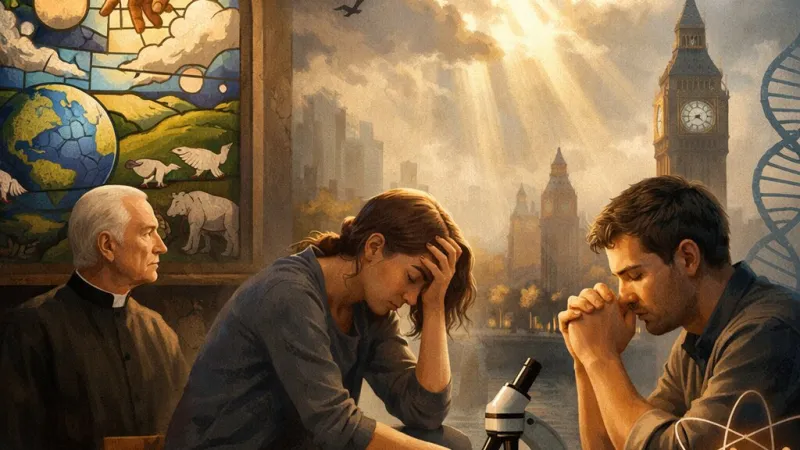
Across centuries, religion and science have been a source of both curiosity and contention within British society. From chapel pulpits to university lecture halls, age-old questions about the origins of the universe, the presence of suffering, and the nature of prayer continue to stimulate debate among scholars, believers, and sceptics alike. These matters are not merely the concerns of theologians or scientists; they reach into the personal lives of ordinary individuals as they face the mysteries of existence, the pain of loss, and the disappointment of unanswered hopes. This essay aims to explore diverse Christian understandings on issues relating to the origins of life, the challenge of evil and suffering, and the implications of unanswered prayer, highlighting how faith both grapples with and is enriched by modern knowledge and perennial doubt. By considering these themes, the intention is to demonstrate that Christianity in the UK encompasses a spectrum of thought, adapting to new discoveries while drawing strength from tradition and lived experience.
---
Part 1: Religion and Science – Origins of the Universe and Life
Traditional Understandings of Creation
Within British Christianity, particularly amongst Evangelical and some Pentecostal communities, a literal understanding of the Book of Genesis persists. Literalists maintain that God, as described in the opening chapters of the Bible, created the heavens and the earth within six consecutive days, each made up of 24 hours. For these believers, every creature, plant, and star was crafted by divine command, with the first man and woman, Adam and Eve, specially formed by God. This narrative offers not only comfort and certainty but also an immediate sense of purpose, with humanity’s role and relationship to creation clearly spelled out.However, literal interpretations often clash with the findings of modern science. For example, the geological record evidences a planet billions of years in age, while radiometric dating and the fossil record mark the slow development of species over vast periods, rendering a six-day creation increasingly difficult to uphold. Still, for some, the power of tradition and a desire for theological certainty outweigh arguments based on physical evidence, maintaining that scripture should be accepted above all else.
Scientific Accounts: The Big Bang and Evolution
In contrast, scientific enquiry, pivotal to British education since the Enlightenment, offers an alternative storyline. The Big Bang Theory, first proposed by Belgian priest and astronomer Georges Lemaître, postulates that the universe expanded from an initial singularity about 13.8 billion years ago. The widespread acceptance of this model relies on evidence such as the observable cosmic microwave background and the redshift of distant galaxies.Similarly, Charles Darwin, a naturalist educated at Christ’s College, Cambridge, put forth the theory of evolution by natural selection. In his work ‘On the Origin of Species’, Darwin suggested that species evolve over time through the gradual accumulation of small, inherited adaptations. His observations, from the Galápagos finches to the British barnacles, supported the idea that all living creatures share a common ancestry, including humans. This account, grounded in observable phenomena and tested hypotheses, presents life as a natural process, without needing direct supernatural intervention.
Reconciling Faith and Science
Despite perceptions of conflict, many within the Church of England and other mainstream denominations support a more liberal view, suggesting that the Bible need not be interpreted as a literal scientific text. Instead, these Christians view the creation stories as expressions of spiritual truth, symbolism, and moral instruction. Genesis becomes a declaration of God’s authorship and generosity, not a geology textbook. Such an approach accommodates scientific theories, suggesting that God may have caused the Big Bang and guided evolution in a purposeful way.The legacy of Georges Lemaître reminds us that religious conviction is not incompatible with scientific insight; rather, both can deepen our appreciation of reality. Many Christian scientists and theologians, such as the late John Polkinghorne (physicist and Anglican priest), have contributed to this harmonious interaction by insisting that faithful inquiry and scientific investigation each address different but complementary questions about the world. In British classrooms and pulpits alike, this reconciliation allows for a faith that is intellectually honest and spiritually rich.
---
Part 2: The Problem of Evil and Suffering
Understanding Evil and Suffering
At the heart of many philosophical and religious debates is the so-called ‘problem of evil’. For Christians and others, evil and suffering present profound challenges. Evil is often divided into two categories: moral evil, such as acts of violence or intentional cruelty committed by humans, and natural evil, denoting suffering caused by natural events – like earthquakes in Italy or pandemics that have affected Britain and the wider world.The Challenge to Faith
A perennial question faced by British believers is this: how can an all-powerful and loving God allow such sorrow and injustice? This dilemma, often articulated in the writings of David Hume and other Enlightenment philosophers, remains a significant challenge. Some Christians, encountering personal tragedy, find themselves doubting the existence or benevolence of God, asking why prayers for healing or peace often seem to go unheeded.Christian Responses
Free Will Defence
One influential Christian response is the ‘free will defence’, famously articulated by thinkers like Augustine of Hippo and adapted by later British scholars. Here, the argument is that free will is a gift from God, enabling humans to make real choices. However, this freedom carries the risk of evil; suffering arises when people misuse their autonomy. According to this view, a world without free will would be devoid of real love, responsibility, or growth.Soul-Making Theodicy
Others, such as John Hick, a theologian active in the British context, propose the ‘soul-making’ theodicy. Inspired in part by Irenaeus, Hick argued that suffering and adversity are integral to the development of virtue and character. Pain, grief, and challenge become sites for spiritual growth, resilience, and compassion. Rather than granting immediate comfort, God allows (or uses) suffering as an instrument to shape souls fit for eternity.Faith in God’s Plan
A further response encourages trust in God’s broader plan. Just as a child may not understand a parent’s discipline, believers are urged to have faith that God’s wisdom surpasses human comprehension. This approach underlies many pastoral responses within Church of England parishes and is reflected in traditional hymns and prayers that express both lament and hope.Practical Responses
Importantly, Christianity also calls for an active response to suffering. Inspired by the example of Christ, who healed the sick and comforted the distressed, many UK churches provide practical support—food banks, counselling, and charity work—seeking to confront evil not simply through word but deed. For many, this active compassion is as central as any theological explanation.---
Part 3: Unanswered Prayer, Doubt, and Non-Belief
Role of Prayer in Faith
Prayer occupies an essential place in Christian practice, from whispered petitions in country chapels to the formal prayers of cathedrals. It is both a communal and deeply personal act, believed to foster a relationship with God, express gratitude and sorrow, and seek guidance or help.The Problem of Unanswered Prayer
However, the reality that many prayers seem to go unanswered can sow seeds of doubt. People pray for healing, for reconciliation of families, for world peace – and often these requests are met with silence or apparent inaction. This experience can be distressing, especially for those in vulnerable situations, and can reinforce the arguments of non-believers who claim that unanswered prayers prove God’s absence or indifference.Christian responses to this issue are many. Some suggest that God’s timing and perspective are vastly different from our own, and that sometimes the answer is simply “no”, or “not yet”. Others argue that prayers motivated purely by self-interest, or those that would bring harm, may be denied. Prayer, in this view, is not a transaction but an invitation to share in God’s purposes, an act of trust rather than demand.
Saintly figures such as St Monica, who prayed for years for her son’s conversion, are often cited as examples of persistent faith in the face of silence. For many, unanswered prayer becomes a path to deeper spiritual maturity, fostering perseverance, humility, and a sense of solidarity with Christ’s own suffering.
Responses from Non-Believers
For atheists and agnostics in Britain, unanswered prayer can reinforce scepticism. High-profile public intellectuals such as Richard Dawkins have argued that the lack of empirical evidence for divine intervention undermines claims of a loving, omnipotent deity. Others adopt a more open, agnostic position, acknowledging the complexities and uncertainties involved.---
Part 4: Integrative Reflections and Societal Implications
Science and Faith in Conversation
Within the British context, there is significant value in dialogue rather than confrontation between science and faith. Education increasingly recognises the need to present both perspectives thoughtfully, allowing young people to think critically and respectfully about different (sometimes overlapping) ways of understanding the world.Coping with Suffering
British churches and faith-based charities continue to play a substantial role in addressing suffering. Initiatives such as The Trussell Trust or Christian Aid illustrate how faith communities provide practical support regardless of doctrinal disputes, embodying the compassionate ideals found in scripture.Supporting Doubters and Seekers
Churches increasingly acknowledge the need for pastoral care that addresses doubt honestly. Programmes such as ‘Alpha’, originating in Holy Trinity Brompton, create spaces for questioning and exploration, recognising that doubt is often a companion, not an enemy, of faith.---
Rate:
Log in to rate the work.
Log in