Understanding Cells, Specialisation and Diffusion in GCSE Biology Unit 2
This work has been verified by our teacher: 25.04.2026 at 15:14
Homework type: Essay
Added: 23.04.2026 at 13:21
Summary:
Explore GCSE Biology Unit 2 to understand cell structure, specialisation, and diffusion, mastering key concepts for exams and homework success.
Biology Unit 2: The Foundation of Life – Cells, Specialisation, Diffusion, and Organisation
In the study of biology at GCSE level, Unit 2 forms the bedrock of understanding living systems, focusing on cells, their specialisation, diffusion, and the way living things are organised into tissues, organs and systems. These ideas are like the threads weaving together our picture of what makes life possible, from the simplest bacteria to complex organisms such as humans and oak trees. Every grand feat in nature, whether the blossoming of a bluebell in spring or the electrical impulses firing in a heart, traces back to the inner life of the cell. In this essay, I will explore the highly organised structure of cells, examine how specialisation enables efficient functioning, explain the essential role of diffusion in living things, and outline how cells are organised into the higher levels of biological order. We will see not only how these concepts interconnect, but also how they come alive in true-to-life examples and experiments relevant to the UK science curriculum.
---
I. Cell Structure and Function
A cell is the smallest unit capable of life; it is, as Robert Hooke observed in 1665 when he first described them looking at thin slices of cork under a primitive microscope, like a small room in which the business of living gets done. All living things are constructed from one or more of these remarkable structures. Let us examine exactly what makes up a cell, and how its parts contribute to the vitality of organisms.A. Universal Cell Components
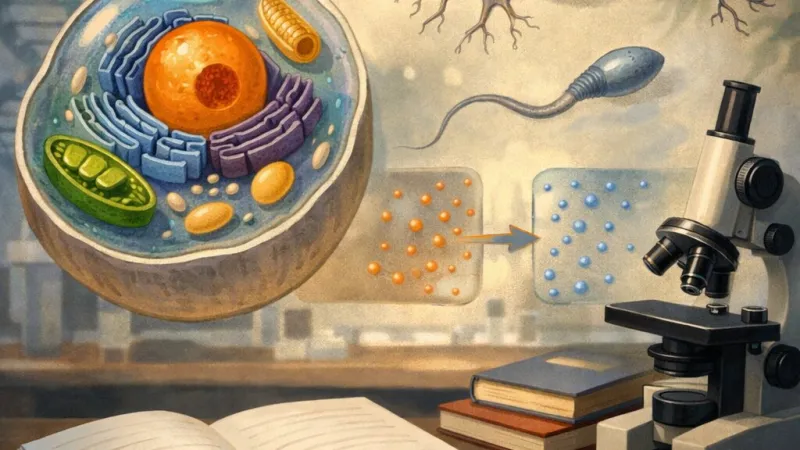
Both plant and animal cells share common architecture and components, but with key differences. Every GCSE student begins by learning the basics: the nucleus, sitting at the heart of most cells, is their command centre. It houses DNA, the coded instructions for making proteins and thus for building and running the cell. Just as a school office organises the running of a school, the nucleus orchestrates life within its walls.Surrounding the nucleus, the cytoplasm is a jelly-like substance where all chemical processes required for life – collectively called metabolism – occur. This soup brims with enzymes, which are like microscopic workers catalysing essential reactions.
Encasing the cell, the cell membrane acts as a selective barrier, controlling entry and exit of materials: nutrients in, wastes out. This separation resembles the way school gates both protect and regulate who enters school grounds.
The mitochondria are often called the ‘powerhouses’ of the cell. Their role is to release energy from food using oxygen, a process termed aerobic respiration. This energy is captured as ATP (adenosine triphosphate), the cell’s immediate energy currency, which powers everything from muscle contraction to active transport.
Finally, ribosomes are the site of protein synthesis, converting the genetic instructions carried in DNA into practical molecules to carry out cell activities. Ribosomes may float freely in the cytoplasm, or attach themselves to networks within the cell (endoplasmic reticulum).
B. Special Features of Plant Cells
Turning to the plant kingdom, plant cells have a few distinctive components. Most prominent is the cell wall, a sturdy mesh of cellulose that gives plant cells their characteristic box-shape and provides rigidity. This is why a celery stick crunches when bitten – the walls hold shape even as water moves in and out.Chloroplasts contain chlorophyll, the green pigment that captures sunlight's energy to drive photosynthesis. Not all plant cells possess these; for instance, root cells hidden in the soil don’t need chloroplasts as they encounter no light.
The permanent vacuole is a large, fluid-filled sac containing cell sap – a dilute solution of sugars and salts. It’s not just a storage bag; by drawing in water, it helps maintain turgor pressure, which keeps plant tissue firm and upright.
C. Variations in Single-Celled Organisms
Living things outside the animal and plant lineages often exhibit a different cellular make-up. Yeast, for example, is a unicellular fungus, featuring a nucleus, cytoplasm, cell membrane, and a cell wall, but this wall is made from chitin rather than cellulose. Bacteria, as prokaryotes, are even simpler. They lack a nucleus – instead, their genetic material sits in a nucleoid region. Their tough wall is built from peptidoglycan, and some carry additional rings of DNA called plasmids, granting extra abilities such as antibiotic resistance.---
II. Cell Specialisation
A. The Essence of Specialisation
One cell by itself can only do so much. By contrast, multicellular organisms such as humans, earthworms, or daffodils are made up of many different types of cells, each adapted to a particular job: this is specialisation. Think of a football squad: the goalkeeper and the striker play different roles, and together, they form an effective team.B. Specialised Animal Cells
Consider the sperm cell: sleek and streamlined, equipped with a tail (flagellum) that propels it forward like a tiny swimmer, and packed with mitochondria in the midpiece to fuel this journey. Its head carries a nucleus with half the genetic material, poised to fuse with an egg and begin a new life.Fat cells (adipocytes), in contrast, resemble balloons; they store lipids and expand or shrink as the body requires energy. Their cytoplasm is pushed to the edge by a central fat droplet; since their job is storage not activity, they contain few mitochondria.
Cone cells in the human retina are tailored for colour vision. The outer segment is loaded with light-absorbing pigments, while a high mitochondrial content ensures pigments can be rapidly reformed. Their specialisation allows us to read a red stop sign or enjoy a rainbow over the hills.
C. Specialised Plant Cells
Plants are just as imaginative. Root hair cells sprout long extensions to enormously increase surface area for absorbing water and minerals from the soil. They nestle close to the xylem, streamlining water transport up to the leaves.Palisade mesophyll cells, found just beneath leaf surfaces, are packed with chloroplasts and arranged in tight columns to maximise light absorption for photosynthesis, rather like solar panels on a rooftop.
---
III. Diffusion in Biological Systems
A. What is Diffusion?
The movement of substances in and out of cells occurs chiefly by diffusion – particles move from areas of high concentration to areas of low concentration, spreading out like perfume wafting across a classroom. It requires no extra energy; in contrast, active transport needs ATP to force substances against their concentration gradient.B. Factors Affecting Diffusion
Four factors shape the speed of diffusion:1. Surface area: More surface = faster entry, as more ‘doors’ are open. 2. Temperature: Higher temperatures mean faster movement. 3. Distance: Thin barriers quicken the process; thickness slows it. 4. Concentration gradient: The larger the difference, the swifter the movement.
C. Biological Examples
A classic example is gas exchange in the lungs: oxygen moves from air sacs (alveoli) into blood, while carbon dioxide travels out, thanks to a thin membrane and enormous surface area. Plants operate similarly: carbon dioxide diffuses into leaves through tiny pores (stomata) for photosynthesis, and oxygen exits the same way. In roots, mineral ions enter via diffusion and sometimes active transport, vital for healthy growth.---
IV. Organisational Levels in Multicellular Organisms
A. Cells, Tissues, Organs, Organ Systems
Biology is nothing if not hierarchical. Many cells of one type combine to form a tissue. Examples include muscular tissue (contracts to bring about movement), glandular tissue (secretes substances like enzymes), and epithelial tissue (lines organs and protects them).Several tissues together form an organ. The stomach, for instance, contains muscular tissue (churning food), glandular tissue (secreting digestive juices), and epithelial tissue (protecting its inner lining).
Organs function within organ systems. The digestive system includes the mouth, oesophagus, stomach, intestines, liver, and pancreas, working in tandem to break down food, extract nutrients, and dispose of waste. Each organ has a unique role, but without the rest, the process would collapse.
B. The Value of Organisation
This precise division of labour ensures efficiency, with each part carrying out a single function superbly. It also explains the stunning complexity of life forms compared to single-celled organisms, who must do everything alone. Without such organisation, our bodies or even a fox’s keen hunting ability would be impossible.---
Conclusion
To understand living things, we must look both closely and broadly: into the detailed interiors of cells and at the grand scale of organ systems. Each aspect – cell structure, specialisation, diffusion, and the hierarchy of organisation – builds upon the other, lending strength, flexibility, and adaptability to life as we know it. Practical investigation, whether examining onion cells under a school microscope or watching coloured crystals diffuse in water, deepens this knowledge. For those whose curiosity stretches further, one can investigate what happens when these systems fail, as in cystic fibrosis (affecting diffusion) or diabetes (organ and tissue malfunction). Ultimately, mastering these fundamentals opens a window onto the remarkable machinery of life.---
Additional Tips for Students
- Use diagrams: Visualising a cell or organ system supports memory and clarity. - Link structures to functions: For example, compare a sperm cell to a swimmer, or plant xylem to pipes. - Conduct experiments: Watch potassium permanganate diffuse in water to see theory in action. - Master key vocabulary: Accurate spelling and usage, such as mitochondria, palisade, or ‘selectively permeable’ can win marks. - Think systemically: Try tracing a nutrient molecule from digestion to its use in muscle, connecting topics across the unit.In conclusion, Biology Unit 2 serves as a passport to understanding living things, blending core principles and practical application, and nurturing skills essential for future scientific endeavours.
Rate:
Log in to rate the work.
Log in