An Analysis of Curley’s Wife in Steinbeck’s Of Mice and Men
This work has been verified by our teacher: 26.04.2026 at 17:08
Homework type: Essay
Added: 24.04.2026 at 15:54
Summary:
Explore an insightful analysis of Curley’s wife in Steinbeck’s Of Mice and Men to understand her role, symbolism, and impact on key themes in the novel.
Introduction
John Steinbeck’s novella *Of Mice and Men* offers a poignant exploration of the lives of itinerant workers on a Californian ranch during the Great Depression. Within this predominantly male landscape, Curley’s wife stands out as the only significant female character, her loneliness and marginalisation signalling the isolation imposed on women in harsh, patriarchal environments. Steinbeck’s refusal to give her a name amplifies her symbolic significance, reducing her in the eyes of the men around her to little more than her relationship to Curley, the boss’s son. Through a careful examination of key sections involving Curley’s wife, this essay will analyse how Steinbeck crafts her as both a victim and a source of tension, using a tapestry of imagery, dialogue and dramatic technique to illuminate central themes of isolation, desire and gendered powerlessness.Indirect Introduction: Reputation Precedes Reality
Before Curley’s wife appears directly in the narrative, the ranch hands discuss her in hushed, wary tones. Her origins in the novel are not her own; instead, she materialises as a figure shaped by rumour and suspicion. George hears from Candy that she “got the eye,” the colloquialism instantly casting her as flirtatious and dangerous. The term “tart” is used without irony or reservation, revealing the men's expectations of women on the ranch – as sources of trouble, to be kept at arm’s length. This initial reputation is not built on objective interactions but on a collage of gossip and unease. Steinbeck crafts these early references to Curley’s wife to demonstrate the double bind facing women in such environments: visible only through male perception, judged for simply existing among men.For a reader situated in a later British context, these moments resonate with the enduring effect of slander and small-mindedness in closed communities, recalling not only the cruelties of 1930s California but also the echoes of such behaviour in village life described by Hardy or Austen. Stereotypes and casual sexism thrive in small, insular societies. Steinbeck encourages readers to question whether these men’s verdicts reveal flaws in Curley’s wife, or deeper weaknesses of their own: jealousy, insecurity, or fear of the unknown. Thus, even before she speaks, Curley’s wife’s identity is contested territory—her own desires and motives obscured by the world in which she moves.
First Encounter: A Vision in Red
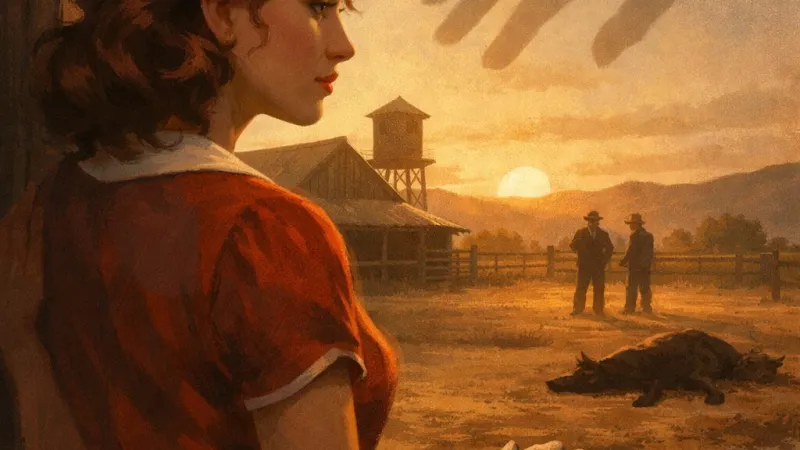
Curley’s wife’s first appearance in person is laden with vivid descriptions and symbolic detail. Steinbeck employs strong colour imagery, repeatedly highlighting her choice of red – "red mules," "red ostrich feathers," and lips painted red. In Western literary tradition, red frequently symbolises both passion and danger, reminding readers of the archetype of the temptress – from the biblical Eve onwards – but also of blood and impending tragedy. The British reader might think of Tennyson's "Lady of Shalott," another isolated woman whose vibrant appearance conceals deep vulnerability.Her entrance temporarily disrupts the male sanctum; she stands “in the doorway,” blocking the light, altering both the literal and metaphorical atmosphere of the room. Light and darkness play tug-of-war in this moment, suggesting that truth about her character remains partially in shadow. Her body language—“she put her hands behind her back and leaned against the door frame so that her body was thrown forward”—connotes a self-awareness, yet behind the smile and flirtatious manner lies the faintest trace of insecurity; she seeks attention, perhaps craving validation in a world where she is otherwise ignored.
The interaction with Lennie, whose fascination with soft things makes him naive and easily led, foreshadows the tragic events to come. George’s harsh warnings – “Don’t you even take a look at that bitch” – reveal his acute awareness of danger but also indicate an unforgiving and deeply prejudiced mindset. Steinbeck’s structuring of this encounter, with tension woven into every gesture and glance, ensures that Curley’s wife’s presence is both enticing and ominous, her motives for friendship or sustenance effaced by the men’s fears and the novella’s inexorable movement towards disaster.
The Men’s Perspective: Between Fear and Contempt
Later, the men continue to discuss Curley's wife when she is not present, deploying argot such as "looloo" and warning Lennie that she'll "make a mess." The effect is to reinforce an environment where women are both objectified and ostracised. Their jokes and nervous laughter disguise genuine trepidation; they fear the trouble that emerges when masculine codes of silence or loyalty are challenged by feminine presence.This motif of the ‘dangerous woman’ resurfaces in British literature, from Hardy’s Tess to the clever manipulations of Lady Macbeth, but in Curley’s wife, Steinbeck complicates the type by giving readers intermittent access to her vulnerability. The ranch hands’ banter may sound light-hearted but is underwritten by anxiety, hinting that their hostility is in part a response to their own impotence and longing. It's easier for them to vilify Curley’s wife than to acknowledge their own yearning for connection. She becomes a scapegoat, embodying what is forbidden or unattainable, thus cementing her role as both victim and agent within the narrative.
The Stable Conversation (Part 1): Yearning and Exclusion
It is in the barn, when Curley’s wife enters into awkward conversation with Crooks, Candy, and Lennie, that her loneliness is most sharply felt. She enters seeking companionship, only to be rebuffed by defensive, distrustful men: Crooks crosses his arms, Candy turns away, Lennie stares without understanding. Once again, she aligns herself with the “weak ones,” revealing that her bravado masks a sense of powerlessness and abandonment.Here, Steinbeck employs dramatic technique: the physical arrangement of characters and Curley’s wife’s persistent quest for company underpinning her social exile. Dialogue is clipped, tones shift from brittle sarcasm to open bitterness—“You’re all scared of each other, that’s what. Ever’ one of you’s scared the rest is goin’ to get something on you.” For a British reader, her speech might evoke the sense of entrapment voiced by characters such as Isabella Linton in *Wuthering Heights*, or the constricting world of George Eliot’s Gwendolen Harleth in *Daniel Deronda.* The desire for attention, for narrative, is not merely vanity—it is a plea against invisibility.
The Stable Conversation (Part 2): Defiant and Trapped
As the conversation continues, we gain insight into Curley's wife’s frustration and longing. She defends herself against accusations of being “no good,” arguing that marriage to Curley is itself a kind of prison from which she dreams of escaping. Her line “Think I’m gonna stay in that two-by-four house and listen how Curley’s gonna lead with his left twict and then bring in the ol’ right cross?” bristles with sarcasm. Yet, beneath the mockery lies aching truth: she is as much a victim of circumstance and broken dreams as any of the itinerant workers.Despite her candidness, the men continue to regard her with suspicion. Her overtures for conversation are repeatedly rebuffed or misunderstood, a reflection of the gendered double standards permeating both the ranch and (by extension) wider 1930s culture. The more she reveals of herself, the more apparent it becomes that male suspicion denies her the possibility of friendship or sympathy. The effect, for a reader, is a complex mixture of irritation at her behaviour and mounting empathy for her situation.
Steinbeck reveals the tension between how Curley’s wife appears—loud, flirtatious, meddlesome—and who she is: a profoundly lonely and deeply limited woman whose possibilities are circumscribed by male authority and social expectation. Her sarcasm and mock anger are as much a form of self-defence as any weapon wielded by the men.
Conclusion
Through a careful layering of hearsay, visual symbolism, dialogue, and character interaction, Steinbeck crafts Curley’s wife as a profoundly multi-faceted figure. She is a disruptor in the closed male world, embodying both danger and desire, yet is ultimately exposed as one of the most vulnerable characters in the novel—marginalised for her sex and punished for her existence. Steinbeck’s portrayal serves not simply to caution against the perils of temptation, but to expose the devastating consequences of loneliness, thwarted ambition, and societal prejudice.Her story echoes, for the British reader, the tragic pattern that emerges in the lives of Tess Durbeyfield or Eustacia Vye – women broken not merely by personal flaw but by environments that render them powerless. Ultimately, Curley’s wife stands as a reminder to look beyond first impressions, to read against the grain of gossip and bias, and to recognise the humanity of those rendered voiceless by history and habit. In challenging stereotypes, Steinbeck offers a call to empathy – one that remains urgent and resonant for audiences in the classroom and beyond.
Rate:
Log in to rate the work.
Log in