A Critical Analysis of the Cosmological Argument in Philosophy
This work has been verified by our teacher: 8.05.2026 at 11:42
Homework type: Essay
Added: 5.05.2026 at 13:53
Summary:
Explore a critical analysis of the cosmological argument in philosophy, uncovering its key concepts, strengths, and challenges in explaining existence and causality.
The Cosmological Argument: A Critical Examination
Among the oldest and most enduring contentions in the philosophy of religion is the cosmological argument: an attempt to reason from the very existence of the universe to the existence of something which might explain it—traditionally identified as God. This essay will explore the principal forms of the cosmological argument, particularly as found in the works of Aristotle, Thomas Aquinas, and later Islamic and modern philosophers, before turning a critical eye upon both its major strengths and significant criticisms as formulated by British and European thinkers. Despite the advances of modern science and philosophical scepticism, the cosmological argument maintains a pivotal role in discussions surrounding ultimate existence, causality, and the limits of human knowledge. I will argue that, while the argument possesses a certain philosophical weight, especially in its instinctive reliance on causal reasoning, it faces enduring difficulties about infinite regress, the necessity of a first cause, and the leap from cosmological explanation to a personal deity.
---
I. Foundations of the Cosmological Argument
A. Definition and General Shape
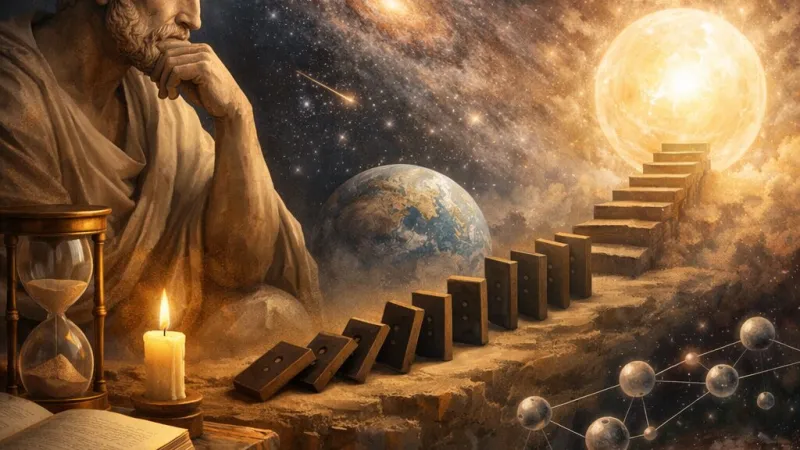
The cosmological argument belongs to the class of a posteriori arguments, those which turn upon empirical observation of the world rather than concepts alone. Its thrust is simple: there are things in the universe—objects, events, processes—which seem not to exist by their own necessity, and which stand in relation to causes and explanations outside themselves. The cosmological argument seeks, often by an appeal to the impossibility of an endless chain of such causes (an “infinite regress”), to explain contingent existence by positing a necessary or ultimate explanation—the so-called “first cause” or “necessary being”. This contrasts with the ontological argument, which tries to derive God’s existence from the very concept of God, and the teleological (design) argument, which looks for order and purpose in nature.B. Philosophical Heritage
The roots of the cosmological argument reach back into ancient Greek philosophy. Plato, especially in the *Timaeus*, questioned how the cosmos came to be ordered and postulated a “demiurge”—a craftsman-like cause behind material reality. It was, however, Aristotle who most clearly articulated the notion of the “Unmoved Mover”. Aristotle observed that all motion (encompassing change of any kind) requires a cause; if one follows this back, something must initiate motion otherwise there would be no movement at all. The Unmoved Mover, itself unmoved yet moving all, stands outside the chain of causes, a necessary being rather than a contingent one.Medieval Christian scholars in Europe, notably Thomas Aquinas, appropriated and developed these ideas. For Aquinas, an educated Dominican friar of 13th-century England and France, the Aristotelian structure proved a helpful framework for synthesising philosophy and theology. Unlike some ancient thinkers who believed the universe to be eternal, many Christian and Islamic philosophers saw it as having a beginning, which deepened the need for an originating cause.
C. Key Terms Explained
Understanding the cosmological argument requires a grasp of several philosophical distinctions:- Cause and effect: The principle that every event or being owes its existence to something external which brings it about. - Contingency: The idea that many things in the universe exist, but might not have done so; their existence is not necessary. - Necessary being: Something whose non-existence is impossible; such a being contains the reason for its existence within itself. - Infinite regress: A sequence extending endlessly backwards with no starting point, seen by many philosophers (though not all) as problematic when it comes to explanation.
The classic cosmological argument maintains that an actual infinite regress of explained by explained is not a satisfactory account: at some point, it is argued, we must reach something which is self-explanatory.
---
II. Major Variants of the Cosmological Argument
A. Aquinas’ ‘Three Ways’
Perhaps the most influential Western formulation comes from Aquinas’ *Summa Theologica*, where he presents “Five Ways” to prove the existence of God. The first three are cosmological in nature:1. The First Way: Motion Aquinas observes that things change (move) and that this conversion from potential to actual requires something already ‘in act’. He claims that an infinite regress of movers is impossible, and so there must be an unmoved mover which begins all motion—that is, God.
2. The Second Way: Efficient Causation This version appeals to cause and effect in the world. If every effect has a preceding cause, and if there cannot be an infinite chain stretched backwards, there must be a first uncaused cause.
3. The Third Way: Contingency and Necessity Here, Aquinas focuses on the fact that things come into and pass out of existence—implying they are contingent. If everything were contingent, nothing would have existed at some point—there must therefore be a necessary being which grounds the existence of all contingent things.
B. The Kalam Cosmological Argument
Emerging from the work of medieval Islamic philosophers and given new attention by modern thinkers, the kalam argument posits:- Whatever begins to exist has a cause. - The universe began to exist. - Therefore, the universe has a cause.
This version focuses on the universe’s temporal beginning, strengthened in the modern era by Big Bang cosmology. Figures such as Al-Ghazali, and today William Lane Craig, have made this argument central to philosophical debate. Unlike Aquinas, the kalam is more deductive: if one accepts the premises, the conclusion follows with logical necessity.
C. Distinctions Among Forms
Though related, these strands of cosmological reasoning differ in detail: Aquinas’ argument is more metaphysical, focusing on existence and the nature of beings; kalam, on the other hand, is more concerned with the temporal sequencing of events. Moreover, assumptions about the impossibility of infinity in cause or time are interpreted differently across these arguments.---
III. Strengths of the Cosmological Argument
A. Intuitive and Empirical Appeal
At its core, the cosmological argument echoes the way people naturally explain things: we look for causes and find it unsatisfying to accept that something comes from nothing. The principle “ex nihilo nihil fit”—nothing comes from nothing—feels obvious, almost a bedrock of reason.B. Philosophical Rigor
The distinctions between contingent and necessary existence serve to clarify the nature of explanation itself. The argument that not everything can be contingent if anything exists at all is, at least, compelling on a logical level. By driving towards something self-explanatory, the cosmological approach seeks explanatory completeness.C. Compatibility with Modern Science
Though not without controversy, advocates argue that discoveries such as the Big Bang—the apparent ‘beginning’ of space and time—support the premise that the universe began to exist, in line with the kalam argument. Scientific cosmology cannot, it is claimed, explain its own laws or why there is something rather than nothing; the cosmological argument simply points beyond the reach of scientific enquiry.D. Explanatory Power and Theoretical Elegance
By positing a single necessary explanation for all contingent existence, the cosmological argument aspires to both simplicity and grandeur. It provides an account which, if true, would explain why anything exists at all and undergird moral and theological reflection.---
IV. Criticisms and Challenges
A. Questioning Causality and Regress
One line of criticism targets the axioms on which the argument depends, such as the universality of causation. In quantum mechanics, for instance, some events appear uncaused; is the intuitive principle of cause and effect really as absolute as it first appears? David Hume, an Edinburgh philosopher, doubted whether we ever truly perceive cause and effect; perhaps it is merely habit.Additionally, some philosophers—such as J.L. Mackie—argue that an infinite regress may not be problematic; the demand for a single stopping point might be arbitrary.
B. The Leap to God
Even if we grant the need for a first cause, critics challenge the automatic identification of this with the God of Christian or classical theism. Why should the first cause be personal, omnipotent, or benevolent? Might it not be some impersonal principle or necessary law? Thus, the cosmological argument, for many, only gets one so far.C. Issues of Necessity
Is “necessary existence” a coherent notion? Some, including John Hick, have challenged whether any being (or thing) could be truly necessary, or whether this is a concept beyond human comprehension. Perhaps the universe itself is, in some unexpected sense, necessary.D. Russell and Logical Positivism
Bertrand Russell famously remarked, in a 1948 BBC debate with F.C. Copleston, “The universe is just there, and that’s all.” For Russell, demanding a cause for the universe was a category error, and in fact some contemporary philosophers influenced by logical positivism insist upon the meaninglessness of questions which overstep observable experience.E. The Problem of Causality and Time
If time itself begins with the universe, as modern cosmology suggests, what does it mean to talk of causes “before” time? Many, such as Anthony Kenny, argue causality is a temporal relation and cannot exist “outside” time. This undermines the argument’s foundation.---
V. Contemporary Developments and Responses
A. Philosophical and Theistic Defence
In response, defenders of the cosmological argument have adapted its terms using tools like modal logic to clarify the meanings of necessity and contingency. Others argue that the uncaused cause must, by its explanatory role, be a being with consciousness or power akin to the traditional God.B. Science and New Cosmologies
While the Big Bang lends some plausibility to the claim that the universe has a definite beginning, current physics acknowledges possibilities such as cyclic or branching universes—concepts which arguably restore infinite or indefinite causal chains.C. Infinite Regress Revisited
Some philosophers now accept the possibility of infinite regress, or at least that the need for a first cause is not proven. The philosopher Graham Oppy, for instance, contends that cosmological arguments give us no reason to think the explanatory chain cannot be infinite.D. Alternative Accounts
Naturalistic or pantheistic explanations offer competing frameworks: perhaps the ‘brute fact’ of the universe, or some impersonal force, is the ultimate reality. Some philosophers, such as A.J. Ayer, reject the search for any metaphysical explanation beyond what science can reach.---
Conclusion
The cosmological argument remains, in many ways, the cornerstone of philosophical attempts to explain why there is something rather than nothing. Its appeal derives from both the intuitive satisfaction of causal explanation and its apparent compatibility with scientific discoveries regarding the universe’s origin. Nonetheless, it faces serious objections: doubts about causality, the problem of infinite regress, the leap from “first cause” to God, and the applicability of necessity to anything beyond the empirical world.While the argument may not deliver a decisive proof of God, it provides a robust framework for thinking about question of ultimate explanation. Whether one embraces the argument or critiques it, to engage with it is to participate in one of philosophy’s most ambitious projects: the pursuit of reasoned understanding of reality itself. For these reasons, the cosmological argument not only endures, but continues to challenge and inspire those who seek answers to life’s deepest mysteries.
Rate:
Log in to rate the work.
Log in