Discover key themes and vivid imagery in Seamus Heaney’s poem Follower, exploring family bonds, identity, and the changing father-son relationship.
Introduction
Seamus Heaney stands as one of the most significant voices in twentieth-century poetry, particularly renowned for his sensitive and evocative depictions of rural Irish life. Drawing heavily from his childhood in County Derry, Heaney’s poetry often explores the themes of identity, heritage, and the intricate bonds of family. One of the most celebrated poems from his early collection, *Death of a Naturalist* (1966), is *Follower*. By focusing on the dynamic between a father and son, Heaney at once celebrates the artistry of manual labour and captures the shifting nature of familial relationships. In *Follower*, ordinary activities such as ploughing are transformed into acts of skill and almost mythic reverence, reflecting deeper questions about belonging, expectation, and the cyclical patterns of life.
This essay aims to unpack the complexities of Heaney’s *Follower*, examining the poem’s presentation of childhood admiration, growing self-awareness, and eventual role reversal between parent and child. It investigates the ways in which language, imagery, and form contribute to the poem’s powerful emotional charge, and considers how Heaney’s depiction of a rural father-son relationship resonates within a broader Irish and universal framework. Ultimately, *Follower* emerges not merely as a nostalgic reflection on youth but a poignant meditation on the ways in which identity is shaped by family, labour, and the passage of time, all conveyed through Heaney’s carefully honed poetic craft.
Exploration of Themes
Father-Son Relationship and Admiration
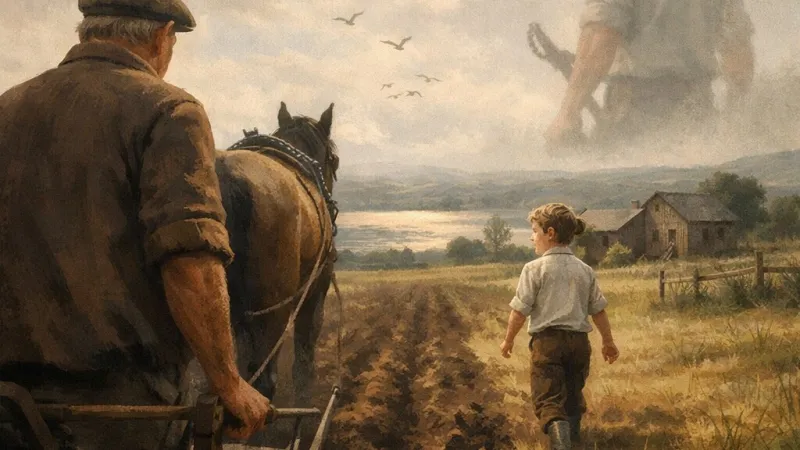
At the core of *Follower* is the young speaker’s awe towards his father. The boy watches as his father, “An expert,” guides horses with “a single pluck / Of reins,” operating with a skill and confidence that border on legendary. This admiration is palpable in the precise and respectful language used to describe the father’s actions: “The horses strained at his clicking tongue. / An expert. He would set the wing / And fit the bright steel-pointed sock.” The technical vocabulary chosen reflects not only the father’s authority but the son’s own recognition of his father’s mastery. In rural Irish communities, such practical skill was highly valued, and the poem channels the respect traditionally afforded to the patriarch who could work the land efficiently.
Yet, admiration is tinged with the pressure of living up to such standards. While the son is proud of his father, he is also painfully aware of the gulf between his own abilities and those of the man he idolises. Following is therefore not simply a physical act, but a desire to emulate and, perhaps, to inherit competence.
Childhood and Innocence
*Follower* captures the intensity and vulnerability inherent in being a child. The poet recalls stumbling “in his hob-nailed wake,” tracing literal footsteps in the earth, desperate to keep pace. The act of following his father through the “headrig” becomes a poignant metaphor for the learning process, where imitation is the first step towards independence. Here, Heaney invokes the universal childhood urge to impress one’s parents and the frustration when one inevitably falls short. The descriptions of “tripping, falling, yapping” powerfully communicate both innocence and helplessness; the adjectives are onomatopoeic and almost childlike, reflecting not only inexperience but also the chaos of growing up.
This innocence is soon complicated by a dawning sense of inadequacy. Heaney gives voice to that early, painful recognition that grown-up skills are not immediately grasped – the dawning awareness that one’s heroes are, for now, unattainable.
Loss of Innocence and Growing Awareness
As the poem unfolds, the boy’s naivety gives way to a sharper self-awareness. The recurring motif of stumbling – “I stumbled in his hob-nailed wake,” and later, “Sometimes he rode me on his back / Dipping and rising to his plod” – marks the move from childhood playfulness towards a more honest reckoning with his limitations. Rather than simply adoring his father, the speaker recognises the complexities of the relationship: hero worship comes with the burden of not measuring up. The poem’s structure – six quatrains with regular rhymes that sometimes break their own patterns – subtly echoes this shift; the neatness of form contrasts with the emotional turbulence beneath.
Heaney thus documents the journey from innocence to self-consciousness, a theme also present in poems such as Philip Larkin’s *This Be The Verse* and Gillian Clarke’s *Catrin*, both of which reflect on generational divides and the shifting currents of parental expectation.
Role Reversal and Growing Dependence
It is the final stanza, however, that delivers the poem’s most poignant twist. Where at first the son followed his sturdy father, by the poem’s end it is the father who “will not go away,” now trailing “behind me, and will not go away.” This reversal is not openly sentimental, but understated; the father, once powerful, has become dependent. This development echoes the broader pattern of familial ageing: what was once strength is now frailty, and what began as emulation transforms into care-giving. There is a sense of inevitable circularity, suggested by the poem’s closing image, reinforcing the idea that all children eventually become caretakers for those who once looked after them.
The emotional resonance here is particularly profound, especially for readers who have witnessed or experienced the slow inversion of parental roles due to ageing, illness, or the simple march of time.
Language, Imagery and Poetic Devices
Use of Technical Language to Elevate the Father
Heaney’s choice of agricultural lexicon is no accident. Words such as “headrig,” “sock,” and “furrow” are deeply rooted in the world of traditional farming, grounding the poem both geographically and culturally. This technical precision not only testifies to the father’s expertise but elevates his actions to those of a craftsman or even an artist. The division between father and son is underscored by the difference in their vocabularies; while the father inhabits the language of mastery, the son’s vocabulary is comparatively tentative, awash with terms like “stumbled,” “tripping,” and “yapping.” This reinforces the speaker’s sense of inadequacy and reinforces the divide between aspiration and ability.
Imagery Linked to Farming and the Rural Landscape
*Follower* draws repeatedly on the evocative imagery of the Irish countryside. The land is “globed like a full sail,” the furrows “exactly,” and “narrowed and angled at the ground.” These lines do more than describe; they conjure the grace and discipline inherent in field work, transforming a mundane occupation into something both noble and beautiful. For readers familiar with rural Britain or Ireland, these scenes are immediately tangible, and for others, they offer a vivid window into a way of life rapidly vanishing in the modern age. The ploughing becomes a metaphor for life’s path – at once linear and winding, fraught with obstacles but also with the promise of growth.
Sound Devices: Assonance, Alliteration, and Repetition
Heaney’s mastery of sound is apparent throughout the poem. Alliteration abounds, as in “fit the bright steel-pointed sock,” lending music and emphasis to the descriptions. Assonance, too, ensures the poem mimics the steady, rhythmic clop of the horses’ hooves and the father’s unwavering motion. Repetition is used to reinforce both the speaker’s failings – the triple rhythm of “tripping, falling, yapping” – and the persistent nature of the relationship: the stubbornness of both following and being followed. The musicality of language ties the poem’s meaning to its sounds, guiding the reader’s emotional response.
Structure and Form
Heaney’s use of six tightly-structured quatrains imparts a sense of order, mirroring the discipline of the ploughman at his work. Yet, within this structure, there are subtle disruptions – variations in rhyme, enjambment, and sudden shifts in tense – that mirror the underlying tension between admiration and anguish. The pacing of the poem is notably controlled, reflecting the steady pace of the father’s progress and the more uneven steps of the son.
Symbolism and Metaphorical Layering
The Father as a Symbol of Tradition and Stability
The physical and symbolic stature of the father cannot be underestimated; he embodies not just individual experience, but an entire tradition. In portraying his father as a figure rooted in the land, Heaney taps into the Irish reverence for ancestry and the passing on of knowledge through generations.
The Son’s Journey as a Metaphor for Personal Growth
The act of following is not merely filial loyalty but a metaphor for the process of learning, growing, and ultimately diverging from the path laid out by one’s predecessors. The repeated stumbling is both literal and metaphorical, signifying the difficulty of finding one’s own stride in the shadow of greatness.
Role Reversal as a Metaphor for the Cycle of Life
The closing reversal presents the family relationship as a cyclical process, speaking to universal experiences of ageing and dependency. Heaney’s perspective widens to one shared across communities and generations – the understanding that life’s roles are transient and ever-shifting.
Personal and Broader Cultural Significance
Heaney’s Reflection of Irish Rural Life
*Follower* is deeply embedded in the socio-cultural context of rural Ireland. Its emphasis on manual labour, respect for elders, and connection to the earth reflects values upheld in traditional farming communities. Yet, while unmistakably Irish, the poem’s insights transcend geography, reminding British readers of similar histories of rural labour in England, Wales, or Scotland and the universal ties of family.
The Poem’s Relevance to Contemporary Readers
Although set in a rural world that may seem distant from urban twenty-first-century Britain, the poem’s exploration of admiration, aspiration, and the inevitability of change is timeless. The struggles articulated by Heaney echo in every relationship marked by expectation and the passage of time. *Follower* evokes empathy for both parent and child, drawing readers into its tender drama regardless of their background.
Conclusion
Seamus Heaney’s *Follower* is a masterful study of familial love, aspiration, and change, voiced through the lens of rural labour. By intertwining precise language, evocative imagery, and carefully controlled structure, Heaney deepens our understanding of admiration, inadequacy, and the gentle, sometimes painful, inversion of family roles. The poem stands as a testament to the enduring significance of simple acts and the human connections they encode. In honouring his father, Heaney also honours the universal journey from dependence, through emulation, to acceptance and care. *Follower* thus remains a profoundly moving account of what it means to love, to follow, and, inevitably, to lead – a poem that continues to resonate with readers well beyond the fields it describes.
Frequently Asked Questions about AI Learning
Answers curated by our team of academic experts
What are the main themes in Seamus Heaney's poem 'Follower'?
The principal themes are admiration for the father, family bonds, identity, and the process of growing up. The poem explores childhood, family roles, and the lasting effects of heritage and labour.
How does Heaney use imagery in the poem 'Follower'?
Heaney employs vivid rural and technical imagery, describing ploughing in sensory, respectful detail. This transforms ordinary farm work into acts of skill and mythic reverence.
What is the significance of the father-son relationship in 'Follower' by Seamus Heaney?
The father-son relationship highlights the son's admiration and desire to emulate his skilled father. It also reflects the pressures of living up to parental expectations and changing family roles.
How does 'Follower' by Seamus Heaney portray childhood and innocence?
The poem portrays childhood as a period of awe, imitation, and vulnerability. The son is eager to follow his father but faces frustration and inadequacy when he cannot keep up.
How does the theme of identity develop in Heaney's poem 'Follower'?
The theme of identity develops through the son's struggle to match his father and eventually understanding how family and labour shape personal identity. The poem reflects the cyclical passage from youth to adulthood.
Rate:
Log in to rate the work.
Log in