Exploring Affluence and Social Conformity in 1950s-60s America
This work has been verified by our teacher: 15.01.2026 at 19:46
Homework type: History essay
Added: 15.01.2026 at 19:14
Summary:
From 1955-63, the US saw economic boom, suburban growth, conformity, car culture 🚗, and the rise of rebellious youth and consumer society.
2b.1 Affluence and Conformity, 1955-63
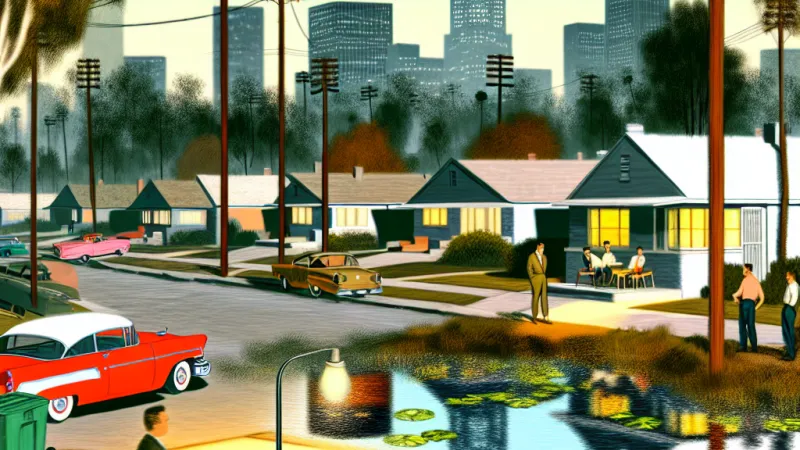
The period from 1955 to 1963 was one of remarkable transformation in the United States, a nation emerging triumphant from the shadow of the Second World War. This era, often immortalised in glossy advertisements and television sitcoms, was characterised by unprecedented economic prosperity, rapid growth of suburban communities, an explosion in consumer culture, and, perhaps paradoxically, a tightening grip of social conformity alongside rising currents of rebellion—especially among the youth. The 'American Dream' was both visualised and realised in newly built suburbs, filled with modern conveniences and a sense of communal security, underpinned by white-collar expansion and the nearly universal aspiration to own a car. Yet, beneath this veneer lay issues of social division, racial exclusion, and growing restlessness among younger generations.
This essay aims to critically explore the reasons behind the swift urban and suburban development of the period, the economic and social impetus provided by car ownership and highway construction, the transformation of the workforce via white-collar jobs, and the shaping of the USA as a consumer society. It will assess portrayals of suburban conformity in television, contrast these with trends in Hollywood cinema, and chart the emergence of a rebellious teen and beatnik culture. Finally, it will reflect on the most significant cultural shifts of the age, arguing that while affluence defined the decade, its very advances laid the groundwork for both conformity and the seeds of resistance that would bloom later in the 1960s.
---
I. Reasons for Rapid Urban and Suburban Development (1955–63)
The economic affluence that enveloped America after the Second World War cannot be overstated. Between 1945 and 1960, gross domestic product (GDP) almost doubled, and the average income of American families increased sharply. Households now enjoyed comforts once considered luxuries: refrigerators, television sets, and washing machines became commonplace, removing much of the daily drudgery and reinforcing a sense of prosperity. Crucially, this prosperity fuelled a demand for new spaces in which to enjoy it—driving the rapid expansion of suburbs.One of the defining features of suburban growth was the phenomenon of ‘white flight’, wherein middle-class white families left the racially diverse inner cities for the burgeoning suburbs. This migration was not accidental: federal government initiatives, particularly through the Federal Housing Administration (FHA), offered cheap loans and low down payments for homebuyers heading to these new developments. But a darker side of this story is the role of restrictive covenants and discriminatory lending practices which excluded African American, Jewish, and other minority families from participating in this suburban boom. As such, while the white middle class thrived in idyllic surroundings, minority Americans were often left confined to decaying inner cities and poorly maintained ‘projects’—public housing that fell far short of needs.
Suburban construction was exemplified by developments such as Levittown in Pennsylvania and New York. Bill Levitt’s homes were mass-produced, affordable, and represented the zenith of post-war efficiency—but for white Americans only. By contrast, African Americans rarely benefited from FHA guarantees, a reflection of systemic racism endured even in the so-called 'land of opportunity'.
Regionally, migration patterns shifted dramatically. Many moved from rural areas and the segregated South to Northern and Western cities in search of work and a better life. The ‘Sun Belt’—a swathe of the country from California to Florida—grew rapidly, attracting residents with its climate, new industries (including aerospace and electronics), and its own wave of suburban development.
However, the state failed in its responsibility to provide adequate public housing. The so-called 'projects', intended as a safety net for urban populations, quickly turned into symbols of neglect and deprivation, especially for black Americans stranded by discriminatory policies. While suburbanites enjoyed privacy, space, and modernity, city dwellers grappled with overcrowding and diminishing opportunities.
---
II. Importance of Car Ownership and Highway Construction to Suburban Growth
If the house was the symbol of post-war prosperity, the car was its enabler. The mass production of affordable vehicles, notably by Ford and General Motors, brought about a cultural and social revolution. Car ownership skyrocketed: by 1960, nearly eight out of ten American families owned at least one car. This made daily commuting from suburbs not just possible, but ordinary—physically linking the residential and commercial life of burgeoning suburbs with the economic heart of the cities.A key reason for this transformation was the passage of the National Interstate and Defence Highways Act in 1956—a colossal $25 billion investment resulting in 42,500 miles of high-speed motorways. This was funded with a 10:90 split between individual states and the federal government, catalysing a national network which fundamentally re-made American geography: suburbs flourished along these arterial routes, while many older inner-city areas faded into decline.
The car quickly became the lynchpin of a new, uniquely American culture. Drive-in cinemas—over 3,000 existed by 1956—were emblematic of this trend, offering entertainment tailored to car-owners. Motels, drive-through restaurants, and shopping malls (1,800 by the mid-1950s, over 4,000 by 1960) sprung up to serve a highly mobile consumer base, further marginalising traditional urban centres. Even leisure was shaped by the automobile, as families took to the open road to visit distant attractions and national parks.
All this fed into the era’s consumerist ethos: ‘planned obsolescence’—the deliberate regular updating and replacement of products, especially cars—became an accepted business model, embedding consumer spending and a desire for the ‘latest’ into the fabric of society. Arthur Miller's play *Death of a Salesman* (although first performed in 1949, still resonant in this period) captured the anxiety underlying this spiralling materialism, as individuals strove for the increasingly elusive rewards promised by modernity.
---
III. Increase in White-collar Jobs (1955–63)
This new economic order required a workforce to match. White-collar jobs, a term signifying professional, clerical, and managerial roles as opposed to manufacturing or manual labour, expanded rapidly. The service sector boomed, driven by the needs of suburbia—motels, shopping malls, and tourism all tapped into the disposable income of the post-war family.Crucially, the ‘military-industrial complex’ provided further impetus. The Korean War had given a vital jolt to manufacturers like Boeing and Lockheed, and Cold War tensions meant government defence contracts remained a bedrock of employment. Aerospace, electronics, and defence worked hand-in-glove with federal agencies, keeping white-collar workers in steady, well-paid jobs.
Women, who had entered the workforce en masse during the war, found new opportunities in this white-collar world, primarily in secretarial, clerical, and service roles. While traditional gender roles were often reinforced by media and popular culture, in practice, many families thrived on a second income, further increasing their consumer power and expectations of comfort.
---
IV. Features of the USA as a Consumer Society by 1963
By the early 1960s, the US had become the epitome of a consumer society. Central to this transformation was the rise of credit. The introduction of the Diner’s Club card in 1950, followed by American Express in 1958, paved the way for everyday Americans to buy now and pay later—a dramatic shift from previous generations’ caution and frugality.The range of consumer goods expanded with dizzying speed. Automatic washing machines, dishwashers, televisions, transistor radios, vinyl records and, later, the earliest household computers and space-age kitchen gadgets were symbols of the good life. Influences from the ongoing space race filtered into everyday products—non-stick pans, for example, or new, lightweight materials.
The act of shopping itself became a form of recreation rather than necessity. The proliferation of shopping malls in the suburbs—over 4,000 by 1960—meant buying was no longer simply functional but emerged as a leisure pursuit, part of a shared communal experience. This was matched by an increase in leisure time, fuelled by labour-saving devices in the home and shorter working weeks.
Teenagers emerged as a vital demographic within this consumer paradise. Through part-time jobs and generous parental allowances, young people gained unprecedented spending power, shaping markets for music, fashion, automobiles, and popular entertainment. The cult of Elvis Presley and the rock’n’roll revolution illustrated the impact of this new youth consumerism on wider culture and on the global stage, influencing the likes of the Beatles and Rolling Stones in the UK.
---
V. Portrayal of Suburban Conformity on Television
Television became the hearth around which the family gathered, not just consuming but shaping culture. The sitcom became its most potent vehicle, transmitting an image of domestic bliss and suburban stability to millions. Programmes like *I Love Lucy* and *Father Knows Best* promoted archetypes of the nuclear family: the breadwinning father, homemaking mother, and dutiful children, all bathed in the warm glow of communal harmony.This vision, however, was tightly circumscribed. Rarely did these shows stray into issues of racial, class, or gender tension. Visually and narratively, they affirmed the desirability of stability, traditional roles, and the rewards of conformity—a reflection and reinforcement of the aspirations of the white middle classes. Even when differences appeared, they were swiftly resolved within the community, reinforcing an underlying message that conformity, more than any virtue, guaranteed happiness and security.
---
VI. Differences Between Film and Television Content (1955–63)
Hollywood during this period diverged sharply from the suburban utopias of television. Films that focused on the monotonous realities of suburban life, such as *No Down Payment*, failed to capture the public’s imagination, perhaps because audiences were less willing to pay for what they could see reflected for free at home.Instead, blockbuster films pursued epic narratives and escapism—*The Bridge on the River Kwai*, *Lawrence of Arabia*, and *Around the World in 80 Days*—whilst musicals such as *West Side Story* explored themes of race and youth violence more daringly than TV dared to attempt. An entirely different strand of cinema, typified by *Rebel without a Cause* with James Dean, channelled the growing unease and alienation of young people, focusing on their struggles with conformity, family, and society.
Hollywood’s representation of black Americans remained very limited, with rare exceptions such as *Lilies of the Field* starring Sidney Poitier marking tentative steps towards inclusion.
---
VII. Main Features of Teenage Culture (1955–63) and Beatnik Culture
Teenagers in this new age were not only consumers but cultural protagonists. Affluence bestowed upon them a degree of independence unknown to their parents’ generation—by 1960, they spent over $10 billion annually, shaping not just advertising but the wider cultural climate.Their rebellion, however, struck a note of dissonance within the wider society. Films such as *The Wild One* and *Rebel without a Cause*—and news coverage warning of 'teenagers on the rampage'—spoke to deeper anxieties about discipline, sexuality, and the future. The rigid boundaries of conformity, celebrated in adult culture, seemed stifling to many younger Americans, whose idols—most famously Elvis Presley—exuded sexual energy and anarchic charisma. Reports such as Alfred Kinsey’s on sexual behaviour, considered scandalous at the time, further fuelled debates about changing mores.
Cars symbolised this new independence: drive-in theatres and fast-food restaurants became teenage institutions, while the music and fashion of youth marked a decisive break from adult tastes.
Simultaneously, the so-called 'beatniks' emerged. Rejecting materialism and suburban monotony, this subculture embraced jazz, poetry, Eastern philosophies, and non-conformity. Their 'coolness', beat poetry, and bohemian lifestyles hinted at a growing counter-cultural undercurrent that would find its fullest expression towards the end of the decade.
---
VIII. Most Important Cultural Change in the Period 1955–63
Some argue that the expansion of consumer society and the spread of easy credit forever transformed American life, allowing for the pursuit of pleasure and variety previously unimaginable. Others emphasise the explosive power of teenage culture, which began to challenge the certainties of parental authority and established tradition.Yet, if one development above all others both symbolised and enabled the era, it was the rise of the car and its associated infrastructure. Automobility allowed suburbs to flourish, gave reality to the dreams of mobility and freedom (however circumscribed by race and class they might have been), transformed commercial and leisure life, and embodied the promise of the American Dream. The car, in short, did not just change the landscape; it altered the psychological terrain of the nation.
---
Conclusion
The years 1955 to 1963 were marked by exceptional affluence and, for the majority, an embrace of conformity that shaped the built environment, work, consumer habits, and culture. Rapid suburban expansion, facilitated by economic growth, car ownership, and federal investment, reshaped the American landscape, deepening both opportunity and exclusion—particularly along lines of race. The rise of white-collar jobs and a consumer society created new expectations of comfort and leisure, but also laid bare the limitations of such prosperity, especially on the nation's margins.Media, especially television, projected an idealised vision of suburban life and reinforced social conformity, even as cinema and youth culture began to challenge these ideals. The simultaneous growth of teenage and beatnik cultures exposed the tensions and contradictions at the heart of this affluent society, foreshadowing the cultural revolutions to come.
The era’s legacy endures in the patterns of modern American life—suburban sprawl, car dependency, ceaseless consumption, and the dance between conformity and rebellion. Though briefly united in apparent material contentment, America in 1963 stood on the brink, its foundations already trembling with the first rumbles of the upheavals that would define the remainder of the twentieth century.
Rate:
Log in to rate the work.
Log in