Crimean War 1853–1856: Clash of Empires and Lasting Impact
This work has been verified by our teacher: 29.01.2026 at 16:08
Homework type: History essay
Added: 27.01.2026 at 14:32
Summary:
Explore the causes, key battles, and lasting impact of the Crimean War 1853–1856 to understand this pivotal clash of empires in European history.
The Crimean War 1853-56: Clash of Empires, Catalyst of Change
The Crimean War, fought from 1853 to 1856, stands as a watershed moment in European history, taking centre stage as the continent’s first major military confrontation since the fall of Napoleon in 1815. In an era often referred to as the ‘Age of Metternich’, when diplomats strove to uphold a brittle peace, the rapid descent into conflict over the Black Sea and the Ottoman domains shocked contemporaries and signalled deep-rooted tensions beneath the surface of Pax Britannica. Unique among Victorian wars, the Crimean conflict drew together a striking array of actors—Britain, France, the Ottoman Empire, Sardinia, and Russia—over a tangled web of imperial ambition, religious rivalry, and anxieties about the fate of the so-called ‘sick man of Europe’.
The war’s significance, however, extends beyond battles and treaties. In its smoke-filled hospitals, the foundations of modern nursing were laid by Florence Nightingale and Mary Seacole; in muddy encampments, journalists like William Howard Russell etched a new form of war reporting into public consciousness. This essay explores not only the geopolitical origins and military conduct of the Crimean War, but analyses how leadership failures, media scrutiny, medical reform, and the war’s cultural legacy made it a crucible for change in Victorian Britain and across Europe.
---
Geopolitical Background and Causes of the Crimean War
The Decline of the Ottoman Empire and the Eastern Question
By the mid-nineteenth century, the Ottoman Empire was a shadow of its former might. Once a formidable force in European affairs, its control over territories in the Balkans had ebbed through insurrections and wars. The struggle for Greek independence earlier in the century, supported for moral and strategic reasons by Britain and France, highlighted the fragility of Ottoman authority. This uncertainty became known as the ‘Eastern Question’—what would happen to Balkan territories and Turkish possessions if the empire collapsed?European powers were divided, not so much by affection for the Ottomans as by suspicion of each other. Britain and France feared any vacuum in the region would be filled by Russia—whose army was the largest on the continent and whose Tsars cast covetous eyes on the Bosphorus and Dardanelles. The fate of Constantinople, seat of Eastern Christendom, loomed large.
Russian Ambitions and Religious Pretexts
Russia’s involvement was far from subtle. Tsar Nicholas I believed Russia had a God-given responsibility to safeguard Orthodox Christian minorities under Ottoman rule. Whether genuine concern or diplomatic fig leaf, this claim allowed the Tsar to menace the Ottomans while presenting his actions as benevolent intervention. However, more tangible motives lay beneath. Russian strategists yearned for secure access from the Black Sea to the Mediterranean—a ‘warm water’ route that would transform Russia’s naval power. The occupation of the Danubian principalities, Moldavia and Wallachia, was a calculated step towards this goal, cloaked in pious rhetoric.British and French Imperatives
Faced with Russian expansion, Britain’s anxieties were manifold. Preeminent among them was the threat to the trade route to India, the crown jewel of Victoria’s empire. Should Russia capture Constantinople, its fleet could menace British shipping or even sway Persian and Afghan politics. The French, under Napoleon III, had different ambitions: prestige in the Mediterranean and champions of Catholic interests in holy places like Jerusalem—thus positioning themselves as rivals to Russian Orthodoxy.The diplomatic flashpoints multiplied: Russian envoys, such as Prince Menshikov, pressed their demands in Constantinople, only to be rebuffed. The Russians then advanced into the Danubian provinces, spurring Anglo-French outrage and failed diplomatic missions. Neither Nicholas’ posturing nor Britain’s sabre rattling prevented the slow spiral into war.
---
Military Campaigns and Leadership Failures
Early Skirmishes and Strategic Blunders
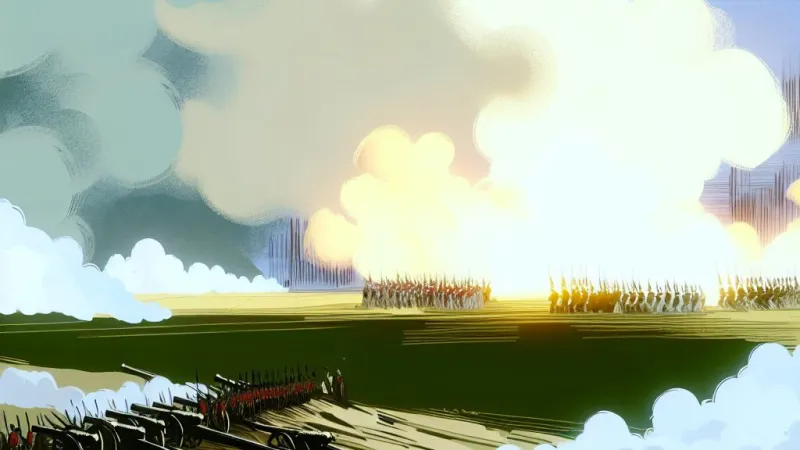
Hostilities began in the peripheral lands of the Danube, with Ottoman and Russian forces engaging along the River’s lower banks. However, the decisive actions soon shifted to the Crimea, with the Allies landing at Eupatoria and confrontations erupting at the River Alma in September 1854. Despite superior numbers, the Allies struggled with coordination; the British redcoats, many equipped with recent Minie rifles, managed to break the Russian line, but at frightful cost.The conditions were abysmal. Far more deadly than Russian muskets was cholera, which swept through the ranks with little resistance. These early engagements set the pattern: mismanaged logistics, disease, dreadful confusion as orders were garbled, and ill-prepared men stumbled to their objectives.
Leadership Under Scrutiny
Nowhere was British aristocratic amateurism more exposed than in the Crimea. Lord Raglan, commander of British troops, brought with him the habits and outlook of Waterloo’s generation. His charm and bravery were admired, but he was hampered by a convoluted high command, lack of field experience, and a penchant for dispatching cryptic orders. The rivalry between Lord Lucan and Lord Cardigan, both cavalry commanders, culminated at the Battle of Balaclava in the infamous Charge of the Light Brigade—a botched command that led to spectacular but pointless loss of life, later immortalised by Tennyson’s pen: “Theirs not to reason why / Theirs but to do and die.”Russian general Menshikov, meanwhile, proved no more inspired, failing to exploit Allied weaknesses and presiding over a crumbling defensive strategy. The Allies’ fractious relationship—Britons and Frenchmen viewing each other with mistrust—further delayed operations and blunted opportunities for decisive action.
The Siege of Sebastopol
The bear-trap at Sebastopol defined the year-long Allied campaign. Unable to take the city by storm, British and French troops were consigned to static siege warfare. Soldiers froze in inadequate uniforms as the Crimean winter bit hard; supplies were mismanaged, equipment lost, and hunger stalked the trenches. The logistical failures of the British were mercilessly reported back home, causing widespread anger and shaming Ministers into reform. It was only through attrition, superior Allied artillery, and Russian exhaustion that Sebastopol ultimately fell in 1855, after appalling sacrifice.---
Medical Reforms and Social Impact
Sanitary Catastrophe and the Cost of Neglect
If military confusion reigned in the field, it was surpassed only by chaos in the hospitals. Disease claimed more British lives than Russian gunfire; rampant lice, filthy bedding, and spoiled provisions produced scenes that shocked even hardened Victorian sensibilities. The Army’s Medical Service was wholly inadequate—understaffed, undertrained, and unable to cope.Florence Nightingale: The Lady with the Lamp
Into this abyss stepped Florence Nightingale, whose courage and organisation transformed the Scutari barracks hospital. Relying as much on statistics as on compassion, she implemented strict hygiene regimes, proper ventilation, and trained volunteer nurses, fundamentally reducing mortality rates. Nightingale’s letters and reports, often published in British newspapers, became rallying calls for reform. In Nightingale’s own words, written later in her ‘Notes on Nursing’, “No amount of medical knowledge will lessen the accountability for nurses to do their very best.” Her legacy persists in today’s NHS, where evidence-based care owes much to her pioneering work.Mary Seacole: Forgotten Heroine
No account would be complete without Mary Seacole, a British-Jamaican practitioner who, despite official rebuffs, set up the British Hotel near Balaclava. Her herbal remedies and tireless work earned her the adoration of common soldiers. The contrast between Nightingale’s institutional reforms and Seacole’s more personal, practical approach highlights race and class prejudices within Victorian society—debates that have re-emerged in contemporary reassessments.Broader Social Impact
The war’s aftermath led to sweeping medical reforms, including the establishment of the Army Medical School at Netley and new standards for hospital construction and record-keeping. Public empathy for veterans and the recognition of women’s major contributions shifted attitudes towards nursing, paving the way for an enduring professional legacy.---
War Reporting and Public Opinion
The Rise of Modern War Correspondence
Perhaps for the first time, war was brought home to British drawing rooms by William Howard Russell, correspondent for *The Times*. His dispatches, uncensored and often critical, painted a harrowing picture of cold, incompetence and avoidable suffering. In one article, Russell condemned the state of the hospitals as “a disgrace to any civilised country.” The result was a surge in public pressure for change—parliamentary investigations, heated debates, and ministerial resignations.Photography: Images from the Battlefield
Photographer Roger Fenton was dispatched to Crimea to counter such damning reports, tasked with producing images that would shore up public morale. His posed, sanitised pictures—the famous ‘Valley of the Shadow of Death’—stood in stark contrast to the ugly reality recorded by Russell and others. Yet they remain among the earliest photographic records of war, hinting at the power and limitations of imagery in shaping national memory.Media Influence on Policy
The Victorian press, newly influential thanks to technological innovations like the telegraph, compelled politicians to reckon with public scrutiny. The Queen herself became involved, awarding medals and expressing concern, while figures such as William Gladstone introduced the first peacetime income tax to pay for the war. For the first time, media shaped both public opinion and government responses directly, a feature that has only grown in significance in subsequent conflicts.---
The War’s Legacy and Historical Interpretations
Lessons for Military Doctrine
The shambolic command and logistical failures of Crimea prompted systemic reforms—new training for officers, improved supply lines, and a more professional staff structure. Yet the memory of disasters like the Light Brigade persisted, both as symbols of heroism and examples of avoidable blunder.Shifting Geopolitics
The Treaty of Paris (1856) forced Russia to cede territory and demilitarise the Black Sea, temporarily restraining expansionist ambitions. Nevertheless, the deep-rooted tensions remained unresolved, laying seeds for future hostilities—notably the Russo-Turkish War and, further ahead, the alliances that would detonate the First World War.Cultural Remembrance and Myth
Despite its enormous human cost, the Crimean War quickly faded from popular memory, eclipsed by later conflicts. Yet cultural artefacts remain: not only Tennyson’s ‘Charge of the Light Brigade’, but paintings, monuments (such as the Crimean War Memorial in London), and letters. Modern efforts to recover the stories of neglected figures like Mary Seacole have sparked ongoing debates about race, empire, and the construction of British national identity.---
Rate:
Log in to rate the work.
Log in