The Impact of the Yalta and Potsdam Conferences on the Post-War Era
This work has been verified by our teacher: 18.03.2026 at 12:48
Homework type: History essay
Added: 16.03.2026 at 15:04
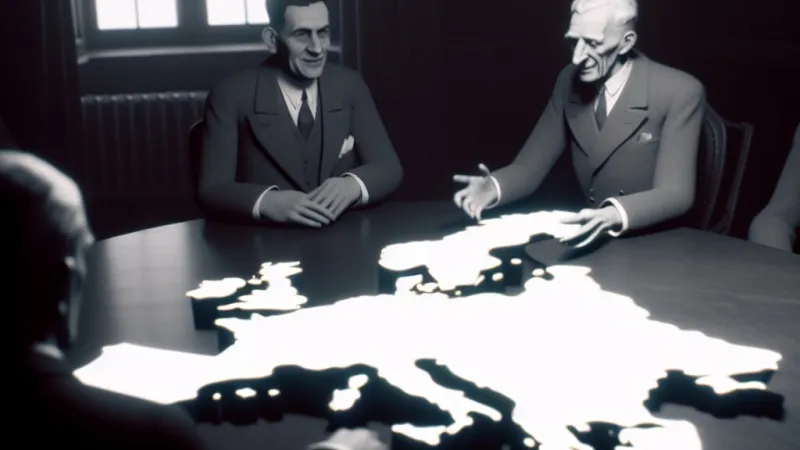
Summary:
Explore the impact of the Yalta and Potsdam Conferences on the post-war era, revealing key agreements and their role in shaping modern Europe and global peace.
Yalta and Potsdam: Shaping the Post-War World Order
The final years of the Second World War witnessed not just the physical defeat of Nazi Germany, but also an intense period of strategic dialogue among the Allied powers regarding how peace and order would be reconstructed once the guns fell silent. The magnitude of devastation across Europe, the enormous displacement of peoples, and the looming presence of the Soviet Union in the east, set the stage for high-level diplomatic summits of unprecedented consequence. Among these, the conferences at Yalta in February 1945 and Potsdam in July-August of the same year stand out as pivotal moments that charted the trajectory of the post-war world. While both conferences were ostensibly about cooperation to ensure lasting peace, the agreements, compromises, and failures that characterised them would cast a long shadow, setting the foundations for both the promise of the United Nations and the deep divisions of the Cold War. This essay will examine the aims, agreements, controversies, and legacies of the Yalta and Potsdam conferences, using examples, British cultural touchstones, and critical perspectives to show how these meetings moulded the shape of Europe and the wider world for much of the next half-century.
---
Background to the Conferences
The Military and Political Context of Early 1945
By the start of 1945, the war in Europe was, by every military estimation, entering its final stages. D-Day had shattered Hitler’s western defences, France was liberated and British, American and Commonwealth forces were pushing into Germany from the Rhine. Meanwhile, Stalin’s Red Army had rolled back the Nazi invaders at dreadful cost, sweeping through Poland and heading inexorably westward. While for many contemporaries in Britain it portended imminent victory—an ending so compellingly depicted in wartime speeches and newsreels—there was a growing awareness among policymakers that peace might be as difficult to win as war itself.Political leadership at this time was in transition. The Yalta Conference brought together the wartime ‘Big Three’: Winston Churchill, then still Conservative Prime Minister of Britain; Franklin D. Roosevelt, the long-serving American President; and Joseph Stalin, Soviet leader and victor-dictator of the East. Each arrived with different priorities. Churchill, well-schooled by the ghosts of appeasement, was wary of Soviet ambitions, yet reliant on Russia’s contribution for final victory. Roosevelt, ailing and keen to sustain Allied unity, often acted as a mediator. Stalin, triumphant and calculating, demanded genuine security for the USSR’s scarred western border—security which, in his eyes, required both geographic buffer and political dominance in Eastern Europe.
By Potsdam five months later, the faces had changed as much as the mood. Roosevelt had died and his post assumed by Harry S. Truman—a relative unknown in British circles and far more suspicious of Soviet intentions. In Britain, the Labour landslide of July 1945 had just propelled Clement Attlee into power, replacing Churchill at the conference’s halfway mark. The atmosphere was no longer one of wartime fellowship, but growing mistrust, as reports of Soviet actions in Poland and beyond set alarm bells ringing in Whitehall and Westminster.
---
The Yalta Conference: High Hopes and Uncertain Promises
Germany’s Future
At Yalta, the need to prevent future German aggression dominated discussions. Germany was to be occupied and administered by the four principal Allies, each controlling a zone. The intention was cooperation—yet as later seen in Berlin, this division proved anything but temporary. There was also agreement (at least in principle) on demilitarisation, denazification, and the prosecution of Nazi war criminals. Reparations would be extracted, a subject the British press followed closely, scarred by memories of the punitive approach after 1918 that many felt paved the way for Hitler’s rise.Eastern Europe: Elections, Borders, and Spheres of Influence
One of the most contentious subjects was the fate of territories ‘liberated’ by the Red Army. Poland was to have its borders redrawn westwards; this would result in the forced transfer of millions of civilians in one of the greatest demographic upheavals Europe had seen. At Yalta, Stalin gave commitments to enable “free and unfettered elections” in Poland and across Eastern Europe. Yet, as British diplomats such as Anthony Eden soon realised, these words meant vastly different things to East and West: for Stalin, control on the ground trumped paper agreements. Already, Soviet-backed governments were emerging behind the ‘liberated’ curtain.Forming a New World Body
Not all was wrangling. The conference saw final agreement on creating the United Nations—a project championed by British intellectuals and statesmen, eager to avoid the failings of the League of Nations. The Security Council, with its permanent members and veto power, reflected both the prevailing mood for great power cooperation and the inherent suspicion among its architects: a structure designed, as George Orwell might have observed, as much to prevent future wars as to safeguard the interests of its founding members.The Far East: Towards Japan’s Defeat
Yalta also addressed the ongoing Pacific war. With victory in Europe now likely, Churchill and Roosevelt sought Stalin’s promise to enter the campaign against Japan, in return for Soviet gains in Manchuria and northern territories. This commitment would come to be crucial in hastening Japan’s defeat, though its political aftershocks in Asia would soon reverberate.Britain’s View: Relief and Reservations
British opinions on Yalta, as reflected in the House of Commons and newspapers such as The Times, combined relief at progress towards peace with unease about Soviet ambitions. Churchill himself would later write in his memoirs of the difficult trade-offs made, famously describing the ‘iron curtain’ that had descended across Europe.---
Potsdam: Diplomacy Fractures as the Cold Peace Looms
Leadership Changes and Shifting Dynamics
The Allied faces at Potsdam were new, and the mood perceptibly altered: no longer victors-in-arms, but wary partners-turned-rivals. Truman, less inclined to trust Stalin, and Attlee, new to the summit stage, typified a British political class now more anxious about Soviet intentions than ever.Germany: Division Becomes Destiny
Potsdam finalised the division of Germany and confirmed joint control of Berlin itself. Reparations, still a fraught subject, saw Stalin insisting on compensation drawn heavily from his zone, while the Western powers—acutely aware of the economic collapse that followed Versailles—cautioned restraint. Meanwhile, Nazi collaborators were to be removed from positions of responsibility, and a democratic Germany gradually rebuilt, albeit on sharply diverging Western and Soviet lines.Poland and the Eastern Bloc: A Souring Vision
Disquiet now surrounded the fate of Poland and the emerging ‘people’s democracies’ in Eastern Europe. New governments friendly to Moscow appeared to Western eyes as clear signs of communist expansion; their existence ran counter to the spirit, if not the letter, of Yalta’s promises. When Attlee and Bevin, his Foreign Secretary, returned home, they faced mounting pressure from both Parliament and public opinion to defend British influence in Eastern Europe—an aspiration increasingly difficult to reconcile with the facts on the ground.Japan, the Atomic Bomb, and New Realities
The Potsdam Declaration, issued to Japan, demanded surrender on terms that contained both threat and imprecision. Unknown to Stalin, Truman possessed a new ace: successful testing of the atomic bomb at Alamogordo. This shifted the balance further and arguably lessened Western dependence on Soviet help in Asia. For the British, even as the scale of American atomic power came clear, there remained an acute anxiety about entering a new technological age where Britain’s own place as a global power might be under threat.Unmistakable Divisions
The sense of Allied unity unraveled at Potsdam. The differences—political, strategic, and, most of all, ideological—became overt, as vividly captured in newsreel footage of strained handshakes and wary body language. The seeds of the ‘Cold War,’ a term popularised in Britain by George Orwell before it took hold internationally, were sown in these very meetings.---
Consequences: From Agreements to Divisions
Germany and the Start of the Cold War
What was intended as temporary occupation of Germany ossified into a symbolic and physical partition—West versus East, capitalist democracy versus communist dictatorship. Berlin became the epicentre of confrontation, seen later in the Berlin Blockade and the building of the Wall.Eastern Europe and the ‘Iron Curtain’
Despite promises, Soviet influence dominated in Poland, Hungary, Czechoslovakia and beyond. British writers and commentators, from the Manchester Guardian to the BBC, began speaking of an ‘Iron Curtain’ dividing Europe, echoing Churchill’s famous speech at Fulton in 1946.Birth of the United Nations
The UN emerged, for all its faults, as a vital forum where even deadly enemies could debate and, occasionally, cooperate. British diplomats such as Lord Halifax and writers like Eglantyne Jebb (founder of Save the Children and proponent of early humanitarian law) became active in shaping its humanitarian and legal wings.Territorial Realignment and Human Cost
The redrawing of Poland’s borders and the expulsion of populations created bitter legacies that would last for generations. For many British families who had welcomed Polish airmen and soldiers during the war, the fate of their homeland was a personal tragedy as well as a diplomatic defeat.Japan and the Shift in World Power
Soviet entry into Manchuria coincided with the atomic bombings of Hiroshima and Nagasaki, hastening Japan’s surrender but also sowing the ground for future conflict in Asia—as would be seen in the Korean War just a few years later.---
Critical Analysis: Perspectives and Debates
Was It Inevitable?
Some British historians, such as A. J. P. Taylor, have argued that the unraveling of Allied cooperation was more or less inevitable given the vast ideological gulf and mutual suspicions. Others, like the revisionist E. H. Carr, suggest there were opportunities for better understanding, had the power dynamics or personalities differed.The Role of Personalities
Roosevelt’s death and Churchill’s electoral defeat removed the two Western leaders most committed to close communication with Stalin. Truman’s more confrontational style and Attlee’s caution shifted the balance towards suspicion and blunt negotiation. Stalin, wily and deeply paranoid, exploited every division to his advantage.Diplomacy’s Limitations
The British experience of Yalta and Potsdam is often cited in political debates about the limits of summitry and the dangers of sacrificing moral principles for strategic gain. That the architects of peace also unwittingly designed the battleground of Cold War Europe remains a powerful cautionary tale.---
Rate:
Log in to rate the work.
Log in