The Impact of SALT 1 on Cold War Arms Control and Diplomacy
This work has been verified by our teacher: 20.03.2026 at 17:33
Homework type: History essay
Added: 19.03.2026 at 10:07
Summary:
Explore the impact of SALT 1 on Cold War arms control and diplomacy, learning how this treaty shaped nuclear limits and eased superpower tensions.
The Significance of SALT 1 in Cold War History
The Cold War, an era marked by seismic shifts in international relations and the ever-looming threat of global conflict, saw the world’s two superpowers — the United States and the Soviet Union — locked in a tumultuous arms race. From the late 1940s into the early 1970s, technological advancements led to a rapid proliferation of nuclear weapons, creating a perilous state of mutually assured destruction (MAD). This balance of terror, as it was sometimes called, cast a shadow over daily life and politics within both countries and their respective allies. Yet, by the dawn of the 1970s, geopolitical realities, public anxiety, and economic strains compelled both sides to search for a way to alleviate the tension. Against this backdrop, the Strategic Arms Limitation Talks (SALT 1), culminating in a treaty signed in 1972, emerged as a watershed moment in Cold War diplomacy. This essay examines the deep significance of SALT 1, analysing its origins, provisions, impact, criticisms, and lasting influence, and situates it within both the wider context of arms control and the broader search for security in an uncertain world.
---
I. Historical Background to SALT 1
To understand the emergence and importance of SALT 1, one must grasp the fevered pace of the nuclear arms competition that defined the post-war decades. After the atomic bombings of Hiroshima and Nagasaki in 1945, the United States briefly held an unrivalled position. This dominance, however, was shattered by the Soviet detonation of their own atomic bomb in 1949. Over time, the superpowers jostled for supremacy through the development of increasingly advanced and destructive systems, such as intercontinental ballistic missiles (ICBMs) and submarine-launched ballistic missiles (SLBMs). These weapons, capable of being launched from hidden silos or beneath the oceans, made the possibility of a sneaky and devastating first strike ever more real.A pivotal moment was the Cuban Missile Crisis of 1962, when the world teetered alarmingly close to nuclear war. The harrowing near-miss highlighted the horrifying consequences that unbridled competition could bring. Though both sides retreated from the brink, mutual suspicion ran deep and early attempts at nuclear arms control — including the Limited Test Ban Treaty of 1963 — were only modest steps forward. The 1960s also saw attempted negotiations mired in difficulties, with both nations wary of relinquishing any strategic advantage and struggling to overcome mistrust.
By the end of the decade, however, the costs of the arms race were biting hard. The United States grappled with the economic and political ramifications of the Vietnam War, while the Soviet Union faced growing pressure to balance military expenditure against domestic needs. In tandem, the Soviet invasion of Czechoslovakia in 1968 and other tensions forced national leaders — notably Richard Nixon and Leonid Brezhnev — to reassess their positions. Thus emerged the policy of détente: a deliberate move towards reducing hostilities. It was within this climate of necessity and cautious optimism that SALT 1 was conceived.
---
II. Content and Provisions of SALT 1
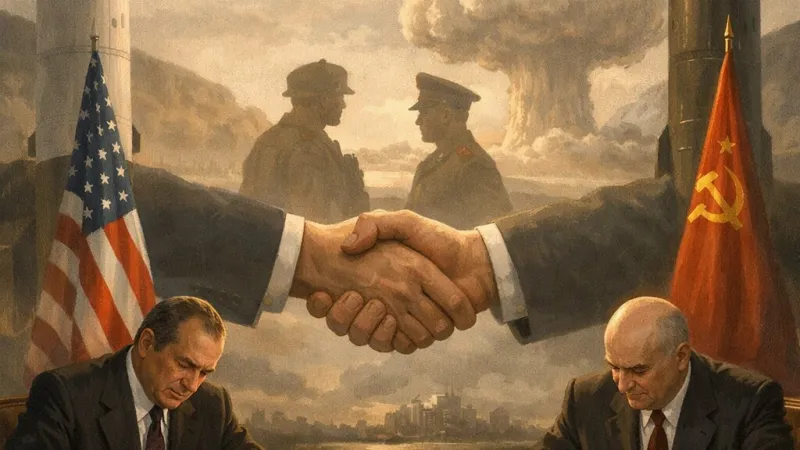
At its core, the Strategic Arms Limitation Treaty was an ambitious attempt to put brakes on the spiralling nuclear competition. The agreement, finalised in May 1972 during the historic Moscow summit, comprised two main elements: the Anti-Ballistic Missile (ABM) Treaty and an Interim Agreement on strategic offensive arms.The ABM Treaty limited both nations to two sites each where ABM systems could be installed, with strict caps on the number of interceptors and launchers. ABMs, designed to shoot down incoming nuclear missiles, were seen by strategists as potentially destabilising — if one side could shield itself, it might be tempted to strike first, shattering the precarious balance. By restricting ABMs, the treaty enshrined the logic of mutual vulnerability, an uneasy but arguably safer equilibrium.
The Interim Agreement set ceilings on the number of ICBMs and SLBMs each side could deploy — essentially freezing both arsenals at existing levels for five years. For example, this meant that the United States was limited to 1,054 ICBM launchers, while the Soviets could maintain 1,618. No further construction of launchers was permitted, though upgrades and replacements were allowed within those numbers. Importantly, the treaty did not cover newly developed multiple independently targetable re-entry vehicles (MIRVs) nor did it place limits on bombers or smaller, “tactical” nuclear weapons.
An innovation within SALT 1 was the provision for national technical means of verification — essentially, allowing satellites and other intelligence-gathering tools to monitor compliance. While no on-site inspections occurred, this tacit acceptance of “spying” marked a significant shift towards transparency, if not outright trust.
---
III. Immediate Impact of SALT 1 on US-Soviet Relations
The signing of SALT 1 was greeted, both at home and abroad, as a diplomatic triumph. After years of mutual denunciations and military build-up, the treaty was a tangible demonstration that the United States and Soviet Union could find common ground, even at the height of their ideological rivalry. British academic and historian Sir Lawrence Freedman observed that SALT 1 “created a framework for regular dialogue, breaking the cycle of provocation and reaction.” On a practical level, capping launchers and restricting ABMs slowed the quantitative pace of the arms race, allowing both sides a degree of reassurance.Though the treaty did not roll back existing arsenals, it checked further expansion and stabilised the technical balance. Just as crucial was the psychological impact: ordinary citizens, politicians and allied leaders alike found renewed hope that nuclear Armageddon was not inevitable. British newspapers of the day, such as The Times, reflected widespread relief, while also warning against complacency.
SALT 1 also served as a springboard for further negotiations. Its apparent success cleared the path for the more ambitious, if ultimately troubled, SALT 2 negotiations, reaffirming the value of diplomatic engagement.
---
IV. Broader Significance of SALT 1 Beyond Arms Control
Looking beyond its immediate results, SALT 1 heralded a new era in international security architecture. The notion that adversaries could agree limitations upon their most fearsome weapons influenced other nations and solidified momentum towards greater multilateral arms control. For instance, the Helsinki Accords of 1975, which involved European states, built upon the spirit of dialogue and restraint fostered by SALT 1. In the UK, the treaty influenced debates on Britain’s own nuclear deterrent and its role within NATO, as policymakers weighed the balance between national defence and international stability.Economically, SALT 1 allowed both superpowers to temper their defence budgets, offering an opportunity — albeit a temporary one — to redirect resources toward domestic priorities. This was particularly important for the Soviet Union, which was facing mounting strains within its planned economy. In Britain, political watchers observed that detente relieved some of the pressure to drastically expand the UK’s own nuclear capacity.
Politically, SALT 1 became a tool for each side to project responsibility and statesmanship. For Nixon, negotiating with Brezhnev bolstered his image as a global leader capable of peaceful engagement, while for Brezhnev, the agreement allowed him to assure hardliners that Soviet security was not compromised. The principles forged in the treaty provided a template for addressing regional conflicts, from the Middle East to South-East Asia.
---
V. Criticisms and Limitations of SALT 1
Despite its historic nature, SALT 1 was fraught with limitations. Critics pointed out multiple loopholes: it failed to cover significant categories of weapons, such as the newly emergent MIRVs and shorter-range nuclear missiles. Some argued that freezing numbers did little to counter qualitative improvements. In practice, both nations utilised permitted “modernisation” to maintain or even boost the lethality of their arsenals.Problems of interpretation and verification soon surfaced. Without formal on-site inspections, suspicions of clandestine cheating lingered. Voices within each country — especially military hawks and political conservatives — decried the treaty as lopsided or insufficiently secure. The American Secretary of Defence at the time, Melvin Laird, confessed his “nagging doubts” about the Soviets’ intentions, while Soviet generals remained equally wary of Anglo-American technological advantages.
Debate raged over whether SALT 1 truly increased security or simply provided a veneer of restraint while both sides innovated outside the treaty’s remit. Yet, for all its flaws, the treaty was the best that could be forged given the prevailing contexts of distrust and power politics.
---
VI. Legacy and Historical Assessment
In retrospect, SALT 1’s ultimate legacy was its role as a foundation stone for subsequent arms control efforts. Though the 1979 SALT 2 agreement would flounder in the wake of renewed tensions (notably the Soviet invasion of Afghanistan), the processes, principles, and verification mechanisms pioneered by SALT 1 shaped the later successes of the Intermediate-Range Nuclear Forces (INF) Treaty and the Strategic Arms Reduction Treaties (START) of the late 20th century.SALT 1’s spirit of negotiation contributed to the gradual reduction of Cold War tensions during the 1970s, even as the arms race flared anew in the 1980s. For today’s policymakers, the challenges of nuclear proliferation, missile defence, and verification remain pressing. While the strategic landscape has changed, with Britain, France, China, and newer powers seeking deterrence, the enduring lesson of SALT 1 is that even the fiercest rivals must talk, compromise, and seek manageable limits for the sake of humanity.
---
Conclusion
In sum, the significance of SALT 1 lies not only in its direct limitations on superpower arsenals but in its wider impact upon diplomacy, security, and international relations. It opened a path for dialogue where confrontation had seemed inevitable, and for the first time placed enforceable limits on the most dangerous instruments of war the world had ever known. While imperfect and disputed, its very existence was a triumph of pragmatism over fatalism.For students, teachers, and citizens in Britain and beyond, SALT 1 stands as a powerful reminder that negotiation and moderation can temper even the most intractable conflicts. As the world faces new dangers and new forms of rivalry, the principles underlying SALT 1 remain as relevant as ever: ultimately, the pursuit of peace demands neither naivety nor cynicism, but the patient conviction that even sworn enemies can — and must — find ways to live with each other, rather than to die together.
Rate:
Log in to rate the work.
Log in