Exploring Gender Perspectives in Historical Analysis for a Balanced Past
This work has been verified by our teacher: 1.04.2026 at 9:01
Homework type: History essay
Added: 31.03.2026 at 8:07
Summary:
Discover how applying gender perspectives in history reveals balanced, inclusive insights into Britain’s past, enriching your understanding of historical analysis.
A Gender Approach in Historical Analysis: Understanding the Interplay of Men and Women in Shaping the Past
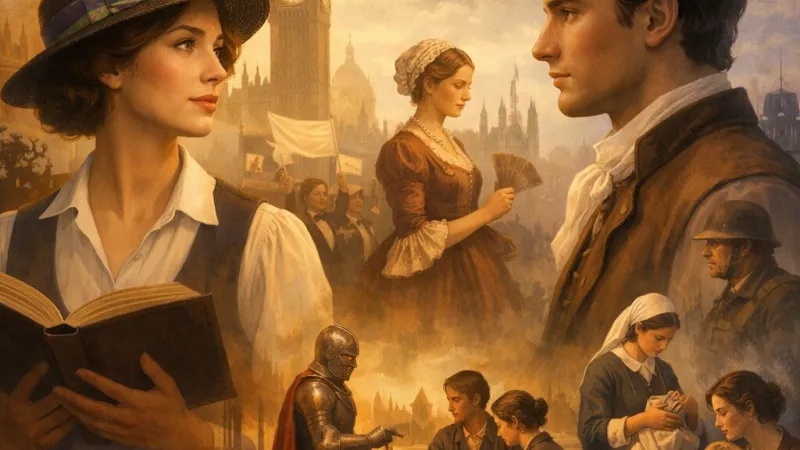
The study of history is an ever-evolving practice, shaped as much by the questions we pose as by the sources we examine. In recent decades, historians in the United Kingdom and beyond have adopted what is commonly known as a "gender approach" in order to expand the scope of historical analysis. Rather than focusing solely on the achievements, experiences, and perspectives of men, this approach seeks to weave male and female narratives together to form a more intricate and truthful tapestry of the past.
By adopting a gender lens, historians challenge the conventional, and often restrictive, frameworks that prioritised singular interpretations rooted in masculine experiences. The intention behind adopting such a perspective is not simply to "add women and stir" but to reconceptualise the way in which all actors—regardless of sex or gender—contribute to historical processes. Furthermore, it pushes us to transcend adversarial or binary thinking, prompting us to examine how gender identities and relations collectively shape, and are shaped by, broader societal currents.
This essay aims to explore the richness that emerges from applying a gender approach to historical inquiry. Through a careful consideration of theory, sources, and illustrative examples from British and European contexts, the discussion will demonstrate the nuances of gender as a lens, assess its advantages and limitations, and argue for its continuing relevance and necessity in historical scholarship.
---
Defining the Gender Approach in History
To fully appreciate the importance of a gender perspective within history, it is first necessary to clarify its meaning. In historical scholarship, the term "sex" refers to biological attributes typically classed as male or female, whilst "gender" describes the social and cultural meanings attached to those physical differences. Gender is not a fixed identity; it is constructed and reconstructed across different eras and places—a point demonstrated by how femininity in the medieval period differs markedly from Victorian notions or contemporary understandings.Traditional historical narratives often centred on events and figures deemed significant—monarchs, military leaders, and statesmen—overwhelmingly casting men as active participants in shaping the nation’s trajectory. For instance, British curricula long revolved around tales of Henry VIII, the Napoleonic Wars, and the Industrial Revolution, frequently sidelining or even erasing female agency. The inception of gender-focused history emerged as a remedy to these biases, striving to recover and reinterpret the lives, actions, and influences of those rendered invisible by earlier accounts.
Pioneers of this approach developed innovative methodologies, drawing attention not only to women's exclusion but to how gendered norms informed politics, work, family, and cultural life. Rather than operating as supplementary or corrective, this scholarship recognises that all historical actors, whether male or female, were affected by prevailing notions of gender.
---
Theoretical Frameworks for a Gender Approach
Several theoretical frameworks underpin this approach and help reveal the complexities of gender in historical settings. Intersectionality, for instance, allows historians to consider how multiple axes of identity—such as social class, ethnicity, and sexuality—interact with gender to produce different forms of experience. In the case of Britain, the gritty realities confronting a Victorian working-class woman in Manchester could diverge radically from those facing her aristocratic counterpart in Somerset, differences exacerbated by both gender and class position.Social constructivism further posits that gender roles and expectations are products of cultural and historical processes. Feminist historiography, which initially underpinned much gender research, exposes patriarchal undercurrents whilst striving for inclusivity—to examine both men's and women's positions relative to power, not merely their opposition.
A particularly fruitful avenue is the idea of gender relations as entangled and dynamic. Instead of a simple hierarchy, this approach views masculinity and femininity as mutually influential, constructed in relation to one another. Historians attending to gender often scrutinise textual language, religious symbolism, legal codes (such as the 19th-century Married Women’s Property Acts), and social rituals to uncover how societies defined and enforced gendered expectations.
---
The Roles of Men and Women: Beyond Binary Opposition
Historically, the spheres occupied by men and women were rarely as rigidly separate as formerly believed. Consider the medieval English manor; whilst men might manage the land, women’s economic roles—as brewers, healers, merchants, and estate managers—were crucial to the household and local community. Such realities challenge the simplistic stereotype of women's activity being uniformly private or subordinate.Political influence, likewise, was not always confined to male hands. Aristocratic women, from Eleanor of Aquitaine to Bess of Hardwick, exercised considerable sway over estate affairs, marriages, and patronage. On a communal level, the suffragette movement, typified by organisations such as the Women’s Social and Political Union, highlights both the collective struggle and the collaborations—sometimes fraught—between men and women striving for democratic reform.
Religious and cultural norms, too, shaped and were shaped by gender assumptions. The gendering of religious offices, legal punishments, and even folklore offers rich ground for analysis. The construction of masculine ideals—whether the chivalrous knight or the rational Enlightenment philosopher—demonstrates that men, as much as women, were subject to cultural expectations. There are revealing instances, such as women working in heavy industry during the two World Wars, where necessity blurred and redefined accepted gender boundaries. Men, too, sometimes adopted caregiving roles due to wartime absences, highlighting that gender identities are neither innate nor immutable.
---
Gender Relations and Social Change
Societies are not static; shifts in gender relations frequently preface or accompany significant transformations. The erosion of rigid stereotypes has often followed broader social changes—industrialisation, workplace reforms, and wars all intensified reconsiderations of what men and women could, and should, do. The deconstruction of patriarchal norms opened public life to more women, seen in growing female literacy in the 19th century, access to education via institutions like Girton College (Cambridge), and women moving into political advocacy.Pivotal historical episodes illuminate how gender questions intersected with power and ideology. The witch trials of the 16th and 17th centuries, for example, reflected anxieties over female agency, religious orthodoxy, and social change, often targeting vulnerable women but also some men perceived as transgressive. Similarly, the suffrage campaigns and legislative reforms of the early 20th century reconfigured public and private life, not only expanding women’s rights but also catalysing new debates over men’s roles.
Importantly, changes were not the result of one-sided struggle. Both men and women participated in, benefited from, and sometimes resisted reforms. Understanding the ways in which their interests aligned or diverged tells us far more about historical evolution than the simplistic trope of perennial "war between the sexes".
---
Applying the Gender Approach: Methodological Considerations
Employing a gender approach requires careful attention to methodological detail. Many historical sources are silent, partial, or openly biased regarding women's and even some men's experiences, necessitating creative approaches to research. Diaries, oral histories, court records, and personal letters offer vital insights, often contradicting or complicating official records. For instance, the testimonies of working women strike leaders offer a precious counterpoint to Parliamentary debates or business records.To unearth implicit gender assumptions, close attention to language and framing is vital: how did observers describe "ideal manhood" or "proper femininity"? Furthermore, it is crucial to avoid simply privileging women’s perspectives as a corrective. Instead, a genuinely gendered history examines the full spectrum, resisting the temptation to invert established biases.
Finally, context is indispensable—a practice that dismisses the centrality of time and place risks distorting evidence. Notions of gender in Tudor London are not directly transferable to contemporary Manchester or colonial Bengal, and sensitivity to difference keeps analysis grounded and nuanced.
---
Advantages of the Gender Approach in History
Adopting a gender perspective leads to richer, more balanced histories. It exposes the agency of individuals regardless of gender, allowing for a dynamism too often lost in traditional narratives. The interdependency of gender roles—how women’s work enabled men’s public endeavours, and vice versa—brings fresh clarity to social structures. These insights prove invaluable not only in historical analysis but for interdisciplinary dialogue with fields such as sociology, anthropology, and gender studies.Moreover, tracing the roots and evolution of gender inequalities equips us to better address present-day questions of equality and representation. Understanding women’s exclusion from property or parliamentary rights, and the shifting construction of masculinity, underpins contemporary debates in classrooms, policy-making, and activism.
---
Potential Limitations and Critiques
Despite its merits, the gender approach is not without pitfalls. There is a danger in overemphasising gender to the neglect of other factors such as class, ethnicity, or economics. It may at times risk essentialising or stereotyping, especially when contemporary theories are imposed without regard to historical context. Some critics charge that gender history can be narrowly focused or indulge in presentism, but these are not inescapable flaws; they can be combatted through reflexivity, interdisciplinarity, and rigorous source evaluation.---
Conclusion
The application of a gender approach has transformed historical scholarship, not by simply amplifying women’s voices, but by compelling us to reconsider the architecture of power, identity, and agency. Acknowledging both male and female perspectives, in all their variety, allows for a deeper appreciation of the forces—visible and unseen—that have shaped societies past and present.Ultimately, ongoing critical engagement and originality are key. Only by diligently interrogating sources, questioning assumptions, and embracing complexity can we hope to reconstruct a history that is truly representative. The gender approach remains a vital tool for historians determined to understand, rather than merely recount, the stories of the past.
Rate:
Log in to rate the work.
Log in