Key Dates that Shaped the African American Civil Rights Movement
This work has been verified by our teacher: 5.04.2026 at 17:15
Homework type: History essay
Added: 3.04.2026 at 13:40
Summary:
Explore key dates that shaped the African American Civil Rights Movement and learn how pivotal events advanced equality and justice in history.
A Critical Chronology of the African American Civil Rights Movement: Key Dates and Their Legacy
The pursuit of civil rights for African Americans is a compelling testament to resilience in the face of ingrained injustice. Following the abolition of slavery in the United States, the promise of freedom was all too often accompanied by a grim reality of continued discrimination, social exclusion, and legal segregation. The subsequent battles for equality, waged in courtrooms, in the streets, and through the ballot box, would shape not just American history, but global consciousness on issues of justice and human dignity. In tracing the milestones of this movement, we unravel the interplay between high-profile legal decisions, grass-roots activism, and seismic shifts in public attitude. This essay critically explores the pivotal dates marking triumphs and setbacks, examining not just the outcomes but also the complex social currents that drove or impeded progress. From the immediate aftermath of emancipation to the contemporary era of new activism, the African American civil rights movement’s chronology offers insights that continue to resonate—reminding us that justice is rarely won overnight and that every right achieved demands vigilance to be maintained.
The Immediate Post-Civil War Era: Foundations of Legal Equality (1865–1877)
The defeat of the Confederacy in 1865 ended formal slavery but it did not herald an unqualified dawn of freedom. Instead, the period known as Reconstruction (1865–1877) was marked by an intense contest between hopeful reform and white resistance. The ratification of the 13th Amendment in December 1865 marked the legal abolition of slavery, anchoring a new constitutional order. Yet, the provisions of the amendment, though transformative, were met with determined opposition, particularly across former Confederate states, where ‘Black Codes’ sought to limit black Americans’ newfound liberties.The subsequent passage of the 14th Amendment in 1868, guaranteeing citizenship and the equal protection of the law, and the 15th Amendment in 1870, which barred racial discrimination in voting rights for men, signalled an extraordinary assertion of egalitarian principles. However, these constitutional victories proved brittle in practice. Mechanisms such as poll taxes, literacy tests, and outright violence ensured that the right to vote remained largely theoretical for many African Americans, especially as federal commitment to enforcement waned.
The Civil Rights Act of 1866 deserves special mention for affirming the rights of freedpeople to own property and seek redress in court. Even so, the limitations of enforcement became starkly apparent as southern states devised new ways to circumvent these protections, with the withdrawal of federal troops in 1877—marking the end of Reconstruction—underscoring this retreat. With their departure, white supremacist groups and political compromises ushered in the Jim Crow era, laying the foundations for a century of systematic disenfranchisement and social exclusion. The cautionary tale of Reconstruction thus encapsulates the need for sustained commitment if legal advances are to endure beyond the page.
The Institutionalisation of Segregation and Legal Challenges (1896–1930s)
The hope kindled by the early constitutional amendments was dashed by the United States Supreme Court’s fateful decision in Plessy v. Ferguson (1896). Homer Plessy, supported by the Comité des Citoyens, had challenged Louisiana’s segregation of railway carriages. In upholding the pervasive ‘separate but equal’ doctrine, the Court provided a legal fig leaf for a sprawling architecture of racial segregation, which extended from railway compartments and schools to public lavatories and theatres. Lawrence’s *To Sir, With Love*, while set in post-war London, offers an instructive parallel in its depiction of institutional prejudice and the ways in which legal equality does not always yield substantive fairness.In practice, the ‘separate’ was all too real, and the ‘equal’ all too fictional. Black schools and facilities were invariably of a far lower standard, a pattern reminiscent of the historic underfunding of rural schools in England prior to 1944's Education Act, though now rooted in the explicit ideology of racial hierarchy. Facing walls of both law and violence, African Americans found few avenues for redress in Southern courts. Nonetheless, landmark legal struggles began to emerge. The case of the Scottsboro Boys (1931–1937) involved a group of black teenagers falsely accused of raping two white women in Alabama. Despite inconsistent testimony and an absence of evidence, their initial convictions starkly illustrated the deep-seated racism not only in society, but within the ‘impartial’ system of justice. The NAACP and International Labour Defence, by mounting high-profile legal defences and attracting international attention, laid the groundwork for later appeals to the courts as instruments of social change.
Though most legal battles failed to immediately overturn discriminatory laws, persistent challenge established important precedents and helped galvanise a new generation of activists. The courts, far from being simply obstacles, became arenas of contestation—a reality mirrored in Britain by the gradual extension of civil liberties only after protracted legal and political struggle.
The Early Civil Rights Movement: Legal and Social Activism (1940s–1950s)
The decades following World War II witnessed a growing willingness to confront systemic injustice through both legal and popular mobilisation. The horrors of Nazi racial ideology rendered American hypocrisy over race increasingly untenable, both at home and in the eyes of the world. The tide first turned decisively in the 1954 Supreme Court case Brown v. Board of Education. Overturning Plessy at last, the justices unanimously declared segregated schools ‘inherently unequal’. This legal victory drew on innovative sociological testimony—most famously the ‘doll tests’ of psychologists Kenneth and Mamie Clark—demonstrating the psychological damage inflicted by segregation on black children.The ruling kindled both hope and rage, met with often violent ‘massive resistance’ in the South. Only months later, Rosa Parks’ quiet refusal to yield her seat on a Montgomery, Alabama bus in 1955 triggered a 381-day boycott. Here is a remarkable example of grass-roots organisation: relying on word-of-mouth, church meetings, and local leadership from the nascent Martin Luther King Jr., Montgomery’s black population crippled the city’s transport system and inspired similar action elsewhere. The British tradition of nonviolent protest, from the suffragettes to later anti-racist campaigns, finds echoes here in the combination of dignity and defiance.
The next flashpoint came with the Little Rock Nine in 1957: nine black students braved jeering crowds and the hostility of Arkansas’s governor to enter the previously whites-only Central High School. President Eisenhower’s decision to deploy federal troops marked a turning point in federal enforcement of civil rights, highlighting the tension between state and national authority—a theme not unfamiliar to those who consider the tensions between Westminster and local authorities in periods of social reform.
In summary, this period marked a critical shift from litigation alone to mass participation, as well as the growing influence of media imagery in shaping public opinion—much as the arrival of television influenced attitudes in Britain to social change, from the abolition of capital punishment to the campaign for homosexual law reform.
The Height of the Civil Rights Movement: Major Events of the 1960s
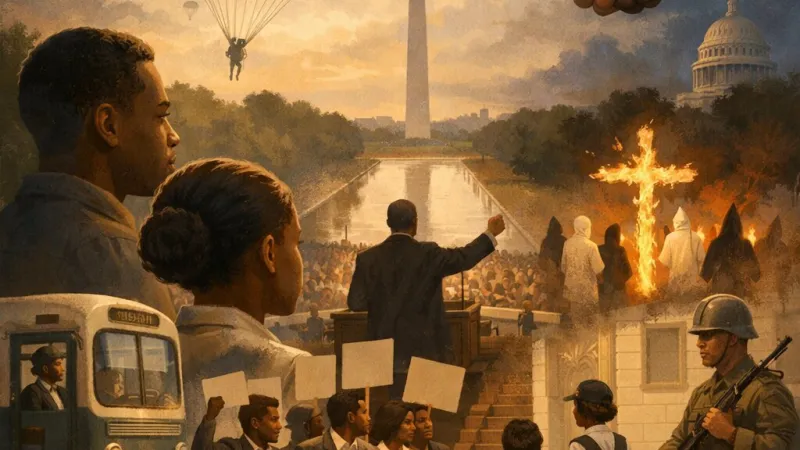
The 1960s were arguably the apogee of the civil rights movement, a period ablaze with sometimes tragic, often heroic, energy. In 1962, James Meredith, under the shadow of federal marshals and violence, became the first African American to enrol at the University of Mississippi, breaking the de facto college colour bar of the South. The tumultuous events in Birmingham, Alabama, in 1963—a deliberate campaign for desegregation chosen because of the city’s notorious hostility—produced ugly images of fire hoses and police dogs unleashed upon peaceful protesters, including children. Such imagery, beamed to homes across America and around the world, proved the moral bankruptcy of segregationist claims and won powerful sympathy for the movement.In August 1963, the March on Washington drew more than 200,000 people to the Lincoln Memorial, where Martin Luther King Jr.—in a rhetorical style reminiscent of some of British oratory’s finest moments—entranced the crowd with his “I Have a Dream” speech. This new spirit bore legislative fruit: the Civil Rights Act of 1964 outlawed discrimination in public spaces, education, and employment, and created the Equal Employment Opportunity Commission for enforcement—a bureaucratic development not dissimilar, in its centrality, to the creation of the Commission for Racial Equality in the UK. The fight for voting rights culminated in the 1965 Voting Rights Act, targeting longstanding barriers such as ‘literacy’ tests. Taken together, these were seminal shifts, backed now by the machinery of the state.
There were further milestones: the 1967 Supreme Court decision in Loving v. Virginia dismantled bans on interracial marriage, an echo of legal struggles for interracial harmony that Britain, in its own way, faced with the arrival of Commonwealth immigrants.
Throughout this era, a synergy grew between popular mobilisation, legal action, and political will, as Washington moved from hesitancy to full engagement. Yet this was no neat arc: the movement provoked fierce counter-reaction, and the late 1960s saw both landmark laws and tragic assassinations.
Civil Rights Evolutions and Challenges in the Late 20th Century
Change brings both hope and new challenges. The 1991 Rodney King incident in Los Angeles—when amateur video showed police officers brutally beating an unarmed black motorist—unleashed days of rioting after the officers’ acquittal. Here, technology played a role similar to that of the printed press in earlier decades: exposing truths long denied and shaking confidence in the impartiality of institutions. If the legal advances of the 1960s seemed to fulfil the movement’s aims, events like these underscored the persistence of institutional racism and the need for further activism.Successive generations of campaigners have drawn upon the legacy of those who marched and litigated before them, from the Black Power movement to the contemporary Black Lives Matter movement. As British campaigns against police discrimination in places like Brixton and Liverpool have shown, the challenge of uprooting systemic inequality is persistent and internationally resonant. The struggle continues, requiring vigilance long after headline victories.
Conclusion
The chronology of the African American civil rights movement, from the broken promises of Reconstruction to the firebrand activism of the 1960s and beyond, paints a picture of hard-won progress constantly at risk of reversal. Legal and political changes have delivered undeniable advances, but the quest for true equality is neither linear nor complete. From the polling booth to the classroom, from courtrooms to communities, each milestone has been both a step forward and a reminder of the work yet to come. This is a history not just of America, but of all societies confronting the legacy of exclusion. As students in Britain, we might not share the precise contours of the American struggle, but its themes—justice, dignity, persistence—ring true in every fight for equality. The movement’s lessons urge us to remain alert: that freedom, once attained, must be defended as fiercely as it was won.---
Suggestions for Further Study
- A chronological timeline mapping major events, legislative changes, and court decisions for detailed study. - Biographies of leading figures, such as Martin Luther King Jr., Rosa Parks, Thurgood Marshall, and contemporary activists. - Comparative studies with other rights movements, such as the British anti-racist struggle or the campaign for women’s suffrage.In examining these milestones, we honour not only the victories achieved but also the enduring necessity of vigilant activism in the ongoing pursuit of justice and equality.
Rate:
Log in to rate the work.
Log in