Edward VI's Reign: Challenges and Religious Reforms in Tudor England
This work has been verified by our teacher: 15.04.2026 at 15:49
Homework type: History essay
Added: 14.04.2026 at 9:59
Summary:
Explore Edward VI's reign challenges and religious reforms in Tudor England, understanding political intrigue, regency struggles, and key historical impacts.
The Brief and Turbulent Reign of Edward VI: A Critical Assessment of Challenges, Reforms and Political Upheaval (1547–1553)
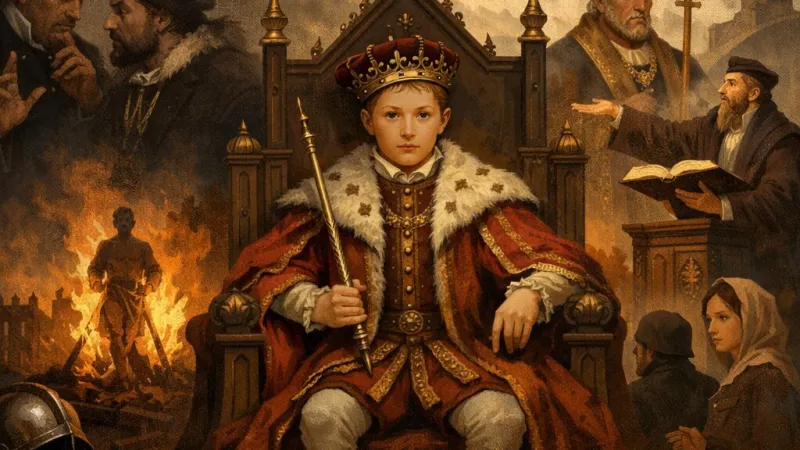
England in the mid-sixteenth century stood at a crossroads. Following the death of the indomitable Henry VIII in 1547, his only son, the nine-year-old Edward VI, became king—the first English monarch to be raised a convinced Protestant and educated in the humanist tradition. Yet Edward’s youth meant that, in effect, his reign would be defined by those who governed in his name, first the ambitious Duke of Somerset and later the calculating Duke of Northumberland. The short years between 1547 and 1553 would see dramatic religious innovation, deep social discord, failed foreign adventure and cutthroat political intrigue, all framed by the inexperience and fragility of a boy king at the centre of events. In examining Edward VI’s reign, it is necessary to explore the manifold and knotty challenges of the regency, the ambitions of his protectors, the collision between old and new faiths, and the social trials that would leave an indelible mark on the Tudor state.Regencies and Rivalries: The Problem of Royal Minority
The Tudor dynasty had rarely faced a situation so fraught as the succession of a child. Henry VIII’s final will devised a Regency Council to safeguard Edward’s position and to ensure that power was shared among the kingdom’s most powerful nobles. This council included men such as William Paget, Thomas Wriothesley, Archbishop Thomas Cranmer and others, representing both reformist and more conservative tendencies. However, practical reality rapidly overtook theory. Edward Seymour, elder brother to Jane Seymour (Edward’s mother), seized the initiative within weeks of the old king’s death, engineering his own appointment as Lord Protector. By a combination of political calculation and careful manipulation—involving, it is said, the employment of Henry’s Great Seal on blank sheets of paper—Somerset ensured that authority would be concentrated in his hands and, for a crucial period, bypassed collective rule.Somerset’s dominance was initially tolerated due to his blood relationship with Edward, perceived military prowess and apparent dedication to the new king’s welfare. Nevertheless, his high-handed style, tendency to act unilaterally and disregard for advice soon bred resentment within the Privy Council. Government, once projected as collaborative, became instead an unstable battleground of ambition and suspicion, the king’s minority providing fertile soil for old rivalries and new dangers.
Factionalism and Intrigue: The Regency in Disarray
Nowhere was the instability of the regency more apparent than in the Seymour family itself. Somerset’s brother, Thomas Seymour—envied and scheming—grew resentful at being denied a share of power. Made Lord High Admiral, Thomas courted the young king directly, seeking influence and even attempting to marry Elizabeth (later the celebrated “Gloriana”), a match which, if successful, would have propelled him to the heart of the crown. His reckless plot to kidnap Edward was swiftly uncovered. The details, preserved in state papers and ambassadorial reports, show a man acting out of both personal frustration and genuine political ambition. Convicted of treason, Thomas was executed in 1549, an early and telling illustration of how the supposed unity of Edward’s protectors was but a façade.Factional tensions deepened as Somerset’s grip faltered. His persecution of rivals—such as the Catholic Earl of Southampton and Thomas Wriothesley—alienated key sections of the court and created space for John Dudley, Earl of Warwick (later Duke of Northumberland), to begin amassing patronage and support. Dudley, more tactically astute, perceived that Somerset’s isolation, together with mounting dissatisfaction over his handling of government, was an opportunity for political ascent. Indeed, Somerset’s distracted rule, surrounded by enemies, became increasingly ineffective, so much so that even the king’s boyish entries in his Chronicle hint at the uncertainty of these years. Factional governance, rife with plots and counter-plots, weakened the machinery of state and diminished public confidence at a time when resolute leadership was most needed.
Foreign Policy Failures: Ambition Confronted by Reality
Somerset, riding the wave of English martial pride, sought to force a dynastic union between England and Scotland by imposing his nephew’s marriage to the infant Mary, Queen of Scots. This “Rough Wooing”, as it became known, was a continuation of Henry VIII’s ambitions, aiming to ensure peace (and Protestantism) through alliance. Early successes, such as the victory at the Battle of Pinkie Cleugh (1547), masked longer-term failures. Scottish resistance hardened, fortresses were costly to garrison and supply, and the ever-reliable Auld Alliance with France meant that English troops faced both highlanders and continental reinforcements.French intervention under Henry II not only revived Scottish spirit, but also posed a direct threat to English-held territory on the continent. Military overstretch forced the government to debase the coinage repeatedly, devaluing the pound and triggering a wave of inflation across the land. While Somerset hoped military glory would mask economic strain, the mounting costs of war exacerbated social tensions and began to corrode the perception of Tudor strength abroad. As historian Geoffrey Elton once remarked, “Somerset believed himself the new Cromwell, but acted rather as the old Talbot at Castillon—engulfed by continental realities, ending in defeat.”
Religious Revolution: Protestant Ascendancy and its Consequences
The most visible and enduring legacy of Edward’s reign lies in the dramatic advance of Protestantism. Somerset and his circle—strongly influenced by humanist scholarship and the radicalism of reformers such as Cranmer—pushed the programme of religious change far beyond what had occurred under Henry VIII. The Injunctions of 1547 ordered the removal of images from churches, the destruction of relics, the abolition of candle-lit altars, and the opening of the Bible to all the people, translated into the vernacular. The same year, the dissolution of chantries—the endowments that funded prayers for souls in purgatory—struck a blow not only at Catholic theology but also at the social fabric of many towns, as the proceeds were diverted to the crown to pay for war.Perhaps the defining act was the publication of the Book of Common Prayer in 1549. Composed primarily by Cranmer, this liturgical innovation replaced the ancient Latin rites with English, enshrining congregational participation and distinctly Protestant doctrine. The first Act of Uniformity (1549) demanded its use in every parish. While for many these changes promised spiritual renewal, for others—particularly in rural communities—a sense of being force-marched into unfamiliar worship bred alienation and resistance.
Unrest in the Shires: The Tumultuous Summer of 1549
Religious disturbance was matched by profound social unrest. The twin pressures of inflation and enclosure—the practice of converting open fields and common pastures into private sheep runs—brought misery to those least able to bear it. Taxes on sheep, designed to control enclosure, instead provoked fierce opposition. It was in this febrile atmosphere that two major rebellions erupted. The Western, or Prayer Book, Rebellion (1549) centred on Devon and Cornwall, was fuelled by both religious conservatism and economic distress. Insurgents demanded the restoration of Catholic mass and denounced the prayer book as alien and heretical. Contemporary chronicles record their rallying cry: “We will not receive this new learning, for it is but like a Christmas game!” The government’s response was sluggish—Lord Russell was hampered by a lack of troops and supplies. Eventually, decisive and bloody repression at Clyst Heath crushed the insurgency, but not before revealing the depth of conservatism beyond London.At the same time, in Norfolk, Kett’s Rebellion—named after Robert Kett, a disillusioned yeoman—assembled thousands of men on Mousehold Heath near Norwich. These protestors were less concerned with liturgical reform and more with social justice. Their demands included an end to enclosure and the punishment of greedy landlords and corrupt officials. Remarkably, Kett maintained discipline and order, establishing a quasi-parliament and dispensing justice in Edward’s name. Here was evidence not just of anger but also of a real yearning for a responsive, accountable local government. The rebellion was ultimately quashed by Dudley after prolonged fighting and heavy loss of life.
The failure to resolve these grievances peacefully fatally weakened Somerset, who was blamed for both the causes and the sluggishness of the royal response. His reputation, undermined by forceful yet inept attempts at reform, never fully recovered.
From Somerset to Northumberland: The Shifting Sands of Power
By the close of 1549, Somerset’s authority had all but collapsed. Having retreated to Windsor with the young king in a clumsy bid to retain control, he was beset by conspiracies within council and court—a virtual palace coup. John Dudley, buoyed by the kudos from suppressing rebellion, placed himself at the head of a more disciplined and pragmatic administration. The transition was not bloodless: Somerset, initially spared the scaffold, was finally executed in 1552 after a fresh bout of conspiratorial activity. Dudley’s rule, in turn, would prove no less turbulent, though his methods were more subtle, using the Privy Council to broaden responsibility and bringing in able administrators such as William Cecil.Under Northumberland, the government proceeded with the Protestant reforms at pace. More radical changes—such as the removal of altars and the introduction of the Second Book of Common Prayer in 1552—deepened the Protestant identity of the Church of England, augmenting the transformations begun by Somerset.
Legacies: Lasting Change and Unfinished Business
Edward VI’s reign, though brief, set precedents and currents which shaped the Elizabethan settlement and beyond. The forceful, top-down imposition of Protestantism ensured that, even after Mary I’s Catholic reaction, England would not return to its pre-Reformation state. The English liturgy, the character of parish life, the role of the monarch as Supreme Governor—all were defined, at least in embryo, by the years of Edward’s regency. Politically, the experience demonstrated the dangers of personal rule without consensus, and the capacity for noble factions to exploit a ruler’s minority. Socially, the decade brought home the potentially explosive consequences of economic mismanagement and the failure to heed popular grievances.Edward’s own role, apart from sporadic entries in his Chronicle and the testimony of ambassadors, was that of a scholarly, pious observer—his precocity and seriousness noted by all, but his agency circumscribed by council politics and poor health. He died in July 1553, not yet sixteen, his kingdom more Protestant but more divided than ever.
Conclusion: Edward VI—A Reign Between Worlds
Edward VI’s six years as king were marked by ambitious reform and profound discord. His protectors wrestled with one another for power, and their rivalries often crippled effective governance. Desperate foreign policy adventures drained the treasury, provoking inflation and hardship. Attempts to force religious uniformity produced uprisings which almost spun the country out of control. Yet amidst the failures lay progress: the foundations of Protestant England, the beginnings of a more modern polity, and instructive lessons—so soon learned by Mary, and perfected by Elizabeth—about the perils and possibilities of governing in uncertain times.The regency of Edward VI thus stands as both a cautionary episode and a vital turning point in Tudor history: a period when old certainties crumbled and new forms, both dangerous and hopeful, began to emerge. That turbulence would echo through English society for a generation, but the spirit of innovation—if not always the wisdom—remained. In the end, the reign of Edward VI, overshadowed by the ambition of his council and the misfortunes of his people, was nothing less than the nursery ground for the religious and constitutional order that would define England’s future.
Rate:
Log in to rate the work.
Log in