Exploring the Causes and Impact of China's Cultural Revolution
This work has been verified by our teacher: 15.04.2026 at 16:26
Homework type: History essay
Added: 14.04.2026 at 11:05
Summary:
Discover the causes and impact of China's Cultural Revolution, understanding its political power struggles and lasting effects on Chinese society and history.
The Cultural Revolution: Origins, Causes, and Aims
The Cultural Revolution (1966–1976), orchestrated by Mao Zedong, stands as one of the most tumultuous and transformative periods in twentieth-century Chinese history. Unlike previous movements within the People's Republic of China, the Cultural Revolution was not merely a response to economic crisis or foreign invasion but a complex campaign shaped by personal ambitions, ideological convictions, political struggle, and social experimentation. In the decade following the catastrophic failure of the Great Leap Forward, Mao found his influence within the Communist Party diminished and the legitimacy of his ideas under intense scrutiny. Against a background of internal party rivalries, lingering aftershocks from political disasters, and mounting external pressures, the Cultural Revolution emerged as a radical project to redefine both China’s social fabric and the enduring legacy of its leaders. This essay will explore the myriad causes and underlying ambitions of the Revolution, analysing the interplay between power dynamics, ideology, cultural transformation, and perceived necessity for radical social reform. By evaluating these interwoven elements, it becomes clear that Mao’s campaign was as much about consolidating personal power as it was about forging a dramatic new identity for his nation.
---
Power Struggles and Political Manoeuvring within the Communist Party
To fully grasp the genesis of the Cultural Revolution, one must first appreciate the intricate power games within the Communist Party of China (CCP) during the early 1960s. The Great Leap Forward, Mao’s earlier attempt at rapid industrialisation (1958–1962), ended in economic disaster and widespread famine. Mao's credibility, once unassailable, was undermined not only in the eyes of the populace — millions perished as a direct result of his policies — but, more crucially, amongst top-ranking party members. Reformers such as Liu Shaoqi and Deng Xiaoping emerged as pragmatic voices, advocating for policies that deviated from Mao’s radical blueprint. Their prominence, exemplified by Liu’s presidency and Deng’s policy reforms, signalled the Party’s shifting allegiances.This decline in authority became especially evident at the 7,000 Cadres Conference in 1962, where Mao found himself on the defensive for the first time; his policies were criticised, and the burden for the Great Leap Forward's failure was shifted towards him. The reformist approach, favouring economic realism over utopian ambition, not only sidelined Mao but introduced genuine alternatives to his leadership. This tension was further fuelled by the interplay of personalities and principle — a classical feature in the annals of revolutionary politics, reminiscent of internal Labour Party struggles post-World War II, where ideological purists clashed with pragmatists.
Faced with this erosion of authority, Mao mobilised the Socialist Education Movement as a tool to recapture ideological territory. Determined to outflank his rivals, he gradually transitioned from policy debate to mass movement. The Cultural Revolution, in this context, can be seen less as a spontaneous outpouring of revolutionary zeal and more as a power play: a mechanism through which Mao could both purge his adversaries and redefine the Party on his terms. The fate of Liu and Deng — subjected to public humiliation, stripped of their positions, and placed under house arrest — typifies the ruthless political calculus behind the campaign. The rawness of these intra-party confrontations recalls the intense infighting of the British political class depicted in works such as Michael Frayn’s play *Democracy*; yet in Mao’s China, such struggles had far graver outcomes. Ultimately, Mao’s drive to reclaim supremacy was both cause and catalyst for the Cultural Revolution.
---
External Influences and Mao’s Fear of Political Downfall
The international context of the mid-20th century had a profound, if sometimes understated, impact on Mao’s thinking. The Soviet Union, China’s erstwhile socialist ally, had just undergone a convulsive leadership shake-up. In 1964, Nikita Khrushchev was overthrown, primarily for the setbacks of his reform campaigns and political missteps. To Mao, Khrushchev’s fall served as a cautionary tale: even the most powerful of communist leaders could be toppled when accused of ‘revisionism’ or departure from revolutionary purity.Paranoia that his own fate might mirror Khrushchev’s crept into Mao’s worldview. The Cultural Revolution, then, must also be understood as a pre-emptive bid for survival. By upending the existing social order — particularly through mobilising China’s youth as Red Guards — Mao effectively constructed an independent power base, loyal to him alone and bypassing established party hierarchies. These young radicals, unleashed upon society at mass rallies such as those at Tiananmen Square in 1966, did not merely chant slogans: they targeted perceived ‘enemies of the revolution’ at every level, from high-ranking officials to school teachers.
This combination of mass mobilisation and orchestrated chaos — what in British history we might compare, far less violently, to the unpredictable energies released during the Miners’ Strikes or the 1968 student protests — was at once political theatre and deadly serious. It permitted Mao to neutralise threats in a manner both public and unanswerable, demonstrating his continuing indispensability to the revolutionary project. Beyond the top leadership, countless intellectuals, academics, and civil servants were purged as paranoia gave way to systematic persecution. The result was a regime where authority could only be assured through perpetual upheaval, a cycle that would have tragic echoes throughout the decade.
---
Mao’s Personal Legacy and Quest for Immortality
The spectre of mortality haunted many great leaders, and Mao was no exception. As he aged and his physical health declined, anxieties about how history would remember him assumed new urgency. The Cultural Revolution, therefore, was not merely a struggle for power in the present but a campaign to shape how future generations would interpret the very meaning of the Communist revolution.Central to this effort was the deliberate cultivation of a cult of personality. Mao’s image adorned household walls, public squares, and schoolbooks; his sayings, collated in the ubiquitous *Little Red Book*, were recited as catechism. The scale and intensity of this adulation — including mass rallies and staged performances — made Mao inseparable from the revolution itself. No figure in modern British political history has commanded such a fusion of ideology and personality, though comparisons with the Royal Family’s role in national ceremonies or the iconography surrounding Churchill after the Second World War offer dim reflections.
Yet there is a darker reading, too. By making himself the focal point of revolutionary virtue, Mao rendered any opposition not merely political dissent but a form of heresy. This lent the Cultural Revolution a feverish, almost religious quality, exacerbating its destructiveness and fostering an atmosphere where critical thought and historical nuance evaporated. In seeking immortality, Mao ironically plunged the country into a period whose wounds — both cultural and personal — would endure for generations.
---
Cultural Transformation and the ‘Four Olds’ Campaign
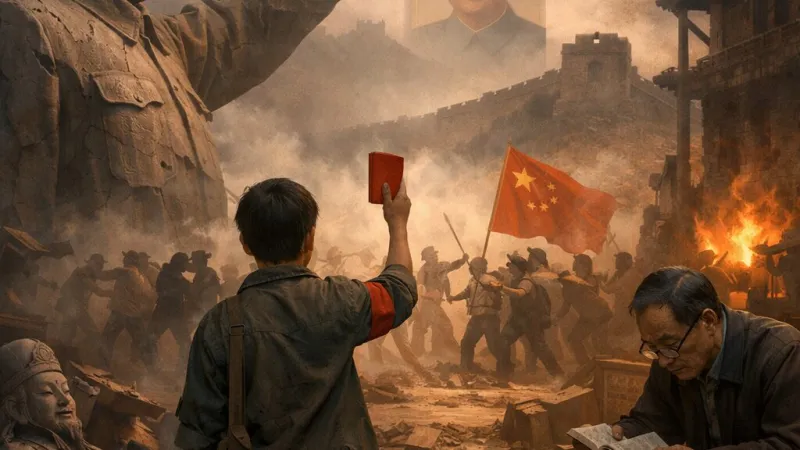
Perhaps the most visible, and devastating, aspect of the Cultural Revolution was the assault on China’s traditional culture, encapsulated in the campaign to sweep away the ‘Four Olds’: old customs, old culture, old habits, and old ideas. With Red Guards as their shock troops, the revolutionaries set about smashing temples, burning ancient texts, and persecuting writers, artists, and scholars. The destruction was reminiscent of the Dissolution of the Monasteries in Tudor England, where religious and cultural heritage was systematically eradicated, though the scope and violence of the Chinese campaign was far greater.The motivations for this iconoclasm were couched in the language of socialist purification and modernisation. Mao’s wife, Jiang Qing, played a leading role in orchestrating revolutionary opera and propagandistic art meant to replace traditional forms with ideological content. In practice, however, the campaign often concealed the darker intent of consolidating social control. By rooting out the building blocks of inherited culture — from family veneration rituals to classical literature — Mao aimed to refashion Chinese society into a tabula rasa, emptied of competing loyalties and values.
The aftermath, however, was not the flourishing of a vibrant new culture but a yawning vacuum. Centuries-old practices and memories were lost in a matter of months, creating not only material devastation but a deep existential trauma. These episodes, like those chronicled in Jung Chang’s *Wild Swans*, testify to the psychological toll wrought upon ordinary Chinese people — particularly the older generations, who saw lifetimes of custom obliterated overnight. The ostensible ‘cultural renewal’ was thus as much an instrument of terror and control as of genuine artistic innovation.
---
Socialist Ideals and Social Reform Efforts
A key plank of the Cultural Revolution was the effort to erase ‘bourgeois’ elements from every corner of society, replacing them with egalitarian structures and socialist consciousness. Nowhere was this more apparent than in the realm of education. Schools and universities, once the bastions of elite learning, became the front lines of a campaign against perceived intellectual elitism. Teachers and professors were publicly castigated, curricula were overhauled, and entire cohorts of young people were dispatched to the countryside to ‘learn from the peasants’ — a policy that, although well-intentioned, produced a lost generation with fractured educational trajectories.Healthcare, too, underwent radical transformation. The ‘barefoot doctor’ initiative sought to deliver basic medical care to remote rural areas, an admirable embodiment of egalitarian ideals. This was in part a response to genuine inequalities in the provision of public services, similar to the NHS reforms in post-war Britain, yet it was implemented in an ad hoc and often chaotic fashion. Broader attempts to merge urban and rural populations, break down class distinctions, and invoke mass criticism sessions reflected a coercive approach to social engineering, one less reliant on consensus than on relentless pressure.
The practical results were deeply mixed. While some previously neglected areas indeed felt the benefits of new social policies, the broader effects were dislocation, confusion, and resentment. The coercive nature of these reforms left little space for debate or dissent, in marked contrast to the more measured — albeit contentious — reformist debates that characterise even the most turbulent moments in British politics.
---
Conclusion
The Cultural Revolution stands as one of the most extraordinary episodes in modern history, its origins embedded in a web of personal ambition, ideological struggle, external threats, and revolutionary zeal. At its core, it was an exercise in the reclamation of power — Mao’s response to diminished authority, threats from within and without, and ambition to shape history’s verdict in his favour. Yet, in his pursuit of ideological purity and personal immortality, Mao unleashed forces he could not fully control, resulting in a decade marked by violence, trauma, and incalculable cultural loss.Understanding the causes of the Cultural Revolution, from the stratagems of internal party rivalries to the heights of cultural iconoclasm, helps illuminate not only the trajectory of modern China but also the dangers inherent in the unrestrained pursuit of utopian change. The Revolution’s legacy, both tragic and instructive, remains a stark reminder of the complexities of revolutionary leadership and the far-reaching consequences when power, ideology, and culture collide. For scholars and students alike, it embodies the perpetual tension between the search for progress and the shadow of the past — a lesson both universal and unforgettably specific.
Rate:
Log in to rate the work.
Log in