Medieval Europe's Belief in the Supernatural Causes of Disease
This work has been verified by our teacher: 19.04.2026 at 18:48
Homework type: History essay
Added: 16.04.2026 at 9:36
Summary:
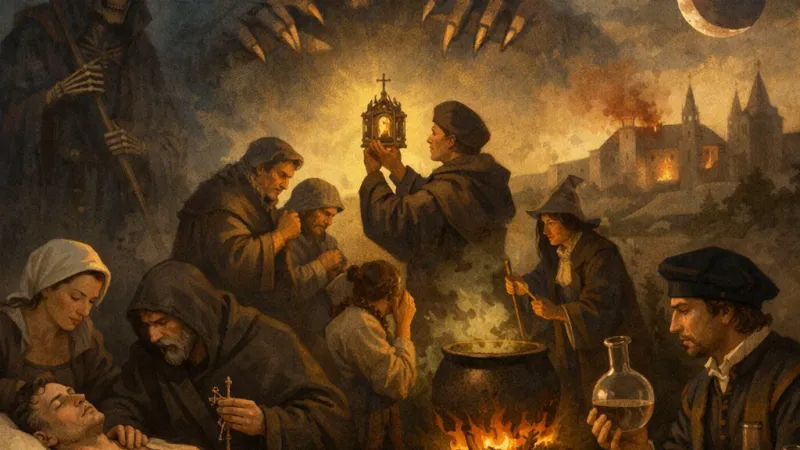
Explore how medieval Europe linked disease to supernatural causes, revealing beliefs that shaped health, society, and the shift to scientific understanding.
Disease and the Supernatural in Medieval Europe
To understand medieval society is to grasp a world both familiar and utterly foreign, shaped by faith, fear, and ritual. Between the years 1000 and 1500, Europe was a patchwork of kingdoms, fiefdoms, and principalities in which the shadow of the supernatural loomed large over everyday life. Medical knowledge, as we would now recognise it, was rudimentary at best and often entangled with religious dogma, awe, and suspicion. In an era devoid of microscopes or germ theory, invisible forces explained the visible horrors of plague, fever, and madness. This essay will explore how the belief in supernatural causes of disease dominated not just medical practice but the fabric of society, focusing on the role of the Church, the avoidance of rational medical investigation, and the eventual shift towards scientific thought. By considering examples drawn from English history and medieval literature, we will see how the supernatural held sway over health, suffering, and the limits of human understanding.
---
Medieval Perspectives on Disease Causation
The Rule of the Unseen
For the average inhabitant of medieval England—whether a farm labourer in Norfolk or a monk at Canterbury—the causes of illness were often presumed to lie beyond the physical world. The influence of supernatural explanations ran deep and persistent. Sickness was frequently interpreted as God’s punishment for sin: in this worldview, to become ill was to bear the consequences of personal or communal moral failing. This belief drew heavily on the teachings of scripture, where instances such as the plagues of Egypt or the afflictions of Job offered templates for interpreting suffering. Priests and preachers emphasised that repentance, rather than remedies, would heal the soul and, perhaps in time, the body.At the same time, not all disease was attributed to divine will. The medieval period brimmed with warnings about the power of witches, curses, and malevolent spirits. Songs, ballads, and tales—such as those found in Chaucer’s *Canterbury Tales*—give a sense of the general mood of suspicion. When outbreaks of strange illness occurred, particularly if they struck the young or otherwise healthy, whispers of witchcraft were quick to emerge. Witch trials, although more widespread in the early modern period, had their roots in these earlier centuries, and those accused of casting fatal spells could find themselves shunned, tried, or worse.
Moreover, mental illness in particular was often seen not as a physical matter but as a case of possession by evil forces. Chronic fits, hysterical behaviour, or unexplained suffering led to exorcisms—dramatic rituals conducted by clergy involving incantations, relics, and holy water. The goal was not to cure but to expel the malevolent entity believed to be responsible.
Spiritual Remedies Above All
This preoccupation with the supernatural meant little attention was paid to the workings of the human body as a system susceptible to natural causes. Diagnosis rarely aimed to uncover physical or environmental sources of disease such as water contamination or nutrition. Instead, healing focused on restoring spiritual wholeness, whether through prayer, confession, or ritual act. Complex herbal brews might be applied, but their efficacy was often believed to derive from blessed status or the recitation of sacred words, rather than any pharmacological property.---
The Role of the Roman Catholic Church
The Gatekeeper of Knowledge
The Church in medieval England and Europe was a formidable authority—social, political, but above all, spiritual. Its influence seeped into every aspect of medicine. Clergymen were often among the best educated of their times and presided over the few libraries and universities that existed, such as Oxford and Cambridge.The Church’s teachings underscored the view that illness was a reflection of sin and that healing naturally demanded spiritual intervention. Public health, as we now understand it, was not a priority; rather, attention was given to personal salvation through acts such as penance and pilgrimage to shrines. Cathedrals and abbeys became home to relics of saints believed to have healing powers. The sick flocked to such places in hope of divine intervention, often leaving behind crutches or tokens of their former ailments, a tradition visible still at sites like Canterbury Cathedral.
Equally significant was the Church’s control over the formal study of medicine. Many medieval medical texts were translations of Galen or Hippocrates, their classical origins filtered through the lens of Christian morality. Direct anatomical investigation of the human body was discouraged, verging on the forbidden. Dissection, in particular, was often ruled as a desecration, and where it did occur it was generally in a limited, supervised context. As a result, medical knowledge advanced slowly, hemmed in by centuries of dogmatic certainty.
Dogma Versus Discovery
Anyone challenging orthodox doctrine risked censure, excommunication, or worse. The fate of figures such as Roger Bacon, an early English philosopher who, despite his religious devotion, urged closer observation and experiment, reveals the limits placed upon inquiry. The Church’s suspicion of alternative medical ideas created a stifling environment, in which even genuine progress was hard won.Such was the authority of the Church that its vision of suffering was often internalised by the people. Pain and illness became a kind of test—a way to emulate the suffering of Christ or the saints. Endurance of affliction was valorised, contributing to a society that saw virtue in passivity and, in many cases, discouraged attempts at practical remedies.
---
Consequences of Supernatural Beliefs on Medical Progress
The Price of Faith Over Reason
The dominance of supernatural explanations produced a stalemate in medical progress. Rather than prompting investigation into underlying natural or environmental causes, society continued to rely upon customs and rituals. Effective treatments for infectious disease, from which medieval towns suffered frequently, were virtually non-existent. Instead, those struck down during epidemics would be carried to local churches, where prayers for their recovery—and the community’s deliverance—were held.Psychologically and socially, the consequences could be severe. Victims of disease, especially if their affliction was deemed unusual or mysterious, endured fear, suspicion, and stigma. Those suspected of witchcraft, even on the merest rumour, might be isolated, tried, or even executed. The morality plays and tapestries of the era often illustrate the contrast between the pious sufferer and the ‘wicked’ instigator of disease, reinforcing a climate of mistrust.
Furthermore, the superficial understanding of how diseases spread—linked more to miasma, or 'bad air', and still more often to spiritual pollution—meant that basic measures of hygiene were unheard of. Outbreaks such as the Black Death in the fourteenth century recurred with devastating impact, in part because fundamental knowledge about contagion remained elusive.
---
Case Studies and Examples
The Black Death: Divine Wrath and Public Reaction
Perhaps the most infamous incident illuminating medieval attitudes was the Black Death of 1348-1350. Sweeping across Europe, including England’s towns and villages, the plague killed perhaps one third of the continent's population. Chroniclers such as Geoffrey le Baker and the *Anno Domini* chronicles record how the pestilence was commonly interpreted as a sign of God’s anger at human sinfulness. Townsfolk processed barefoot through the streets, priests led penitential masses, and conspiracy theories about poisoning and heresy arose, fuelling even further persecutions.Witchcraft and Illness
Witch trials, while reaching their peak in later centuries, began to feature in the late medieval period. Those accused of summoning disease were subjected to ordeals or confessions, many of which are preserved in regional English court records. The very fact that illness could stimulate such responses speaks powerfully of how little physical causes were understood or even sought.Exorcisms and Charms
Medical manuscripts from the Middle Ages, such as those held in the British Library, abound with ‘charms’ alongside herbal remedies. Exorcism rites varied from the solemn casting out of devils by bishops to more local traditions involving spoken spells and relics. While some sufferers may have experienced psychological relief, there was rarely any real cure for chronic or contagious diseases.---
The Slow Dawn of Rational Medicine
By the fifteenth century, however, cracks in the edifice of supernatural orthodoxy began to appear. The influence of Renaissance humanism encouraged the retrieval of Greek and Roman medical texts, many of which had been censored or lost. Scholars such as Thomas Linacre and William Grocyn travelled to Italy and returned with new, more observational approaches to medicine.The graduation from blind faith towards scientific inquiry was not immediate—indeed, few major discoveries would occur in England before the arrival of figures like William Harvey in the seventeenth century. Yet, the stage was being set for a new era. The gradual acceptance of dissection, the rise of university study based on observation and experiment, and the slow realisation that diseases could have specific, natural causes, marked a profound transition. The supernatural did not vanish, but it loosened its grip on medicine.
---
Rate:
Log in to rate the work.
Log in