Exploring Climate Change Impact on Sinking Island Nations and Statehood
This work has been verified by our teacher: 24.04.2026 at 16:02
Homework type: History essay
Added: 21.04.2026 at 15:59
Summary:
Explore how climate change threatens sinking island nations and what it means for statehood, sovereignty, and identity in a rapidly changing world 🌍.
Climate Change and the Disappearing States: Rethinking Statehood in a Sinking World
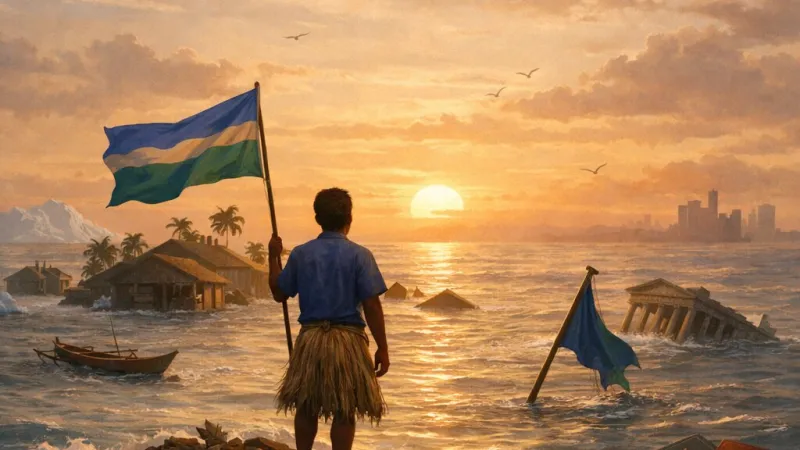
Climate change is arguably the greatest global challenge of the 21st century, but its most harrowing consequences are not always visible in the well-trodden landscapes of the United Kingdom or the bustling cities of continental Europe. Instead, it is in the remote, oceanic margins of the world that its existential threat is most starkly felt. Here, on the fragile atolls of Kiribati, Tuvalu, and the Maldives, entire nations teeter quite literally on the edge of disappearance. Nowhere is the power—and indifference—of climate change more apparent than in the prospect of “disappearing states”: sovereign nations whose land is being inexorably swallowed by rising seas.
Yet, as catastrophic as the physical loss of territory might seem, the demise of these states raises profound legal, social, and political questions. Is a state defined solely by its area of dry land, or do people, culture, and sovereignty linger even when their “home” lies underwater? What happens to the rights, identity, and recognition of displaced populations? This essay explores these issues through the lens of international law, human rights, and political innovation, examining the prospects for statehood and the survival of national identity in a world where geography is in flux.
Understanding ‘Disappearing States’ in the Context of Climate Change
The notion of a “disappearing state” is a chilling reality for certain island nations, conjuring images of entire societies rendered homeless by forces beyond their control. Unlike cities lost to conflict or shifting borders caused by war, these are countries threatened not by human aggression, but by implacable environmental change. The term often refers to low-lying island states in the Pacific and Indian Oceans, such as Kiribati and Tuvalu, whose highest points lie mere metres above sea level; projections suggest that even a moderate increase in global temperatures could render them uninhabitable, or see them vanish altogether.Physical disappearance is driven by a suite of interlinked environmental processes. The most direct is the inexorable rise in sea levels, caused by melting polar ice and thermal expansion, which erodes coastlines, submerges agricultural land, and transforms freshwater supplies into salty, unfit-for-drinking remnants. As the BBC has reported in its coverage of Tuvalu’s efforts to adapt, shrinking freshwater lenses mean crops fail and drinking water grows scarce—forcing people to rely on imported goods, further deepening dependence and social stress. Soil salination devastates local agriculture, eroding centuries-old ways of life and undermining food security. Additionally, the slow but relentless degradation has social consequences: as arable land vanishes, affected populations cluster around shrinking remnants, intensifying urban pressure in already fragile areas and introducing new health risks due to changes in diet and overcrowding.
The timeline of these changes is uncertain, with some estimates—like those made public by the Intergovernmental Panel on Climate Change—offering decades or centuries, while the lived reality of residents is far more immediate: floods, storm surges, and disasters are increasingly common, and gradual loss is often punctuated by sudden crises. Forced migration, as in the case of the Kiribati government’s policies encouraging resettlement to Fiji, may begin long before the last patch of dry land is submerged, raising pressing questions about the long-term continuity of the “state” as both a legal and social entity.
Statehood and its Legal Criteria: Foundations and Challenges
At the heart of the disappearing states issue lies a centuries-old conundrum: what, fundamentally, defines a state? Here, the classic framework—codified in the 1933 Montevideo Convention—remains influential even today, though the United Kingdom is not a party to the Convention, its principles are widely regarded as customary international law. They require: (i) a defined territory, (ii) a permanent population, (iii) an effective government, and (iv) the capacity to enter into relations with other states.In practice, statehood is not as brittle as one might imagine. International law generally presumes the continuity of a state, even through occupation, diaspora, or chaos—witness the survival of governments-in-exile, such as the Polish government during the Second World War, which was recognised abroad despite being driven from its homeland. Failed states, such as Somalia in the 1990s or Libya in more recent years, have retained some degree of legal personality and international status despite the absence of effective government or unified territory.
The plight of nations sinking beneath the waves, however, is without precedent. Previously, extinction of states has resulted from annexation (as in the case of the Ottoman Empire), merger, or voluntary union. In the environmental context, by contrast, there is no conquering neighbour, no transferring of sovereignty; instead, the land itself is being erased. As Ben Macintyre writes in *The Times*, climate change is “not a war of men, but a war on memory and place.” What legal status remains for a nation whose territory is lost to the sea, and whose people are scattered? Can the international community adapt established norms for an entirely novel threat?
Population Displacement: The First Indicator of State Dissolution?
A central criterion for statehood, according to international law, is the existence of a “permanent population”—people with a stable relationship to their state. Forced or voluntary migration caused by environmental change directly threatens this foundation. Historically, people have always moved in response to natural disasters, famine, or war; what distinguishes the modern climate migration of islanders is the likelihood that migration will be total and irreversible.Already, governments of Kiribati and Tuvalu are negotiating with larger nations, such as New Zealand, to secure pathways for migration should the worst come to pass. This process is not just about moving people, but about finding space for culture, language, governance, and identity to survive in new lands. Unlike economic migrants who leave by choice in search of opportunity, climate migrants may well find there is nothing left to return to.
Currently, international law lags behind reality. The 1951 Refugee Convention, for example, does not recognise victims of environmental disaster as “refugees,” focusing rather on persecution. This leaves so-called “climate refugees” in legal limbo. Some campaigns, including those supported by UK-based organisations such as Oxfam, advocate for new international norms that recognise displacement caused by climate change as an urgent humanitarian issue. In addition to legal questions, the threat of cultural erasure looms large. As Dr. Jenny Carroll of the University of Exeter notes, the loss of land risks the disappearance not only of physical homes but also of intangible heritage—languages, traditions, and communal identities built over centuries.
Governance and Legal Strategies for Preserving Statehood Post-Displacement
Given these unprecedented threats, island states and their supporters are exploring innovative legal and governance solutions. The notion of governments-in-exile provides a historical precedent: during the Second World War, the governments of both Norway and the Netherlands operated from London. In theory, a government could continue to function and represent its people even after losing all territory, although the practicalities—especially over generations—would be daunting.Alternatively, some propose forms of “virtual governance,” where state institutions persist online and diplomatic relations continue, even if no land base remains. There is also the model of “free association,” where a smaller territory retains autonomy in partnership with a larger state—a system similar to that between the Cook Islands and New Zealand. This solution, however, presupposes a continuing, if demoted, relationship to territory.
International recognition is key. If the United Nations and leading regional organisations such as the Commonwealth were to acknowledge “labour states” or “diaspora states” existing in exile, this could guarantee some measure of sovereignty, ensuring that treaties and national identity persist despite the physical loss of land. Legal scholars, such as Professor Stephen Allen at Queen Mary University of London, are already contemplating new legal instruments or amendments to the law of statehood tailored to climate-induced disappearance.
Broader Implications and Policy Recommendations
The looming crisis of disappearing states compels a radical rethinking of legal doctrine. International law must adapt, developing flexible frameworks that accommodate new realities—such as forms of “deterritorialised” statehood or alternative criteria for population and territory. Already, some lawyers have suggested that digital technology offers a way to maintain continuity, with states maintaining citizenship registries and governance in an online space, decoupled from a specific territory.As well as legal innovation, the rights of displaced populations must be defended. The UK and its partners in the Commonwealth could take a lead in advocating for the recognition of people displaced by climate change as “climate refugees,” providing dignified migration pathways and opportunities for citizenship. The Home Office already administers visa schemes for unusual humanitarian cases—this expertise could be scaled up for affected islanders, ensuring safe passage and protection.
Environmental protection and adaptation must remain a parallel focus. Financial support, technology transfers, and the sharing of best practices can help prolong the habitability of threatened nations, buying invaluable time for adaptation and cultural continuity. The United Kingdom, with its long tradition of maritime expertise and international development aid, is well-positioned to offer both practical and legal assistance.
Underlying all of this is a broader imperative: global cooperation and solidarity. The sinking of a country is not a “local” problem, but a warning to all. It exposes the moral flaw in a world order where those least responsible for greenhouse gas emissions pay the highest price. As Archbishop Desmond Tutu once remarked during a climate summit in London, “Climate change is a matter of justice, not just science.” The decisions we make now will define not only the survival of these island nations, but the principles by which we operate as a global community.
Rate:
Log in to rate the work.
Log in