Nutrient Cycles and Global Warming: Human Impacts and Responses
This work has been verified by our teacher: 16.01.2026 at 10:48
Homework type: Essay
Added: 16.01.2026 at 10:08
Summary:
Humans disrupt C, N, P and water cycles, driving warming and ecosystem harm; fix via habitat restoration, smarter farming and stronger policy.
Nutrient Cycles and Global Warming: Interactions, Human Influence, and the Path Forward
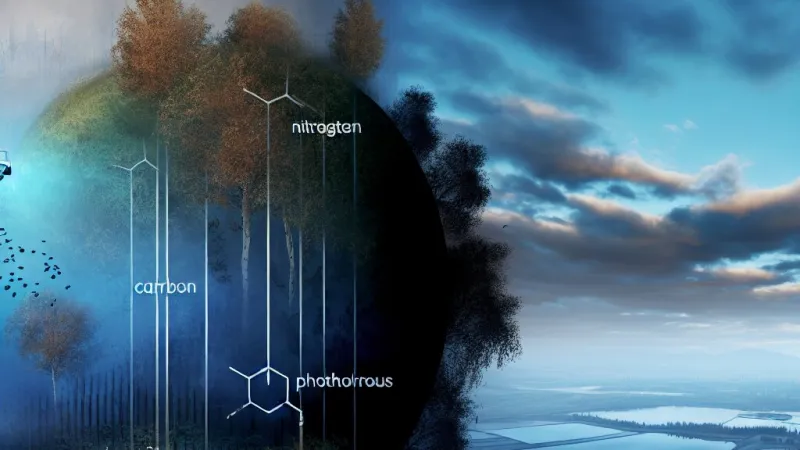
Our planet is sustained by complex systems that recycle the elements vital for life, commonly known as nutrient cycles. Nutrient cycles encompass the movement and transformation of chemicals like carbon, nitrogen, phosphorus and water through various environmental reservoirs: from the atmosphere and oceans to the soil and the biosphere. In their natural state, these cycles maintain a delicate balance underpinning both ecosystems and climate. However, since the Industrial Revolution, human activities have disrupted these cycles significantly. The relentless rise of greenhouse gases—principally carbon dioxide, methane and nitrous oxide—has amplified global warming, leading to far-reaching ecological and societal consequences. UK environments, from upland peat bogs to agricultural fields in East Anglia, bear witness to these changes. This essay will explore how the major nutrient cycles interact with the climate system, assess anthropogenic impacts upon them, and critically evaluate the ecological and policy responses necessary to manage these twin challenges of nutrient imbalance and global warming.
---
The Carbon Cycle: Dynamics, Disruption and Feedback
Components and Major Pathways
The carbon cycle orchestrates the flow of carbon atoms between the atmosphere, biosphere, oceans and geosphere. ‘Fast’ carbon pools include living organisms, leaf litter, and soil organic matter—exchanging carbon with the atmosphere over timescales of days to centuries. For instance, trees in Sherwood Forest or peatlands in the Pennines continually absorb and release CO₂ through photosynthesis and respiration. In contrast, 'slow' carbon is stored in fossil fuels, limestone rocks, deep-ocean sediments and permafrost, taking thousands to millions of years to recycle. Oceans, holding about fifty times more carbon than the atmosphere, modulate climate both by absorbing CO₂ and by supporting marine organisms that sequester carbon through the ‘biological pump’—a process elegantly illustrated by the spring bloom of phytoplankton around UK coasts.Processes Governing the Carbon Cycle
Photosynthesis by plants and algae is at the heart of carbon fixation, drawing atmospheric CO₂ and incorporating it into organic molecules. Animals—such as red deer in the Scottish Highlands—return carbon to the atmosphere via respiration. Microbial decomposition and combustion (e.g., moorland wildfires) further release stored carbon. Soil processes are particularly crucial: British soils store more carbon than all UK vegetation combined. However, their ability to retain or release carbon hinges on temperature, moisture and land management. Meanwhile, oceans absorb CO₂ via dissolution, but this uptake is constrained by water temperature—warmer seas store less carbon, while increased stratification impedes the mixing necessary for ‘deep’ sequestration.Human Impacts on the Carbon Cycle
Human influence on the carbon cycle is profound. Fossil fuel burning and cement production have injected vast quantities of ancient carbon into the atmosphere at unprecedented rates. The UK’s own industrial heritage—marked by the smokestacks of the North—helped drive the concentration of CO₂ from pre-industrial levels around 280 parts per million to over 420 ppm today. Deforestation, both globally and in earlier British history (for example, the extensive clearance of Caledonian Forest in Scotland), reduces carbon sinks and often converts biomass and soils from reservoirs into sources of greenhouse gases. Agriculture and urban expansion, from the Fens to Greater London, have further altered the land’s ability to store carbon.Of particular concern is permafrost thaw. Although not a domestic issue for the UK, the rapid Arctic permafrost degradation releases both CO₂ and methane—a greenhouse gas with far greater warming potential per molecule but a much shorter lifetime in the atmosphere. This constitutes a worrying positive feedback: warming leads to thawing, which releases more greenhouse gases, in turn accelerating warming.
Forest fires, too, are intensifying with climate change. Last decade’s moorland fires in Saddleworth Moor serve as a local reminder that even temperate UK landscapes are not immune to fire-driven emissions. Ocean acidification, driven by increased CO₂ absorption, hinders the formation of shells and skeletons by marine organisms (like those in the North Sea), potentially undermining another critical carbon sink.
Evaluative Perspective
A crucial point is that disrupting slow carbon pools—like burning fossil fuels or draining lowland peat bogs in Somerset—introduces carbon that would otherwise remain sequestered for millennia. Methane, although short-lived, exerts rapid warming, illustrating that both the magnitude and duration of greenhouse gas fluxes matter. However, soil carbon feedbacks are notoriously difficult to predict; laboratory studies of British upland soils show that warming can initially drive losses, but sometimes these slow after adaptation of microbial communities. The fate of vast forested regions such as the Amazon or, to a local extent, the ancient woods of Britain, demonstrates how large-scale vegetation removal shifts climate feedbacks regionally and globally.---
Nitrogen and Phosphorus Cycles: Pathways, Pollution and Climate Connections
The Nitrogen Cycle
Nitrogen is cycled through biological fixation (by lightning or by organisms such as clover in British meadows), nitrification, denitrification, and deposition processes. Human ingenuity, however, has overtaken natural nitrogen fixation: the industrial Haber–Bosch process has dramatically increased the availability of reactive nitrogen, mostly as agricultural fertiliser. This has benefitted UK crop yields but has also contributed to emissions of nitrous oxide (N₂O), a potent greenhouse gas and ozone-depleting substance. N₂O arises during soil microbial processes; excess fertiliser, compounded by heavy rain, increases emissions and losses via leaching—ultimately affecting water bodies from Somerset Levels to Norfolk Broads through eutrophication.The Phosphorus Cycle
Phosphorus is sourced primarily from weathering rocks and is much less mobile in the atmosphere than nitrogen. Yet widespread mining and heavy fertiliser use on UK farmland introduce far more phosphorus than natural cycles can replace. This surplus frequently runs off fields into rivers, contributing to algal blooms and 'dead zones' in aquatic ecosystems. As seen in the crisis facing the River Wye, both nitrogen and phosphorus pollution, exacerbated by climate-driven heavy rainfall, have fostered deoxygenation and biodiversity loss.Interactions and Implications
Nutrient cycles are intimately connected—imbalances can have cascading effects. For example, excess nitrogen can temporarily stimulate plant growth and carbon uptake, but increased microbial activity can offset this gain by accelerating decomposition and releasing CO₂ and N₂O. Furthermore, phosphorus-limited systems may not fully benefit from elevated CO₂, as seen in many British heathlands. The intricate ratios of C:N:P in soils and plants determine whether nutrients serve as growth-limiting factors or drive damaging emissions.Case Study and Evaluation
The widespread use of fertilisers across lowland farms has led to the annual formation of hypoxic zones in the Thames Estuary, threatening fisheries. The UK faces the same mitigation dilemma as other nations: reducing fertiliser usage would curtail emissions and improve ecosystem health, but risks diminishing agricultural productivity unless alternative approaches can bridge the gap.---
The Hydrological Cycle: Climate Interactions and Nutrient Transport
The hydrological (water) cycle, encompassing evaporation, transpiration, precipitation, runoff and groundwater flow, mediates the transfer of nutrients between reservoirs. Climate change has altered rainfall patterns in the UK, with increased winter flooding and prolonged summer droughts. Such changes modify the rates of decomposition and mineralisation in soils. Drought slows these processes, while saturated soils—common in flood-prone regions like the Severn-Beacons area—can create anaerobic conditions, promoting denitrification and methane emissions. Extreme weather events intensify nutrient runoff, carrying nitrogen and phosphorus into rivers and coastal waters, sometimes triggering massive algal blooms akin to those witnessed in the Lake District. Meanwhile, shifts in vegetation cover and soil wetness influence local climate feedbacks by altering reflectivity (albedo) and evapotranspiration rates, further entangling nutrient cycling and the water cycle with the broader climate system.---
Ecological, Agricultural and Societal Consequences
Effects on Ecosystems
Ecosystem responses to nutrient excess and climate change are highly variable. In nutrient-poor habitats such as Dartmoor’s heathlands, deposition of nitrogen and phosphorus disadvantages locally-adapted species while favouring fast-growing, nutrient-loving plants and grasses, often at the expense of biodiversity. Sensitive freshwater systems suffer not only from warming but also from nutrient pollution, combining to spur algal dominance and fish die-offs.Implications for Agriculture
British agriculture faces shifting growing seasons and increased pest pressures. Heat and drought reduce the efficacy of fertilisers and crop uptake, so more nutrients escape as pollution. Intensive tilling and monoculture, particularly in the East Midlands, degrade soil structure and carbon content, undermining long-term productivity and resilience. As climate impacts yields and input efficiency, there is pressure to convert more land or intensify existing use, both of which risk further carbon and nutrient emissions.Wider Societal Effects
Pollution from reactive nitrogen has direct health consequences, contributing to ground-level ozone and particulate matter formation, both linked to respiratory illness in urban populations such as London and Manchester. Soviet-style economic losses loom for those dependent on fishing where dead zones curtail catches, e.g., the shellfish industry in Morecambe Bay. These issues highlight how nutrient cycle disruption is as much a societal challenge as an ecological one.---
Mitigation, Management and Policy Responses
Ecosystem-Based Solutions
Restoring forest cover—such as through the Northern Forest initiative—and rehabilitating wetlands and peat bogs (notably in the Flow Country) can lock up carbon and filter nutrients. ‘Blue carbon’ projects, protecting saltmarshes and seagrasses along the UK’s coasts, offer further promise for carbon sequestration, whilst also defending shorelines against storms.Agricultural and Nutrient Management
The adoption of precision agriculture—fine-tuning fertiliser type, timing and amount to match crop need—minimises nutrient wastage. Use of slow-release fertilisers and inhibitors can further curb greenhouse gas emissions. Better manure management and methane recovery from livestock—important in regions like Devon or Wales—reduces atmospheric contributions. Dietary changes, such as reducing meat consumption, can relieve demand for land and fertiliser-intensive livestock systems.Technology and Policy
Emerging technologies like carbon capture and storage (CCS) may play a role but face challenges of scale and cost. Soil amendment through biochar could enhance storage, but long-term impacts remain uncertain. On the policy front, carbon pricing, targeted farm subsidies and tighter fertiliser regulations are crucial; the UK’s post-Brexit agricultural policy’s ‘public money for public goods’ approach offers a potential path forward.Integrated action is essential: for instance, afforestation projects should factor in potential nitrogen leaching, and attempts to cap emissions must also consider effects on food security and rural livelihoods. International cooperation, through the Paris Agreement and beyond, will be key to aligning national policies with global carbon and nutrient management goals.
---
Methods for Studying Nutrient Cycles and Climate Links
Understanding these cycles requires a variety of scientific tools. Field measurements—such as the UK’s network of atmospheric monitoring towers and long-term ecological plots—help trace carbon and nitrogen fluxes. Laboratory analyses, using stable isotopes, clarify the sources and fates of nutrients. Satellite imagery tracks vegetation changes and identifies eutrophication from space. Biogeochemical models, increasingly sophisticated, attempt to forecast feedbacks, but uncertainties remain, particularly regarding soil and permafrost responses.---
Synthesis and Critical Reflection
There is robust evidence that human activity has fundamentally altered nutrient cycles, with significant climate repercussions. Feedback loops—permafrost melt, peatland drying, and N₂O release—increase the difficulty of meeting climate targets. Managing these cycles in isolation is insufficient; their interactions amplify risks, requiring integrated, ecosystem-based and socio-economic approaches.---
Rate:
Log in to rate the work.
Log in