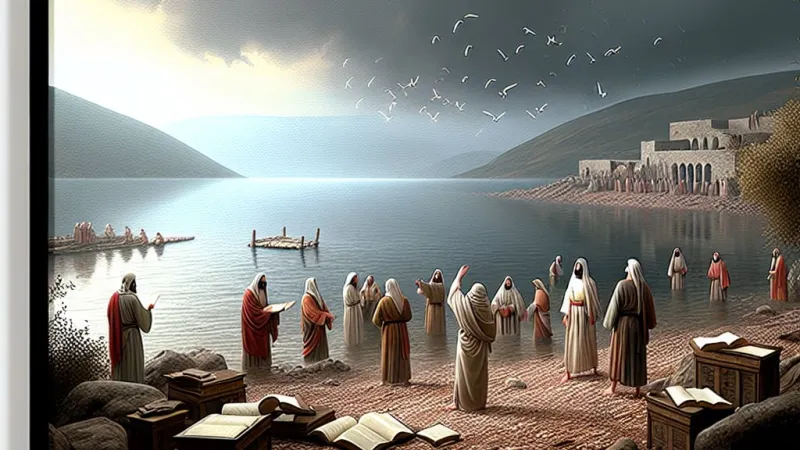
Calling of the First Disciples at the Sea of Galilee: Context and Meaning
This work has been verified by our teacher: 15.02.2026 at 15:09
Homework type: Essay
Added: 13.02.2026 at 13:18
Summary:
Explore the calling of the first disciples at the Sea of Galilee to understand its historical context, meaning, and impact on early Christian faith and commitment.
The Call of the First Disciples: Understanding the Nature and Implications of Early Discipleship
Within the tapestry of Christian tradition, few events are as striking as the calling of the first disciples. Set upon the shores of the Sea of Galilee, this moment represents the spark that would ultimately ignite the spread of Christianity throughout the world. In the Gospels, a group of ordinary fishermen are transformed into the foundation stones of a movement that would alter the course of history. The significance of this calling, however, lies not only in its narrative value but also in its profound symbolism and enduring challenge to the ideals of faith and commitment.
To appreciate the magnitude of this call, one must first consider the societal, religious, and cultural context into which it emerged. First-century Judaea was a land of economic struggle and religious expectation. Fishing, central to the lives of the first disciples, was a demanding trade carried out beneath the ever-watchful gaze of Roman authorities and in the shadow of long-held Messianic hopes. Against this backdrop, Jesus of Nazareth’s call was nothing short of revolutionary. This essay seeks to examine how the calling of the first disciples illustrates a transition from everyday life to extraordinary commitment, exploring the metaphors, demands, and spiritual meanings embedded therein. By delving into the historical context, the meaning of becoming “fishers of men,” and the qualities demanded by this new vocation, we may uncover why this moment continues to resonate so deeply within Christian thought and British religious education.
---
I. Historical and Cultural Context of the First Disciples
A. Occupation of the Disciples
The first disciples whom Jesus called—Simon Peter, Andrew, James, and John—were fishermen, making a living on the Sea of Galilee. This occupation was not an idyllic pastime but an essential, strenuous, and often precarious means of surviving in an agrarian economy. Fishing required strength, skill, and an unflinching work ethic, as the men would cast and haul heavy nets at hours when others slept. The fishing communities around the Galilean lake, as recounted in sources like the Mishnah, formed tight-knit societies often overlooked or looked down upon by the religious elite.Fishermen’s socio-economic status was modest, neither destitute nor powerful; they depended greatly on local markets and, owing to the Roman taxation system, had little security against sudden loss. Their position in society thus highlights the humility and ordinariness of those whom Jesus first chose—a deliberate choice that subverted contemporary expectations for religious leaders and reformers.
B. Religious Climate
Judaea at the time seethed with anticipation of a Messiah, a divinely appointed deliverer foretold in Jewish scripture, who would restore Israel and bring justice. The tradition of discipleship was well established within Judaism—rabbis attracted followers, and key scriptural figures such as Elijah or Moses had apprentices. However, the manner in which Jesus approached his would-be disciples diverged from the norm; instead of accepting aspirants, he actively sought out and summoned his followers. This inversion of standard practice signals a new movement: Jesus’ initiative embodies divine authority and purpose, setting the stage for extraordinary demands.C. Significance of the Sea of Galilee
Geographically, the Sea of Galilee was more than just a local landmark—it was a boisterous centre of trade, teeming with life, uncertainty, and danger. The lake’s turbulent weather was both a boon and a peril, reinforcing the ruggedness required of its fishermen. In Jewish and Christian literature, water symbolises chaos, creation, and renewal—the very elements Jesus would draw upon in his ministry. The setting strengthens the symbolism of the disciples’ transformation: ordinary men, called from the unpredictable waters, are to become stabilising forces within a burgeoning spiritual community.---
II. The Metaphor of “Fishers of Men”
A. Analysis of the Metaphor
When Jesus proclaims, “Come, follow me, and I will make you fishers of men” (Mark 1:17), he employs a metaphor both accessible and profound. While literal fishing involves patience, strategy, and hope tinged with uncertainty, “fishing for men” signals a call to evangelism—a pursuit to draw people, rather than fish, into the net of faith. The metaphor is layered; ancient prophets (such as Jeremiah in the Hebrew Bible) spoke of God sending “fishers” to gather his people, painting a picture of divine initiative and inclusivity.B. Implications of the Metaphor for the Disciples’ New Role
For the disciples, this reimagining of their profession heralds a decisive shift. The skills honed in mending nets and casting lines are to be redirected into nurturing communities, persuading hearts, and embodying the values of the kingdom Jesus preaches. The metaphor thus acknowledges their existing abilities while reorienting their purpose: the faithful labourer is now enlisted in a wider, more consequential undertaking.C. Broader Biblical and Theological Interpretations
Across Christian history, the “fishers of men” image has inspired countless interpretations—sermons, hymns, and visual art have all drawn upon its resonance. Early English poetry, such as that of George Herbert, reflects on the vocational and sacrificial dimensions of discipleship, capturing the sense of being “caught” by divine love and responsibility. Meanwhile, the motif of water and live catch symbolises baptism and transformation, both central rites of the Christian tradition.---
III. The Character and Qualities Required of Disciples
A. Patience and Perseverance
Fishermen understand waiting—enduring long nights, fruitless efforts, and fickle waters. So too, discipleship demands resilience. Proclaiming the Gospel would not bring immediate acclaim or acceptance; often, it entailed bewilderment, jeering, or outright hostility. British writers—such as the medieval anchoress Julian of Norwich—have spoken of the “long patience” required to abide in hope, a virtue mirrored in the disciples' experience.B. Humility and Obedience
One remarkable detail from the biblical accounts is the disciples’ willingness to abandon their trade and family at a moment’s notice. Such a step represents humility—advancing not for personal gain but in the service of a greater cause. Like Thomas More, who abandoned worldly success for conscience’s sake, the disciples’ obedience highlights the cost of authentic spiritual commitment.C. Faith and Trust
To leave behind nets, boats, and kin required trust—not in economic security or social standing, but in the person of Jesus and the promise of a more profound destiny. Their actions echo the faith of figures like Abraham, who left his homeland in response to divine summons. The willingness to risk all for the unseen and the yet-to-come remains a bedrock of Christian faith, cherished in the collective memory of the Church of England and other British denominations.D. Identity Shaped by Discipleship
The disciples’ identities were now indelibly tied to their calling. No longer mainly fishermen, they became apostles, preachers, and eventually, martyrs. This transformation was not without social risk, as it invited scrutiny, exclusion, and suspicion from neighbours and religious authorities. Yet, as the poet R.S. Thomas argues in his reflections on Christian vocation, it is in renouncing old certainties that individuals discover new meaning and purpose.---
IV. The Call as Invitation to Enter the Kingdom of God
A. Understanding the Kingdom of God
Central to Jesus’ call is the proposition of a “Kingdom of God”—a spiritual realm both present and promised. This concept, at the heart of his teaching, upends common notions of power and privilege. Contrary to the political kingdoms of the day, the Kingdom of God is marked by humility, justice, and self-giving love.B. The Role of Disciples in Manifesting this Kingdom
The first disciples were not invited to a private spiritual experience but commissioned as public witnesses—to live, declare, and embody kingdom values. Their role assumed urgency and responsibility, as the Gospels emphasise the need for immediate action: “they left their nets at once and followed him” (see Mark 1:18). The swiftness of their decision underlines the urgency and magnitude of Jesus’ message.C. Immediate Effect of the Call
The disciples’ prompt response is striking. There is no time given to weigh pros and cons, consult family, or arrange affairs. This suddenness points to the in-breaking nature of the Kingdom—a reality that demands and generates radical, all-encompassing commitment. Such immediacy is echoed throughout Christian liturgy and spiritual writings, where the call to repentance and renewal is never postponed.---
V. Challenges and Rewards of Discipleship as Demonstrated in the Calling
A. Challenges
The cost of following Jesus was enormous: social alienation, economic insecurity, and, later, persecution from both Jewish authorities and Roman power. Even family ties were tested; the Gospel of Matthew reports that Jesus predicted division even among those closest to the disciples. The history of British Christianity, from the early Celtic missionaries to the nonconformists of later centuries, is filled with examples of individuals facing similar tests of faith and resolve.B. Rewards
However, the challenges are counterbalanced by the promise of profound spiritual rewards: inclusion in God’s redemptive work, the experience of transformative fellowship, and enduring joy. The Acts of the Apostles records the growth and resilience of the early Church—a testament to the sustaining power of a calling rooted in love and hope. For many Christians in Britain, the legacy of these first disciples continues to inform prayers, hymns (such as “Will You Come and Follow Me?”), and communal worship.C. Relevance for Contemporary Believers
The first disciples’ calling remains profoundly relevant. Their story offers both assurance and challenge: assurance that one's background need not limit participation in God’s purposes, and challenge in the call to continual sacrifice and service. From Christian youth groups in rural English parishes to multi-faith chaplaincies in Scotland’s universities, the model of humble, transformative commitment endures.---
VI. The Legacy of the First Disciples’ Call
A. Impact on Christian Tradition and Identity
The first followers, transformed by their encounter with Jesus, helped shape the core doctrines and communal life of Christianity. Their example served as a template for subsequent generations, informing the very idea of what it means to be a disciple within the Church of England, the Roman Catholic tradition, and beyond.B. Artistic and Literary Interpretations
In Britain, the story of the disciples has been memorialised in art—stained glass, altar panels, and hymnody—and in literature, from medieval mystery plays to the modern poetry of Malcolm Guite. Each interpretation reflects ongoing engagement with the central themes of calling, sacrifice, and faith.C. Application in Modern Religious Education and Spirituality
Within schools that follow the Religious Education curriculum, the narrative of the disciples’ call is used to prompt reflection on vocation, conscience, and service. It serves as a touchstone for teaching about spiritual discernment and the everyday possibilities of living out faith—a theme encouraged in the collective worship assemblies and school chaplaincies across the UK.---
Rate:
Log in to rate the work.
Log in