Exploring the Impact and Role of the Human Rights Act 1998 in UK Law
This work has been verified by our teacher: 14.03.2026 at 13:47
Homework type: Essay
Added: 12.03.2026 at 5:36
Summary:
Discover how the Human Rights Act 1998 shapes UK law, its impact on rights protection, and its role in balancing parliamentary sovereignty and individual freedoms.
The Human Rights Act 1998: Foundations, Functions and Friction in UK Law
The notion of human rights occupies a profound place in the legal and moral conscience of the United Kingdom. At its core, the principle affirms that all individuals, irrespective of background, are deserving of fundamental liberties and protection against abuses of state power. Yet, for much of modern history, the relationship between human rights and UK law was less straightforward than it might seem. Preceding the Human Rights Act 1998, the UK’s approach to human rights primarily relied on a patchwork of common law principles and sporadic statutory provisions, without a comprehensive blueprint. The passing of the Human Rights Act (HRA) in 1998 acted as a seismic shift, not only incorporating the rights enshrined in the European Convention on Human Rights (ECHR) directly into domestic statute, but also changing the manner in which courts, parliament, and public authorities must operate.
This essay examines the historical and constitutional background preceding the Human Rights Act, the mechanisms by which ECHR rights were incorporated, key provisions and judicial use of the Act, tensions arising between human rights protections and parliamentary sovereignty, as well as the practical and political challenges encountered since its enactment. In doing so, it explores how the HRA serves as a pivotal bridge between British parliamentary traditions and the evolving culture of individual rights.
---
Historical and Constitutional Background
The European Convention on Human Rights
The ECHR arose in the aftermath of the Second World War as an international treaty aimed at codifying a minimum standard of civil and political rights. Influenced heavily by the Universal Declaration of Human Rights and determined to avert a repeat of the atrocities seen in Europe, its drafters—of which the UK was a central participant—sought to create a legally binding charter of liberties, from the right to life to the freedom of expression.Human Rights Before 1998
In the UK, prior to the HRA, human rights were protected in an indirect manner. The doctrine of parliamentary sovereignty meant any rights were a matter of parliamentary grant rather than inherent claims. While English common law had long recognised certain fundamental rights, such as habeas corpus, the monarchy and subsequently Parliament remained free to legislate away these rights.Furthermore, though citizens could petition the European Court of Human Rights in Strasbourg for breaches by the UK government, success meant little without a mechanism for timely enforcement at home. The process was costly, lengthy, and ultimately reliant on the state’s willingness to amend its laws. Key cases—such as Malone v UK (1984), which concerned telephone tapping—highlighted the gap between lofty declarations and practical protection. This situation created a patchwork of justice, where access to rights depended greatly on the resources and persistence of claimants.
Genesis of the Human Rights Act
The Labour government of the late 1990s, under Tony Blair, sought to address these shortcomings. Their intention was clear: ensure that British citizens did not have to pursue justice overseas, but could secure their rights in UK courts. The enactment of the HRA thus reflected both a political and practical desire to render rights accessible, embedding them firmly within the domestic legal landscape.---
Incorporation of the ECHR through the Human Rights Act
The Human Rights Act 1998 enacted a sea change by making the ECHR’s substantive rights directly justiciable under UK law. Its mechanism was not to create a new catalogue of rights unique to the UK, but to ‘give further effect’ to the rights and freedoms defined in the ECHR (s.1 HRA).Categories of Rights
The Act distinguishes between various classes of rights: absolute (such as the prohibition of torture, Article 3), limited (for instance, the right to liberty under Article 5, only to be restricted in narrowly defined circumstances), and qualified (notably, Article 8—respect for private and family life—which permits interference ‘in accordance with the law’ if necessary for the interests of national security or public safety).This nuanced approach recognises the need for both robust protection and pragmatic flexibility. It marks a distinct break from the idea of ‘residual rights’—the notion that liberty is presumed unless explicitly limited. Instead, the state now shoulders an active duty to justify intrusions on defined rights, cultivating a culture of justified and proportionate state action.
---
Key Provisions and Safeguards within the HRA
Section 7: Empowering Individuals
For the first time, individuals gained the express statutory right to bring human rights claims directly before UK courts against public authorities. This places the citizen squarely in the frame as an actor capable of vindicating rights, rather than relying on government self-restraint.Section 19: Statements of Compatibility
Ministers steering bills through Parliament must make a formal statement that proposed legislation is compatible with ECHR rights—or else explain why compatibility cannot confidently be asserted. This embeds human rights considerations at the formative stages of law-making, enhancing scrutiny and fostering legislative caution.Section 4: Declaration of Incompatibility
Section 4 empowers higher courts to issue a declaration that an Act of Parliament is incompatible with a Convention right. However, such declarations do not strike out the offending provision; the law remains in force unless Parliament chooses to amend or repeal it. This mechanism respects the UK’s constitutional tradition of parliamentary sovereignty, marking a distinction from ‘strong’ constitutional courts found in some continental European systems.Section 10: Remedial Measures
Where a declaration of incompatibility is made, Section 10 provides an expedited ‘fast track’ process for legislative amendment, bypassing certain stages but maintaining democratic oversight.Section 3: Interpretative Obligations
Section 3 directs courts, ‘so far as it is possible to do so’, to read and give effect to legislation in a way compatible with ECHR rights. This duty applies regardless of when the law was enacted, granting judges significant leeway to ‘read in’, ‘read out’, or ‘read down’ statutory text—a creative and sometimes controversial interpretative approach.---
Judicial Use and Development: Illustrative Cases
A number of cases have shaped and tested the boundaries of the HRA’s interpretative provisions. In R v A (No 2) [2001], the question was whether rape defendants could cross-examine complainants regarding sexual history—an issue pitting the defendant’s right to a fair trial against the complainant’s dignity. The House of Lords, especially Lord Steyn, asserted that Section 3 required courts to adopt rights-consistent meanings even if this demanded considerable ‘linguistic strain’, opting for a creative reading over a formal declaration of incompatibility.However, the judiciary’s creativity is not limitless. In Bellinger v Bellinger [2003], concerning marital recognition of transgender individuals, the Lords declined to interpret legislation so expansively as to subvert Parliament’s clear intent. Rather, they issued a declaration of incompatibility, making plain that only legislative reform could resolve the issue—a demonstration of judicial restraint.
In Ghaidan v Godin-Mendoza [2004], the Lords clarified that Section 3 permitted them to adopt meanings compatible with ECHR rights so long as it did not run counter to ‘the fundamental features’ of legislation, again highlighting the careful balance between interpretative vigour and constitutional deference owed to Parliament.
---
Public Authorities and the Reach of Human Rights Obligations
Section 6 HRA binds public authorities to act compatibly with Convention rights. But what constitutes a public authority? The courts have developed tests for both core public bodies—such as government departments and police—and so-called ‘hybrid’ authorities performing both public and private functions.In Poplar Housing and Regeneration Community Association v Donoghue [2002], a housing association was found to qualify as a public authority, given its close links to the local council. By contrast, in YL v Birmingham City Council [2007], private care homes operating for profit were excluded from the definition, even when delivering publicly funded services. The law thus struggles at the intersection of public function and private enterprise—an increasingly common scenario amid privatization and outsourcing of services.
Direct liability on private entities under human rights law is generally excluded, but courts do recognise an ‘indirect horizontal effect’: rights may influence outcomes in disputes between private parties, where the courts themselves, as public authorities, are obliged to interpret other laws compatibly with ECHR standards. This indirect effect was evident in Douglas v Hello! Ltd [2001], which involved breaches of privacy rights in the context of a private dispute.
---
Parliamentary Sovereignty and Legal Evolution
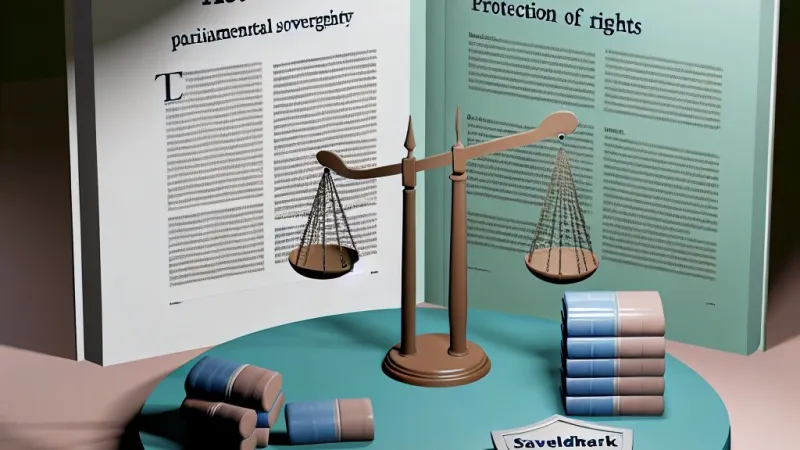
Much of the uniqueness—and controversy—of the HRA arises from the persistent tension between entrenched rights protection and the doctrine of parliamentary sovereignty. Critics argue the Act has tipped the constitutional balance, granting judges too much room to ‘reinterpret’ Parliament’s words, whilst supporters hail it as a necessary corrective to majoritarian excesses.Section 4, by allowing judges only to declare and not void incompatible statutes, preserves Parliament’s supremacy. Meanwhile, Section 3’s broad interpretative duty has been used cautiously, ensuring that truly fundamental legislative objectives remain untouched unless Parliament chooses otherwise. The debate over the HRA’s future—whether it should be reformed, repealed, or replaced by a specifically British Bill of Rights—remains fiercely contested, with Brexit intensifying questions about the UK’s ongoing commitment to Strasbourg jurisprudence.
---
Practical Impact and Contemporary Challenges
The HRA has transformed the legal and administrative landscape. Individuals are more empowered to challenge administrative decisions or public policy incompatible with their rights, whether in the sphere of policing, immigration, or social care. Public authorities now routinely factor human rights considerations into decision-making—a marked cultural shift.Nonetheless, persistent challenges remain. The precise bounds of ‘public authority’ status remain unsettled, particularly amidst the growing reliance on private contractors for public services. In addition, tensions flare when rights protection collides with security imperatives or political priorities, as seen in debates over freedom of expression, counter-terrorism, and the deportation of foreign offenders.
Moreover, widespread public misunderstanding of the HRA’s scope and purpose continues to fuel political controversy, illustrating the need for greater education and engagement with the rights culture fostered by the Act.
---
Conclusion
The Human Rights Act 1998 stands as a monumental innovation, embedding the ECHR’s guarantees into the legal bedrock of the United Kingdom. Through its creative interpretative rules, judicial remedies, and nuanced respect for parliamentary sovereignty, it has profoundly transformed the relationship between citizen, state, and law. Although the Act is not without flaws—particularly regarding its impact on the traditional doctrine of parliamentary supremacy and the difficulties in adapting rights to the complexities of modern governance—it remains a cornerstone of contemporary British constitutional law.As debates over reform intensify, what is clear is that the HRA has fundamentally shifted expectations regarding governmental accountability and individual rights protection. Its legacy is, at the very least, a permanent reminder that the protection of human rights forms a central part of our legal and political life—a lesson that will continue to shape the UK for years to come.
Rate:
Log in to rate the work.
Log in