How Photosynthesis Sustains Life: The Science Behind Nature’s Energy Process
This work has been verified by our teacher: 26.03.2026 at 14:16
Homework type: Essay
Added: 24.03.2026 at 7:05
Summary:
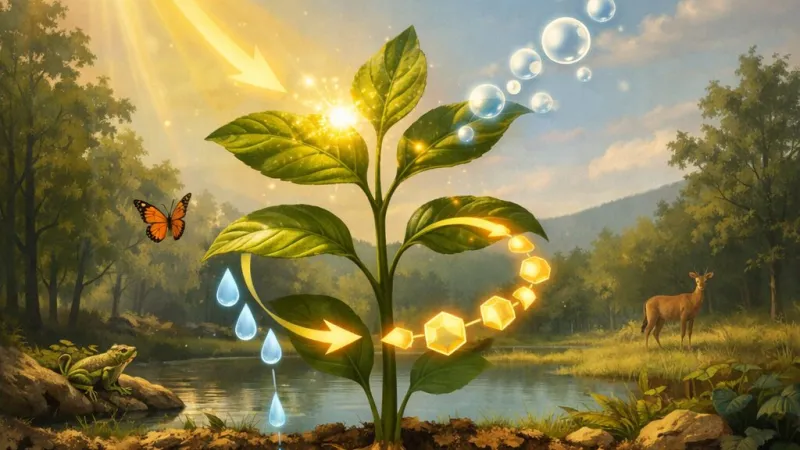
Explore how photosynthesis powers life by converting sunlight into energy, helping you understand its chemical process and vital role in nature and ecosystems 🌿
Photosynthesis: The Essential Process Powering Life
Photosynthesis is an extraordinary process upon which life on our planet fundamentally depends. It is the quiet miracle performed daily by green plants, algae and some bacteria, capturing sunlight and turning it into the energy that drives entire ecosystems. By converting carbon dioxide and water into glucose and oxygen, photosynthesis provides not only food for plants themselves but also, indirectly, for virtually every living creature. If we look at a patch of woodland in the Lake District or a rolling wheat field in East Anglia, we are witnessing photosynthesis in action—unceasing, unseen, yet absolutely essential. This essay aims to examine the intricate workings of photosynthesis, detailing the chemical and biological context, the stages of the process, and the far-reaching consequences it holds for life in Britain and beyond.
Understanding Photosynthesis: The Chemical and Biological Context
At its core, photosynthesis is best described by a chemical equation, one that many students will know from their GCSE Biology lessons:\[ 6CO_2 + 6H_2O + light~energy \rightarrow C_6H_{12}O_6 + 6O_2 \]
Here, carbon dioxide from the air and water drawn up from the soil are transformed by energy from sunlight into glucose (a simple sugar used for energy and growth by plants) and oxygen (released into the air, crucial for animal and human life). While this equation neatly captures the inputs and outputs, it disguises a complex biological process happening within specialised structures inside plant cells.
Photosynthesis occurs primarily in the leaves, where cells are abundant with chloroplasts. These chloroplasts contain chlorophyll, a pigment which absorbs light and gives plants their distinctive green hue. The cellular architecture—especially the mesophyll cells, rich in chloroplasts, and the small pores on the leaf surface known as stomata—creates an efficient system for capturing the essentials: light, water, and carbon dioxide.
The Inputs: What Plants Need to Photosynthesise
Sunlight
The British climate might not be famed for its long sunlit days, but even on a cloudy morning in Devon, enough sunlight filters through for plants to photosynthesise. Chlorophyll absorbs light most effectively in the red and blue regions of the spectrum; interestingly, green light is reflected, not absorbed, which is why plants appear green to our eyes. The energy from sunlight excites electrons in the chlorophyll, kick-starting the process that ultimately leads to the conversion of energy into chemical form.Water
Water, pulled up from the soil through the roots by osmosis and via the xylem vessels, is another critical input. Not only does water provide the electrons needed to power photosynthesis, but it also helps keep cells turgid, maintaining plant structural integrity. School experiments with celery stalks and food colouring, a classic lesson across UK classrooms, visually demonstrate this absorption and movement.Carbon Dioxide
The air around us, whether in the wild fells of Scotland or a city park in Birmingham, contains carbon dioxide—though only a small proportion (about 0.04%). Plants access this gas through stomata, which open and close to regulate both intake of CO₂ and loss of water. During the day, these tiny pores open to let CO₂ diffuse in, a process finely balanced according to environmental conditions.The Mechanism: How Photosynthesis Happens
Photosynthesis is not one single reaction, but instead comprises two main stages.Light-Dependent Reactions
The first stage, known as the light-dependent reactions, takes place in the thylakoid membranes within the chloroplasts. When sunlight hits the chlorophyll molecules, it energises electrons, which travel through a chain of proteins. This energy is used to create molecules of ATP and NADPH—chemical currencies that store and transfer energy. At the same time, water molecules are split (a process called photolysis), releasing oxygen as a by-product. In the words of Cambridge botanist Professor Nick Harberd, “Plants become the world’s solar panels and batteries rolled into one.”Light-Independent Reactions: The Calvin Cycle
The ATP and NADPH produced then move to the second stage: the Calvin Cycle, which occurs in the stroma of the chloroplast. Here, the chemical energy is used to convert carbon dioxide into glucose. The enzyme RuBisCO plays a pivotal role in fixing carbon, binding atmospheric CO₂ and ultimately generating sugars. This process operates independently of light, though only as long as the products of the earlier stage are still available.Factors Influencing Photosynthetic Rate
Photosynthesis is remarkably efficient and adaptable, but its rate can be affected by several variables, a topic often explored through experiments in British schools.Light Intensity
If you move a houseplant closer to the window, its rate of photosynthesis increases—up to a point. This is because more light means more energy for the process. However, after a certain intensity, the rate plateaus; the plant simply cannot process light any faster.Carbon Dioxide Concentration
Increasing the amount of CO₂ (as in some greenhouse farming techniques) can boost productivity, particularly in glasshouse-grown tomatoes in Kent. In the open air, however, the benefits are restricted unless other factors are also optimised.Temperature
Photosynthesis depends on enzymes, which function best within an optimal temperature range. Too cold, and everything slows down—as observed in stunted winter growth. Too hot, and enzymes can become denatured, bringing the process to a halt.Water Availability
Plants in drought conditions rapidly close their stomata, reducing water loss but also limiting CO₂ intake. Extended dry spells, such as in the summer of 2018, lead to scorched grasslands and failed crops—a stark demonstration of water’s key role in the process.The Importance: From the Smallest Garden to the Whole Biosphere
Oxygen Production
The oxygen we breathe—supporting every breath taken in a bustling London Underground carriage or a Cumbrian hill climb—is the direct product of plant photosynthesis. Forests, grasslands, even humble patches of moss between pavement stones contribute tirelessly to the maintenance of our atmosphere.Food Chains
Glucose made by plants does not just remain as sugar. It is transformed into starch (for storage in potatoes or parsnips), cellulose (for plant cell walls), oils, and proteins. These products feed not only the plant itself but become the foundation of food chains—consumed by insects, sheep grazing on moorland, and, ultimately, by people.Agriculture
Modern British agriculture, from vast arable fields to polytunnels for strawberries, relies upon understanding photosynthesis. Breeding programmes aim to develop varieties that use light more efficiently or are more resilient to drought or cold snaps. Climate change adds urgency, as unpredictable weather alters the conditions for this vital process.Advances and Adaptations
Scientific research, ever-growing in universities like Edinburgh and John Innes Centre in Norwich, continues to probe how photosynthesis could be made even more effective. Genetic modification seeks plants with improved Rubisco enzymes or altered leaf structures to maximise light capture. Meanwhile, research into artificial photosynthesis—machines mimicking nature’s process to split water and store solar energy—holds promise for green energy.Plants themselves have, through evolution, developed different strategies to cope with British, Mediterranean, or even arid climates. For instance, many British crops rely on what's called the C3 pathway, efficient in cooler, wetter conditions, while in hotter places, plants such as maize use a C4 route to better conserve water and process CO₂.
Rate:
Log in to rate the work.
Log in