Examining the Role of Beliefs in Modern British Society
This work has been verified by our teacher: 9.04.2026 at 16:05
Homework type: Essay
Added: 8.04.2026 at 15:25
Summary:
Explore how beliefs shape modern British society, learning about religion, secular ideas, and cultural identity through a clear sociological perspective.
Beliefs in Society
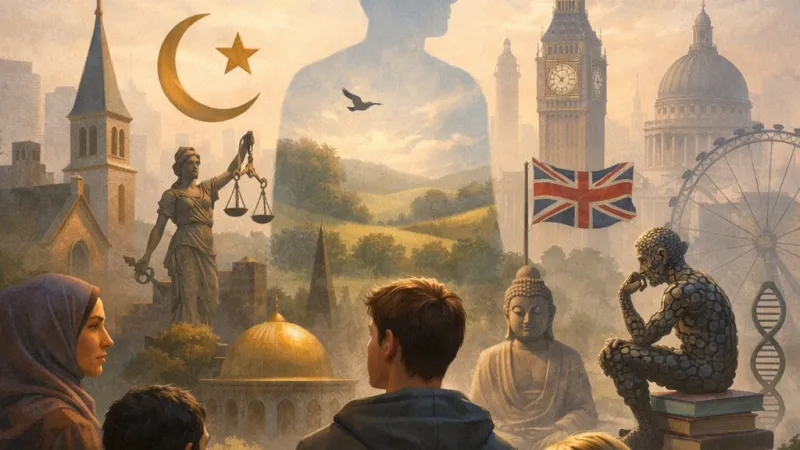
Beliefs function as the scaffolding upon which human societies are constructed, shaping both individual worldviews and collective identities. Among the myriad belief systems present in society, religion has long commanded a prominent role—serving as a wellspring for norms, values, institutional structures and guidance for personal conduct. But belief extends far beyond institutional religion, encompassing secular ideologies, scientific paradigms, and emerging spiritual movements. How we define and explain belief, and the weight we grant to different frameworks, varies across time and culture. In contemporary British society, questions surrounding the relevance, impact and future of belief are perhaps more pertinent than ever.
This essay critically examines the nature of beliefs in society through a sociological lens, interrogating the ways they underpin social cohesion and conflict, foster cultural identity, and adapt (or resist) amidst the tides of historical and global change. Drawing upon classical and contemporary theory, as well as examples from the United Kingdom’s context, I argue that beliefs are complex and dynamic social forces: they are simultaneously conservative and revolutionary, divisive and integrative, deeply historical yet perpetually in flux.
---
1. Conceptualising Religion and Belief Systems
To analyse beliefs in society, it is essential to begin with definitions. Sociologists have developed several approaches to defining religion and belief systems, each with unique strengths and shortcomings.Substantive definitions focus on the content of belief, typically requiring faith in supernatural entities or forces. For instance, Edward Tylor’s definition—“belief in spiritual beings”—has been widely cited. Yet this approach has been criticised for being overly narrow and culturally biased. Such a definition may exclude systems like Buddhism (which, in some strands, lacks a personal deity) or question whether non-theistic traditions common in the East are truly ‘religious’ at all.
Functional definitions shift the emphasis from content to purpose. Rather than what a religion is, these ask what it does—does it unite people, provide purpose, answer existential questions? Emile Durkheim described religion as “…a unified system of beliefs and practices relative to sacred things… which unite into one single moral community…” By this view, even secular or ‘quasi-religious’ phenomena—such as nationalism or environmentalism—could be classified as religious. This inclusivity, while illuminating, risks conflating all group-binding beliefs under a single category.
Social constructionist definitions take yet another perspective, arguing that religion is whatever people perceive as such. This acknowledges the flexibility and contested nature of religion, underscored by the historical shift in the UK from Christianity as a cultural default to a landscape where many self-identify as “spiritual but not religious”, and new religious movements (NRMs) proliferate. The challenge remains: without agreed criteria, useful comparison can become difficult.
Classifying belief systems is further complicated by blurred boundaries: are ‘sects’ always religious, can atheism be a belief system, and how do spirituality and religion differ? The diversity seen in multicultural Britain, with flourishing Sikh temples in West Yorkshire and increasing numbers of ‘nones’ declaring no religion, reflects these ongoing debates and the need for flexible, nuanced definitions.
---
2. The Functions of Religion in Society
Academic theorists have long examined what roles religion and beliefs perform. These range from mechanisms for cohesion and comfort, to vehicles for division and dissent.A. Social Cohesion and Integration: Durkheim posited that religion creates ‘collective conscience’, fostering solidarity through shared rituals and the distinction between the sacred and profane. Consider the unifying nature of state ceremonies—such as Remembrance Sunday at the Cenotaph in London—where secular and sacred motifs intertwine, fostering national unity and shared mourning through ritual.
B. Psychological Functions: Bronisław Malinowski viewed religion as essential in times of crisis, providing explanations and comfort amidst uncertainty. Public displays of ritual—in the aftermath of tragedies such as the Grenfell Tower fire, or vigil services following terrorist attacks in Manchester or London—demonstrate this resilience function, as communities rely on shared belief as a means of coping and healing.
C. Cognitive Functions: Religions offer frameworks for interpreting the world, providing answers to fundamental questions around morality, justice, and the origins of life. These frameworks help shape social expectations and guide moral behaviour, influencing day-to-day decisions ranging from dietary choices to attitudes toward life and death.
D. Feminist Critiques: Functionalist accounts have been critiqued for their universalism. Feminist scholars like Simone de Beauvoir and Mary Daly have examined how traditional religions often underpin patriarchal systems, relegating women to subordinate positions or spiritual ‘others’, as in the historical exclusion of women from priesthoods or places of worship. The Church of England’s long battle over women bishops exemplifies this tension between religion as a force for unity and as a maintainer of inequality.
---
3. Theories Explaining Religion
Functionalism highlights religion’s role in promoting stability and collective conscience, but critics argue it overlooks how belief divides societies, fuels prejudice (e.g., sectarianism in Northern Ireland), or disguises injustice.Marxism views religion as ideology: “the opium of the people”, in Karl Marx’s famous phrase. It soothes distress but ultimately acts to legitimise inequality and prevent uprising by promising future reward rather than present action. Neo-Marxists, however, recognise that religion can inspire resistance—such as the civil rights campaigns led by churches in 20th-century Britain, or Christian opposition to apartheid in South Africa.
Weberian theory, notably Max Weber’s work on The Protestant Ethic, asserts that religious beliefs can spur economic and social development. Weber linked Calvinist predestination beliefs to the emergence of British capitalism—a controversial but influential hypothesis, demonstrating religion’s potential to drive not just stability but transformation.
Feminist and postmodernist approaches add further complexity. For feminists, religion’s relationship with gender is paradoxical: it often sustains patriarchy, but also provides spaces for female leadership and community (as in some Methodist and Quaker traditions in the UK). Postmodernists, meanwhile, reject grand theories and meta-narratives, pointing to the rise of personal, syncretic spirituality—seen in the popularity of yoga, mindfulness, and New Age practices decoupled from dogma.
---
4. Religion and Social Change
Religion has been both a brake and an engine for change. Sometimes, it bars the road to reform: the Church of England, as an established institution, has at times resisted progressive reforms (for example, to same-sex marriage). Yet as Weber’s work suggests, ‘world-rejecting’ beliefs can cultivate radical new social visions. In the UK, non-conformist churches provided the backbone for many 19th and 20th-century campaigns for workers’ rights, abolition of slavery, and suffrage.Religious movements remain important in global contexts. The resurgence of Catholicism in Poland as a rallying point against Communism, or the role of Islamic values in shaping Iranian revolutionary identity, shows how faith often underpins both cultural resistance and mass mobilisations. Conditions—such as political oppression, cultural marginality or existential uncertainty—influence whether religion consolidates order or agitates for change.
---
5. Secularisation and the Changing Role of Religion
Secularisation theory, advanced by sociologists such as Steve Bruce and Bryan Wilson, posits a long-term decline in religious belief and practice as societies modernise. Statistical data (e.g., the British Social Attitudes Survey) reveals that self-identification with Church of England and regular church attendance have both plummeted since the mid-20th century. Rationalisation and scientific progress pose further challenges; explanations for illness, disaster and morality are increasingly sought outside religious frameworks.However, this narrative is not uncontested. Religious diversity is rising, with Muslim, Hindu, and Sikh communities growing within UK cities. New spiritualities—such as Wicca or holistic therapy movements—point to transformation rather than outright decline. Stark and Bainbridge’s Religious Market Theory even posits that pluralism and consumer choice keep religion vibrant in some contexts; Norris and Inglehart’s work links religious decline to increasing existential security rather than modernity per se.
In times of rapid social change or uncertainty, religion may reassert itself as a source of identity—evident in the reinforcement of Catholicism in Ireland, or growth of Pentecostalism among West African diasporas in London.
---
6. Globalisation and Religion
Globalisation reshapes belief in myriad ways: faiths migrate across borders with people, adapt to local contexts, and foster transnational networks. The proliferation of charismatic Pentecostal churches in urban Britain, attended by migrants from Nigeria and Ghana, illustrates how religious identities travel and hybridise.Simultaneously, the global spread of secularism and consumerism can provoke defensive reactions, evident in the growth of religious fundamentalism. In the UK, this is seen in debates over faith schools, the rise of political Islamism, and resurgence of traditionalist Catholic and Anglican movements. The ‘clash of civilisations’ thesis, popularised by Huntington, forecasts increasing conflict at cultural-religious boundaries, but this perspective is challenged by evidence of successful pluralism and intercultural dialogue in cities like Leicester—the UK’s most diverse city.
---
7. Religious Organisations and Social Divisions
Religious organisations present a substantial area of sociological investigation. From established churches (the Church of England), to denominations (the Salvation Army), sects, and cults—each has distinct patterns of recruitment, authority and relationship with society.NRMs like Scientology or Hare Krishna communities thrive among disaffected youth seeking belonging, while traditional sects like the Quakers have seen renewal through an emphasis on social justice. Demographic factors—gender, ethnicity, age—greatly influence religious affiliation and practice in Britain, with women consistently reporting higher religiosity (despite constraints within some traditions), and British Muslims forming some of the youngest, fastest-growing religious cohorts.
Institutional religion may decline, but private spirituality and non-institutional beliefs often flourish in its stead, suggesting that secularisation is by no means a simple process of vanishing faith.
---
8. Religion, Ideology, and Science
Sociology highlights not just religion but also scientific and ideological beliefs as structuring social life. Karl Popper famously distinguished science as an ‘open belief system’, grounded in hypothesis and falsification, while critics such as Thomas Kuhn and feminist theorists highlight the social biases and power structures entrenched even in scientific institutions.Religious systems, comparatively, are often described as ‘closed’, marked by dogmas and resistance to disproof. Nonetheless, science and religion serve parallel purposes: explaining phenomena, generating meaning, and justifying social arrangements. Political ideologies (conservative, socialist, liberal) frequently intersect with religious values, as seen in the faith-based arguments in UK debates over welfare, education, and bioethics.
---
Conclusion
Beliefs, whether religious, scientific or ideological, are intrinsic to social life. They underpin social cohesion and moral order, but also inspire contestation, reform and resistance. The British experience illustrates this complexity: from the long shadow of Anglican establishment to the vibrancy of immigrant faith communities and the growing appeal of non-religious worldviews.Recognising the diversity, adaptability and embeddedness of belief in society enables us to appreciate both its stabilising and disruptive potentials. As twenty-first century Britain continues to change—through globalisation, digitalisation, and increasing diversity—the study of belief systems remains vital for understanding the fabric of social life. Future research might explore the role of online communities in shaping spirituality, the negotiation of plural identities, and the ongoing interplay between ideology, science, and faith. These are not only questions of academic interest, but challenges shaping the future of society itself.
Rate:
Log in to rate the work.
Log in