Exploring Culture and Socialisation in Shaping British Identity
This work has been verified by our teacher: 8.04.2026 at 16:42
Homework type: Essay
Added: 7.04.2026 at 10:53
Summary:
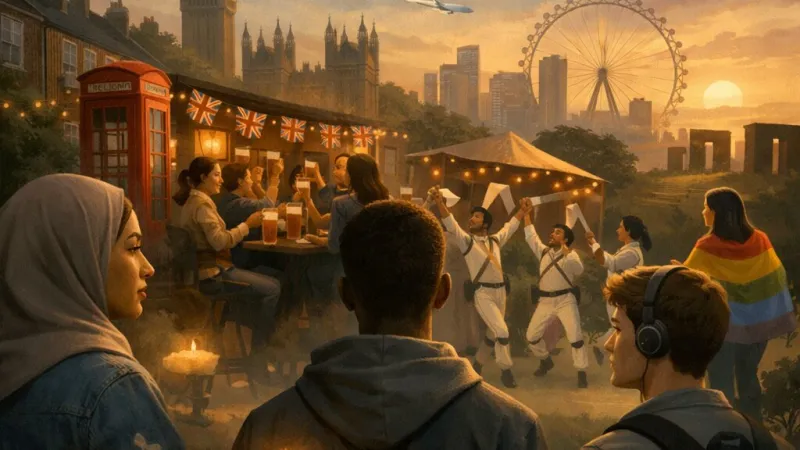
Explore how culture and socialisation shape British identity, revealing key social influences and diverse experiences in contemporary UK society.📚
Component 1 Section A: Culture, Socialisation, and the Making of Identity
The sociological study of culture and socialisation reveals the intricate processes by which individual and collective identities are forged, challenged, and reimagined in contemporary Britain. Far from being simply “a way of life,” culture encompasses shared symbols, rituals, meanings, and the power structures that uphold or contest them. Socialisation, meanwhile, is the lifelong process through which people internalise norms, values, and social roles, often mediated by families, peers, schools, the media, religion, and the workplace. Understanding how ethnicity, gender, sexuality, social class, and age intertwine to shape identity is crucial in making sense of the rich diversity and persistent inequalities in British society. This essay will critique simplistic understandings of culture and socialisation, drawing upon relevant theories, empirical examples, and British cultural contexts. We will identify and interrogate the roles of key socialising agents and analyse how intersecting social positions, such as class, race, and gender, produce varied experiences of belonging and difference. In so doing, we seek to illustrate the dynamic, contested, and context-specific nature of identity formation, engaging with ongoing debates across sociological thought.
---
1. Understanding Culture and Socialisation
1.1 The Multifaceted Nature of Culture
Culture in sociology demands a deeper appreciation than its everyday use as mere tradition or custom. At its heart, culture consists of the shared meanings people assign to the world and each other—expressed in rituals, language, norm systems, fashion, foodways, law, and art. Conflict theory and Marxist traditions in British sociology point out how dominant ideologies—embodied, for example, in “high culture” institutions like the Royal Opera House or Eton College—both reflect and reinforce power structures, often marginalising or “othering” working-class or minority ethnic cultures. Postmodern theorists, such as Stuart Hall, have emphasised how culture is fluid, contested, and driven by ongoing hybridity—think of London, where Caribbean, South Asian, and British traditions intersect in new forms, evidenced by the annual Notting Hill Carnival or the popularity of fusion cuisines. Culture is thus far from monolithic; it is always in flux, shaped by resistance, negotiation, and adaptation.Importantly, British society has witnessed the evolution of “popular culture”—from the Beatles and punk rock through to Grime and Love Island—often blurring the lines between what is deemed high or low. This highlights not just difference, but an ongoing dialogue within culture, sometimes reflecting underlying class or generational fault lines.
1.2 Socialisation: From Cradle to Grave
The process of socialisation unfolds in two main phases: primary socialisation, typically led by the family, where children learn initial language, values, and identities; and secondary socialisation, mediated by agents such as schools, peers, the media, and workplaces. In a British context, families transmit not just a “nuclear” model but a multitude of structures, including extended kin networks common among certain minority ethnic groups.Educational institutions, such as comprehensive schools, act as crucial sites of secondary socialisation, imparting both explicit curriculum knowledge and the “hidden curriculum” of social norms, authority relationships, and expectations. Sociologists like Bowles and Gintis have argued that schools reinforce existing class structures through this hidden curriculum, while others highlight examples of resistance and agency among students.
Peers become vital as young people navigate adolescence, often negotiating conformity and deviation (for example, through subcultures like Mods, Goths, or contemporary “roadmen”). The media, too, wields immense influence, from shaping ideals of lifestyle and beauty, to providing role models and sites of identification—or exclusion (as with the oft-criticised lack of positive representations of working-class or non-white Britons on television). Yet the “hypodermic syringe” model of media influence has given way to more nuanced theories of active audiences who negotiate meaning.
Workplaces constitute a site of resocialisation, requiring individuals to adapt to occupational norms and hierarchies—from the “office banter” of white-collar work to the manual dexterity demanded in skilled trades. Collectively, these socialising agents reveal how identity is constructed, not passively absorbed, with room for both constraint and creativity.
---
2. Ethnicity and the Construction of Identity
2.1 Ethnic Identity: Social Origins and Evolution
Ethnicity is commonly recognised through cues like language, dress, religious practice, or skin colour. It is, however, a social construction—its meanings and significance shifting through time and context. In Britain, the notion of “hyphenated” or “hybrid” identities—such as British-Pakistani or Black British—attest to the complex realities of multiculturalism. Benedict Anderson’s notion of “imagined communities” is pertinent here: national identity is constructed through symbols, rituals, and shared narratives, sometimes inclusive, but often contesting who “belongs.”Notably, diaspora communities, such as the Bengali population in East London or the Somali community in Cardiff, illustrate both the maintenance of heritage (through language, religious observance, or food) and the evolution of new, hybrid cultural forms, often as acts of subtle resistance or self-definition.
2.2 Ethnicity, Socialisation, and Belonging
Primary socialisation within ethnic families often involves the transmission of cultural and religious values alongside language and customs. In some West African or South Asian households, extended family networks play a stronger role than is typical in many white British families, impacting the experience of children and young adults. Gender roles, too, may be delineated differently, sometimes clashing with wider British social expectations.Education acts as a double-edged sword for minority ethnic groups: while schools can offer positive role models (e.g., Nadiya Hussain winning Great British Bake Off), the curriculum has been criticised for failing to represent the histories of black and Asian Britons, perpetuating a narrow, Eurocentric perspective. Phenomena such as “code-switching”—alternating language or dialect depending on context—highlight how many minority youth navigate between home cultures and mainstream expectations. The experience of institutional racism or stereotyping, from playground taunting to disproportionate exclusions, further complicates identity formation.
Media, meanwhile, remains a battleground: negative representations (for instance, tabloid depictions of “illegal immigrants”) can reinforce stigma, while more recent efforts at inclusion (such as actors of colour in Doctor Who or diverse casts in soaps) offer avenues for affirmation and change.
---
3. Gender and Sexuality: Learning and Unlearning Roles
3.1 Gender: Beyond the Binary
Sociological wisdom agrees that gender roles are produced and policed by society, rather than reflecting innate biology. From the pink-blue divide in children’s toys to gendered expectations in schooling (“boys don’t cry,” “girls are quiet”), young people in Britain are socialised into particular scripts of masculinity and femininity. Connell’s concept of “hegemonic masculinity” is evident in the valorisation of stoicism and competitiveness—though alternative masculinities (from David Beckham’s “metrosexual” persona to activists challenging toxic masculinity) contest these norms.In schools, gendered outcomes persist: girls continue to outperform boys academically, yet remain underrepresented in STEM fields and leadership roles. Media representation—think Page 3 in the Sun (now defunct), or the contrasting imagery of “ladettes” and “Essex girls”—both reflects and shapes gendered aspirations, though more diverse and inclusive portrayals are gradually emerging.
Britain has witnessed a “genderquake,” as described by Helen Wilkinson, with women’s ambitions and occupational roles expanding alongside persistent pay gaps and glass ceilings. Simultaneously, men grapple with shifting expectations—navigating between traditional and new models of masculinity.
3.2 Sexuality and Social Attitudes
Sexual identity, long policed by law and social norms (homosexuality was only decriminalised in England and Wales in 1967), increasingly reflects a spectrum rather than a binary. Many young people now identify as bisexual, pansexual, or queer—fluid and chosen, rather than fixed. However, the “heteronormativity” embedded in family, school, and media means that LGBTQ+ identities can be subject to marginalisation or even hostility.Socialisation into sexuality remains complex: some individuals engage in same-sex experiences without claiming an explicit identity label. The continuing evolution of attitudes—Brummies waving Pride flags, drag culture on mainstream television—shows how identities are both shaped by, and push against, prevailing norms. Importantly, peer groups and media have a dual power: they may provide affirming communities or reinforce harmful stereotypes, highlighting agency alongside constraint.
---
4. Social Class: Old Divides, New Realities
4.1 The Significance of Class
Social class in Britain is not just about income; it encompasses occupation, educational attainment, status, and cultural capital (Bourdieu). Traditional distinctions—upper, middle, working class—are still evident in speech, taste, and aspiration: consider the social connotations attached to accents (RP versus “Estuary English”), or the enduring popularity of shows like Downton Abbey, which romanticise upstairs-downstairs divisions.Post-industrial shifts have complicated these boundaries: the decline of heavy industry has transformed working-class identity (Grimsby or the Welsh Valleys) even as new forms of precarity emerge (the “gig economy”). Some commentators, such as Savage et al. (2013), argue that class today expresses itself less in sheer economic terms than through networks, lifestyles, and consumption practices—from artisan coffee to holiday destinations, taste remains a marker of belonging.
4.2 Class, Socialisation, and Inequality
Family upbringing transmits not only values and norms, but aspirations and forms of “cultural capital”—for example, access to literature, familiarity with art galleries, confidence in dealing with authority. Education is a key battleground: grammar schools, comprehensive reforms, the persistence of elite private schools (Eton, Harrow), and debates around university access reveal persistent class-based inequalities.Peer groups frequently reinforce classed norms—those who “sound posh” or “rough” may be singled out at school—and the media too often trades in stereotypes (the “chav” discourse; upper-class “toffs”). Meanwhile, work life may cement or challenge class identity, as professional environments foster “soft skills” and social codes distinct from those in manual or service work. The workplace, therefore, offers both continuity and transformation of class identity through new social networks and role expectations.
---
5. Age and the Lifecycle: Identities in Context
5.1 Childhood, Youth, and the Impact of Transition
The contemporary notion of “childhood” as a protected, distinct stage is a relatively modern invention. British sociologist Philippe Ariès traces its emergence in the 19th century, influenced by compulsory schooling and child labour laws. Today, children and young people navigate a complex socialisation landscape: digital media, youth subcultures, and shifting family forms all contribute to a dynamic environment for identity formation.Peer groups play an outsized role in adolescence, often setting boundaries for acceptable behaviour and taste—sometimes fostering inclusivity, other times exclusion. The rise of social media has amplified this, with platforms like TikTok and Instagram offering new sites for self-fashioning but also new perils, from cyberbullying to hyper-surveillance.
5.2 Adulthood, Ageing, and Shifting Social Expectations
Adulthood brings further role transitions: parenthood, employment, citizenship. The elderly, meanwhile, confront societal ageism, their representation often limited to caricatures of decline or nostalgia (the “grumpy old man,” the “sweet granny”). Yet, longer life expectancies and changing family structures mean that old age itself is highly differentiated—embracing everything from active retirees engaging in new volunteer roles to those facing isolation or poverty.Retirement, once a clear endpoint, now offers varied trajectories: for some, a time of renewed autonomy and social engagement; for others, a trigger for re-negotiating identity in the face of loss, ill-health, or changing family dynamics.
---
Rate:
Log in to rate the work.
Log in