Lord of the Flies: Comprehensive Plot Summary and Analysis
This work has been verified by our teacher: 16.04.2026 at 18:12
Homework type: Essay
Added: 14.04.2026 at 11:55
Summary:
Explore a comprehensive plot summary and analysis of Lord of the Flies to understand key themes, character dynamics, and the novel’s insight into human nature.
Lord of the Flies: Plot Summary
William Golding’s *Lord of the Flies* remains a central fixture of the British literary canon and the UK secondary curriculum, not only as an adventure story but as a searching examination of human nature. Set during a period evocative of the Second World War, the novel transports an evacuated group of schoolboys from the shelter of home to the raw, untamed wilderness of an uninhabited island. Within this microcosm, the boys’ attempt to construct a functional society, only to watch it unravel beneath the pressures of fear, rivalry, and the lurking bestiality of the human spirit. As this essay traces the key events of the narrative, it will also interweave the major motifs and shifts in power that chart the group’s profound transformation. More than a tale of survival, Golding’s plot line lays bare the precariousness of civilisation and the lurking savagery that lies beneath its surface—a concept still pertinent in modern discourse about society, order, and the innate impulses of youth.
---
Initial Order and Leadership Formation
The opening of *Lord of the Flies* quickly acquaints the reader with the chaos that accompanies both war and adolescence. Following the crash of a plane evacuating British schoolboys, Ralph, a twelve-year-old described with the effortless authority of a natural leader, is the first to emerge from the jungle-fringed shore. He soon encounters the bespectacled, asthmatic Piggy, whose intellectual curiosity and physical limitations set him apart from the others. Their initial exploration uncovers the conch shell, which, when blown by Ralph, draws the scattered survivors together, many still clad in remnants of their school uniforms—a symbol of lingering structure and decorum.The arrival of Jack Merridew’s choirboys, moving "like a creature" under his command, injects the group with a more regimented energy. In a display that echoes the traditions of English boarding education, the boys hold a democratic vote for chief. Ralph’s election, owing much to his charisma and the practical symbolism of the conch, sows the first seeds of factional resentment as Jack is appointed head of the hunters. Almost immediately, cracks appear: discussions about the mysterious ‘beastie’ and the need to keep a signal fire burning reveal both the boys’ anxieties and their urge to cling to the routines of their former lives.
Their makeshift signal fire, kindled by focusing sunlight through Piggy’s glasses, blazes uncontrollably, consuming part of the forest—and, it is implied, one of the youngest boys, marked only by a birthmark on his face. This grim incident foreshadows the cost of carelessness and the unpredictability of their new world.
---
Conflicting Priorities and Cracks in Cooperation
Despite their early attempts at constructing order, discord swiftly emerges from differing views on what is most important for their survival. Ralph, ably assisted by Simon, works to build shelters—a tangible form of security and community. In stark contrast, Jack’s growing obsession with hunting is driven less by hunger than by a mounting excitement and bloodlust. The two leaders’ priorities illustrate a broader conflict between civilisation (represented by the maintenance of order and hope of rescue) and savagery (symbolised by the allure of the hunt).Simon’s character distinguishes itself here; unlike the others, he finds solace in the secluded beauty of the forest, foreshadowing his eventual status as an outsider and visionary. Meanwhile, Roger and Maurice's torment of the younger ‘littluns’ signals a decay of moral constraint; as adult authority fades, so too does the boys’ adherence to the rules of home.
A crucial turning point comes when the hunters, finally successful in their quest to kill a pig, let the vital signal fire extinguish at the very moment a passing ship skims the horizon. Ralph’s fury at this lost opportunity for rescue, coupled with Jack’s violent response—smashing Piggy’s glasses—further heightens tensions and undercuts the fragile social contract they had just begun to erect.
---
Rising Fear and the Myth of the Beast
As days pass, the sense of safety that shelters and rules once provided slowly dissolves. Ralph, now struggling to maintain authority, calls a meeting to refocus the group on essential tasks. Yet the shadow of the ‘beast’ looms ever larger, spreading panic and superstition. Even Piggy’s rational explanations cannot dispel the fear, suggesting that terror is as much an internal force as an external danger.The sudden arrival of a dead parachutist on the mountaintop—his body twisted and animated by the wind—introduces a new, more tangible object of dread. Sam and Eric, the twin boys on fire-watch, stumble upon the ‘figure’ and their panicked report to the others fuels a collective hysteria. Sensing opportunity, Jack proposes an expedition to hunt and kill the beast, a move which subtly shifts the group’s energy towards aggression and the worship of violence. The exploration of the island in search of the creature becomes in itself a rite of passage, forcing Jack and Ralph to confront both their surroundings and their own fears.
---
The Descent into Savagery
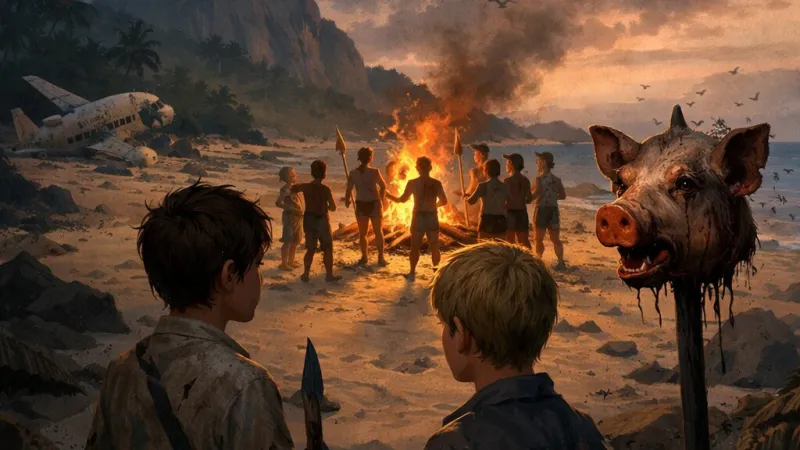
As the days blur and routine fragments, physical changes manifest in the boys: clothes are discarded, hair grows lank, and dirt becomes a second skin. Moral standards slip with each pig killed, each boundary crossed. The hunt for a wild boar becomes a frenzied ritual, culminating in a disturbing mock dance where even Ralph is momentarily caught up in the bloodlust.The true ‘beast’—still misunderstood—is encountered as nothing more than the lifeless parachutist, but the boys’ terror turns observations into imaginings. Jack’s failed attempt to usurp Ralph leads to open rebellion: rejected, he retreats into the forest with a splinter group. There, with uninhibited savagery, they slaughter a sow and impale its head as an offering to the beast—an act both visceral and ritualistic. This gruesome symbol, buzzing with flies, embodies the darkness at the heart of the group, earning the name 'Lord of the Flies'.
In a profound, hallucinated encounter, Simon confronts the pig’s head, experiencing what can be interpreted as a moment of pure insight or even madness: he understands that the real beast is not a physical entity, but the collective violence and savagery grown within the boys themselves.
---
Tragedy and Complete Breakdown
Simon’s epiphany galvanises him to convey the truth, but the group, now fully immersed in primal ritual, mistakes him for the beast as he stumbles into their frenzied dance. In an orgy of violence, Simon is brutally murdered—a moment that starkly signals the collapse of moral restraint.The immediate aftermath is marked by a charged sense of denial and shame among the remaining members of Ralph’s faction. Jack, now dictatorial, establishes dominance in the forest, seizing Piggy’s spectacles to light fires for his own tribe—this theft is both a literal and figurative blinding of reason.
The last ties to civilisation are unravelling; Ralph’s leadership is in tatters, and Piggy is left increasingly vulnerable, his appeals to logic and decency drowned out by the ever-louder calls of Jack’s mob.
---
Final Showdown and Resolution
Driven to desperation, Ralph and his dwindling allies approach Jack’s stronghold to reason and plead for the return of Piggy’s glasses. The confrontation is climactic: as Piggy makes one final, impassioned appeal to sense and justice, Roger dislodges a boulder that strikes Piggy, killing him and shattering the conch shell. This moment, simultaneously the destruction of the group’s last symbol of democracy and Piggy’s death, signals the irrevocable end of civil order.With Ralph alone, Sam and Eric are tortured into submission, leaving him hunted like prey. The island is set alight in an attempt to smoke Ralph out, the habitual signal fire now a weapon of destruction. In a final desperate flight, Ralph bursts onto the beach, only to collapse at the feet of a naval officer. The abrupt return of adult order brings sudden calm, but the rescue is bittersweet. The officer, imposing all the discipline and naivety of British imperial authority, is unable to comprehend the depth of savagery that has just occurred, and the surviving boys are left to grapple with the irreversible loss of their innocence.
---
Rate:
Log in to rate the work.
Log in