Exploring the Family: Sociological and Anthropological Insights in Modern Britain
This work has been verified by our teacher: 19.04.2026 at 12:24
Homework type: Essay
Added: 16.04.2026 at 13:42
Summary:
Explore sociological and anthropological insights into family dynamics in modern Britain to understand how definitions and roles have evolved over time.
The Concept of Family: A Critical Examination from Sociological and Anthropological Perspectives
The notion of ‘family’ is among the most fundamental, yet complex, elements within society. Whether encountered in discussions of social policy, in literature from Jane Austen to Zadie Smith, or within the practical arrangements of everyday life, its significance cannot be overstated. Yet despite its prominence, the term ‘family’ resists easy definition, constantly shifting to reflect the values, circumstances, and expectations held by communities and individuals alike. This essay aims to unpack the concept of family through both sociological and anthropological frameworks, exploring not only how families are constructed and understood but also how they have evolved and diversified in modern Britain. By drawing upon empirical evidence, classic and contemporary scholarship, and distinctly UK-based examples, I will argue that family is a dynamic institution shaped by cultural, economic, and political factors. Recognising this complexity is vital—not only for advancing academic understanding but also for informing public policies that recognise the realities and inequalities in people’s lived experiences.
---
Defining ‘Family’: Sociological Perspectives
Traditional and Contemporary Understandings
Traditionally, particularly in the image presented by much post-war British media and policy, the ‘family’ was often equated with the nuclear model: a married heterosexual couple and their children. This conception—epitomised in sitcoms like "The Good Life" and in sociological classics such as Parsons’s work—assumed clearly delineated gender roles: the man as breadwinner, the woman as homemaker. However, in recent decades, this model has been steadily challenged both in practice and in theory. Many sociologists now argue for definitions that prioritise emotional connections, shared identities, and patterns of care over biological or legal ties.For instance, David Morgan’s ‘family practices’ concept highlights the way individuals ‘do’ family through everyday activities—be that a weekly Sunday roast, offering support in times of illness, or attending a child’s school play. Janet Finch and Jennifer Mason have similarly explored how family membership is negotiated through acts of intimacy and obligation, suggesting family is best understood not as a fixed structure but as a set of actively constructed relationships.
Family as a Social Construct
Sociologically, then, ‘family’ is seen less as a given and more as a construct that is reworked across time, space, and context. What constitutes family in rural Northern Ireland, for example, may differ considerably from the experience of a migrant family in inner-city Manchester or a same-sex couple in Brighton. Schneider’s work on kinship further supports this, arguing that the rules governing inclusion in the family are both contextually determined and subject to negotiation. Contemporary British society thus demands flexible definitions, sensitive to lived experience as well as formal status.---
Typologies and Forms of Family
Classic Family Types
In the UK, the nuclear family long enjoyed privileging as the ideal. Its perceived stability made it central to government policy (as seen in the promotion of married couples in Conservative rhetoric). Yet, throughout British history, the extended family—incorporating grandparents, aunts, and cousins—has played a significant role, particularly in working-class communities or among recent migrants. The Welsh valleys, for instance, have traditions of multi-generational households rooted in economic necessity and mutual aid.Emerging and Alternative Family Forms
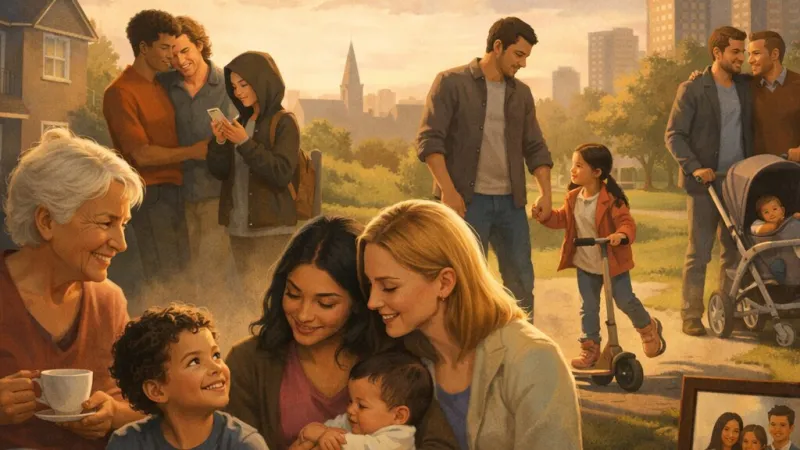
The last fifty years have seen a marked diversification of family forms, a fact reflected in Office for National Statistics reports charting the rise of lone-parent families (now approximately 15% of families with dependent children), stepfamilies, and families of choice. Stepfamilies are increasingly common as divorce and remarriage have lost much of their earlier social stigma. Similarly, LGBT+ individuals have challenged the notion that family must be rooted in blood or heterosexual marriage: as Jeffrey Weeks discusses, ‘families of choice’ prioritise networks of affection and care, often outside traditional kin relations.Migration has also fostered what social scientists term ‘transnational families’, where relatives sustain ties and obligations across borders. For example, Somali and Polish communities in London maintain close WhatsApp contact and frequent travel to ensure cohesion despite physical distance.
Fluidity and Change
Researchers such as Graham Allan and Glynne Evans have observed that family is an ‘evolving’ institution, subject to continual contestation and renegotiation. The increase in cohabitation, births outside marriage, and single-person households in Britain signals both broad cultural shifts and changing structural conditions—rising female employment, economic precarity, and shifting attitudes about gender and sexuality.---
Explaining Changes in Family Structures
Socioeconomic Factors
One of the driving forces behind the transformation of family in the UK has been the increased participation of women in higher education and the labour market. Legislation such as the Equal Pay Act 1970 and equality initiatives have facilitated greater economic independence, reducing the perceived necessity—and, at times, the appeal—of marriage as an economic partnership. Moreover, the decline of heavy industry and the shift towards service-based employment have undermined older patriarchal models in many communities.Individualisation
Anthony Giddens and Ulrich Beck have both theorised the ‘individualisation’ process, where personal fulfilment and autonomy take precedence over traditional familial duty. This has led to trends such as ‘serial monogamy’, delayed marriage, and a growing emphasis on personal choice. While these developments may be liberating for some, they also introduce new insecurities around care in later life, as family support systems become less predictable.Technological and Cultural Shifts
Access to reliable contraception, IVF, and other assisted reproductive technologies has helped decouple sex from reproduction, enabling new family formations and challenging older moral frameworks. The public acceptance of same-sex parenting, as marked by the legalisation of same-sex marriage in 2014, further illustrates the cultural shift towards recognising diverse families.---
Social Divisions and Inequalities within Family Life
Gender and Family Roles
While the classic breadwinner/homemaker split has faded in many households, studies show that women continue to perform the bulk of unpaid domestic labour, even when both partners work full-time. This ‘double burden’ is evident in time-use surveys and has sparked renewed debates about equality within the home, especially during the covid-19 pandemic when childcare demands surged. Feminist scholars have long critiqued compulsory heterosexuality and the normalisation of specific gender roles, noting that policy and popular media often reinforce them.Sexuality and Family
For much of British history, LGBT+ individuals were excluded from mainstream conceptions of family, sometimes losing contact with biological relatives upon ‘coming out’. Over time, however, alternative kinship structures have emerged—‘found families’ built on mutual support, as seen in the history of the London queer scene and the support networks established during the HIV/AIDS crisis. Legal recognition and social acceptance have increased, but discrimination remains, particularly for trans and non-binary parents navigating custody and adoption.Race, Ethnicity, and Family Practices
Families from minority ethnic backgrounds often experience distinct challenges. South Asian, African-Caribbean, and Eastern European households, for instance, may retain strong traditions of family obligation, affecting living arrangements, elder care, and expectations around marriage. At times, these practices have been met with misunderstanding or prejudice by policy-makers and the wider society. The Windrush scandal starkly illustrates the consequences when assumptions about ‘proper’ family ties collide with state power.---
The Public and Political Dimensions of Family
Family in the Realm of Public Policy
Family life is inextricably linked to the state. Government interventions—such as tax credits, parental leave, and the Child Benefit—reflect efforts to shape or support families according to particular ideals. Simultaneously, official recognition of partnerships, reforms to adoption law, and family court proceedings reveal the ways public policy demarcates legitimate from illegitimate family forms. Arguments over welfare ‘dependency’ often rest on assumptions about lone parents or ‘broken’ families, showing how moral judgement can have tangible effects on access to resources.Social Consequences of Judgements about Family
Stigmatising non-traditional families—lone parents, cohabiting couples, same-sex parents—contributes to exclusion and disadvantage. Negative stereotypes are not merely symbolic but impact employment, housing opportunities, and educational attainment, reinforcing cycles of inequality. Improving social cohesion demands greater acceptance and policy reform that recognises the diversity of real families.---
Anthropological Insights into Family and Kinship
Methodologies in Studying Family
Anthropologists employ fieldwork and participant observation to uncover the diversity of family life cross-culturally, emphasising the importance of cultural relativism in interpreting practices different from one’s own. For example, the work of Audrey Richards in Zambia helped British social scientists appreciate the range of kinship roles and responsibilities found outside Europe.Kinship as Central to Anthropological Study
Within anthropology, family is often subsumed under the larger framework of kinship—distinguishing between relationships of descent (consanguinity) and those created through marriage (affinity). These frameworks illuminate how societies organise inheritance, residence, and social status, as seen in matrilineal systems in parts of Ghana or patrilineal inheritance among the Nuer people.Family and Kinship in Small-Scale Societies
Kinship not only structures daily life but also underpins political alliances and economic arrangements, with duties and rights delimited by position in the kin network. For instance, among the Scottish clans, lineage determined not only one’s surname but also land rights and allegiances—a system with echoes in modern legal and cultural practices.---
Synthesising Sociological and Anthropological Perspectives
While sociology often examines family in relation to modern institutions, power, and change, anthropology’s comparative approach brings to light the vast array of arrangements and meanings possible. By combining both disciplines, one can challenge parochial assumptions and better appreciate the historical and cultural contingencies that give rise to particular family types. This synthesis not only advances scholarship but creates space for empathy and understanding in policy and everyday life.---
Rate:
Log in to rate the work.
Log in