The Rise of Richard III and the Fall of Edward V: A Medieval Power Struggle
This work has been verified by our teacher: 25.03.2026 at 15:30
Homework type: History essay
Added: 23.03.2026 at 12:20
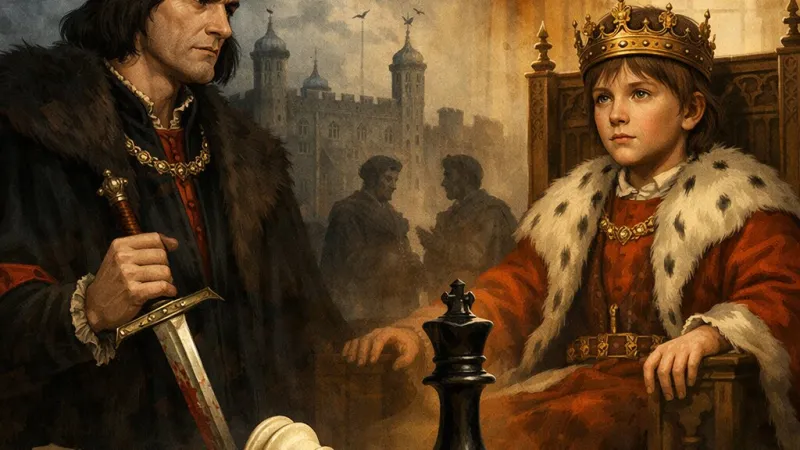
Summary:
Explore the power struggle between Richard III and Edward V, uncovering political intrigue and medieval succession challenges in this detailed history essay.
The Accession of Edward V and the Usurpation of Richard III
The sudden accession and swift demise of Edward V’s kingship form one of the most dramatic chapters in English medieval history, set against the lingering turbulence of the Wars of the Roses. The year 1483 found England exhausted by dynastic struggles, with old alliances worn thin and new ambitions set afire by the premature death of Edward IV. The throne passed to his adolescent son, Edward V, but the crown would never rest securely on the boy’s head. Instead, through a labyrinth of intrigue, Richard, Duke of Gloucester—uncle to the new king—claimed the crown for himself. The events of this fateful year are the product of both inherited vulnerabilities and calculated ambition, where political and personal motives entwined with law, custom, and the raw force of power.
This essay explores the circumstances and strategies that allowed Richard III to usurp the throne from Edward V. Analysing the political setting, Richard’s manipulations, and the responses of those around him, I will argue that his seizure of the crown was neither an inevitable consequence of fate nor a simple act of villainy, but a result of deep fractures within the realm, shrewd political calculation, and the ambiguous legal frameworks that haunted late medieval succession.
I. The Accession of Edward V: Opportunity Amidst Upheaval
Edward V’s accession, though apparently secured by his father’s provisions, immediately revealed the instabilities of royal minority. Barely twelve years old at the time of Edward IV’s death, Edward V’s youth represented both a blank slate for governance and a beacon for factional ambition. The precedent for a minor king’s rule was fraught: regency governments in medieval England were notoriously vulnerable, often serving as arenas for noble rivalry. The most recent memory—the minority of Henry VI—had led to the breakdown of royal authority, contributing directly to the ongoing dynastic conflict.Central to the difficulties was the position of Edward’s mother, Elizabeth Woodville. Her marriage to Edward IV had itself been a subject of controversy, drawing the ire of ancient nobility angered by the king’s preference for her extensive family network. By 1483 the Woodvilles held many key offices, sowing bitter resentment among older nobles, who saw their traditional roles usurped by upstart relations of the queen. This tension between entrenched aristocracy and parvenu power set the stage for crisis. The Woodvilles hoped to retain control by acting as the protectors of the young Edward, but this very dominance made them vulnerable to accusations of self-interest and misrule.
Crucially, the legal and constitutional machinery for succession was opaque. Though the king’s will had not survived, it was widely believed that Edward IV intended a council of regency, with his brother Richard as Lord Protector. This ambiguity left wide latitude for interpretation and, crucially, manipulation by anyone with the nerve and backing to seize the initiative.
II. Richard, Duke of Gloucester: A Calculated Ascent
Richard’s initial actions followed the script of loyal protectorship, but were driven by an astute sense of opportunity. Upon being notified of his brother’s death, Richard proceeded to Yorkshire’s sanctuary at Middleham but was soon named Lord Protector by the royal council—an appointment at once legally sound and, as it turned out, exceedingly dangerous to the new king. Richard’s own position as the late king’s brother provided him with a plausible claim to stewardship; at the same time, his proven military acumen and reputation for fairness in the North lent credibility to the apparent claim that he was acting in his nephew’s best interest.The journey of Edward V from Ludlow to London became the stage for Richard’s subtle—but decisive—coup de main. Meeting the young king’s party at Stony Stratford, Richard swiftly moved against the Woodville guardians. Anthony Woodville, Earl Rivers (Edward’s maternal uncle), and Richard Grey, the king's half-brother, were detained on charges of plotting against his safety—charges never substantiated with evidence. This action removed the primary Woodville influence and, crucially, ensured Edward V was now in Richard’s physical custody. In the violence and instability of the time, control of the king’s person represented both real and symbolic authority.
With his supporters isolated, Elizabeth Woodville fled to sanctuary at Westminster Abbey, clinging to the hallowed right of political refuge. The drama of her seeking sanctuary—immortalised by chroniclers and later by Shakespeare—underscored how deeply threatened her family felt and foreshadowed the brutality with which Richard would act. Sanctuary, a right rooted both in canon law and royal tradition, became in this moment not just a place of safety but a stark commentary on the loss of power and security for Edward V’s closest kin.
III. Political Intrigue and Ruthless Suppression
Richard’s grip on power tightened through a web of alliances and the ruthless elimination of dissent. Seeking the support of influential nobles, Richard gained the backing of Henry Stafford, Duke of Buckingham—a figure whose own ambitions and grievances found fertile soil in the changing political landscape. Yet such alliances were by nature unstable. Lord Hastings, once a staunch Yorkist and supporter of Edward IV, was at first loyal to Edward V and suspicious of Woodville dominance. However, his reluctance to support Richard unconditionally soon proved fatal. During a council meeting at the Tower in June 1483, Richard accused Hastings of plotting and ordered his immediate execution—no trial, no delay. This open act of violence signalled a willingness to jettison legal norms and terrorise opposition, echoing the realpolitik of earlier power struggles.The coup de grâce in Richard’s campaign was his legal delegitimisation of Edward V and his younger brother, Richard, Duke of York. Through testimony, notably from Bishop Robert Stillington, it was alleged that Edward IV had previously contracted to marry Lady Eleanor Talbot before his union with Elizabeth Woodville. By canon law, Edward and Elizabeth’s marriage would therefore be bigamous and their children—Edward V included—bastards, unfit to inherit the crown. Parliament, under Richard’s influence, swiftly passed the Titulus Regius, enshrining these claims in law and retroactively justifying Richard’s succession. The ready compliance of the Church in such a matter illustrated both the pliability of legal structures and the vulnerability of royal legitimacy to manipulation in times of crisis.
IV. The Tower of London: Shadows and Silence
With legal and military control secured, Richard transferred the two princes to the Tower of London. Traditionally a royal residence as well as a fortress, the Tower had, by the fifteenth century, gained a sinister reputation as the place where dynastic rivals could easily vanish. The presence of the two boys within its walls became the epicentre of rumour and public anxiety.Contemporary chroniclers such as Dominic Mancini, writing for a European audience, noted the “pity” inspired among London’s people at the spectacle of two innocent children isolated and powerless. In time, the young princes disappeared altogether from public view, feeding speculation that they had been murdered—on Richard’s orders or otherwise. While definitive evidence remains elusive, their fate became a touchstone for Richard’s growing unpopularity and a rallying cry for opposition. The subsequent success of Henry Tudor hinged in part on the enduring sense of outrage and betrayal among many of Richard’s subjects.
The story of the princes’ disappearance, mythologised and expanded by later writers such as Thomas More, continues to shape popular and historical interpretations of Richard III, casting him alternately as a ruthless tyrant or, more sympathetically, as a victim of circumstance and rumour.
V. Richard III: From Protector to King
Richard’s formal assumption of the crown was underpinned by the legal justification of the Titulus Regius, whereby an act of Parliament, wielded as an instrument of monarchical will, transformed him from regent to anointed king. In his coronation procession and subsequent acts, Richard worked strenuously to project the image of rightful ruler and defender of justice. He issued charters and proclamations promising good governance, attacking the supposed corruption of his predecessors—most notably the Woodvilles.Propaganda was crucial. Artists, chroniclers, and even preachers were enlisted to portray Richard as a champion of stability and the common weal—an image notably at odds with the methods he used to obtain power. The chronicler Croyland notes Richard’s attempts to stabilise the realm through administrative reforms; yet the memory of usurpation, compounded by the unresolved mystery of the princes' fate, continued to erode his support.
Challenges to Richard’s rule persisted from the moment of his accession. Another surviving Yorkist heir, Edward Earl of Warwick, though still a child, remained a potential figurehead for disaffected nobles. Most consequentially, Henry Tudor—claimant to the Lancastrian cause—began to gather support both at home and abroad. The trauma of 1483 had convinced many that legitimate succession, and stable governance, could not be achieved through force alone.
Conclusion
The usurpation of Edward V’s throne by Richard III encapsulates the bloody instability and personal ambition that haunted late Plantagenet England. Richard’s success drew from the vulnerability of a child king, the mutual suspicion among England’s great families, and his own willingness to manipulate law, religion, and social convention. Yet it was also marked by insecurity, violence, and the whiff of illegitimacy that would ultimately lead to his downfall. The fate of the princes and the shadow it cast over Richard’s reputation would echo into the next generation, profoundly influencing the claims and propaganda of the Tudor dynasty—themselves no strangers to the precariousness of royal power.The story offers a potent reminder that kingship in fifteenth-century England was not merely the fruit of royal blood, but the prize for those able to dominate the shifting labyrinth of counsel, legality, and violence. As subsequent centuries have debated Richard III’s character, from Shakespeare’s arch-villain to Josephine Tey’s wronged monarch, the events of 1483 remain a testament to the inherent fragility of hereditary monarchy and the often-brutal realities of medieval realpolitik.
Rate:
Log in to rate the work.
Log in