Understanding Cell Biology: Key Concepts for GCSE Unit 2
Homework type: Essay
Added: yesterday at 9:54
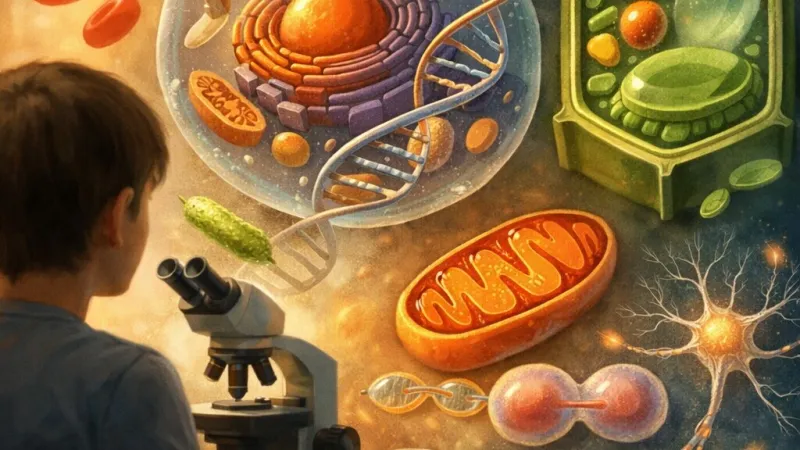
Summary:
Explore key cell biology concepts for GCSE Unit 2 and learn about cell structures, functions, and processes essential for your UK biology studies. 🧬
Biology Unit 2: Exploring the Foundation of Life
Biology, at its very heart, is the study of living organisms and the fundamental processes that allow them to thrive. Of all the topics encountered in secondary school science, few are as foundational as the understanding of cells – the cellular basis of life. Within the United Kingdom’s education system, the exploration of cell structure, function, and the mechanisms underpinning cellular processes forms a central component of the GCSE Biology curriculum. This essay will elucidate the intricacies of cell organisation in animals, plants, bacteria, and yeast, delve into the marvel of cellular specialisation, and unravel the processes by which essential substances traverse cell membranes. By considering both scientific theory and real-world applications relevant to the UK, this discussion seeks to provide a comprehensive appreciation of the living building blocks that constitute all life.---
Unpacking Cell Structure: The Architecture of Life
Every living organism, whether as grand as an oak in Sherwood Forest or as small as a lichen on a Yorkshire stone wall, owes its existence to the humble cell. Within animal cells, several core structures – termed organelles – coalesce to orchestrate an array of life-maintaining processes.Key Organelles in Animal Cells
Foremost among these is the nucleus, often described as the ‘brain’ of the cell. Encased by a double membrane, the nucleus houses chromosomes composed of DNA, the molecule carrying genetic instructions vital for growth, repair and development. It acts as an administrative centre, regulating which proteins are synthesised and when.Enveloping the organelles is the cytoplasm, a gelatinous substance where a plethora of chemical reactions occur, each catalysed by specialised enzymes. The cytoplasm is not merely structural ‘filler’; without its precise environment, many crucial metabolic processes could not proceed.
Encasing the entirety of the cell is the cell membrane. Its structure, a patchwork of phospholipids and proteins, forms a dynamic semi-permeable barrier. Not only does it protect the internal machinery, but it also rigorously controls the ingress and egress of substances, thus maintaining the delicate equilibrium – homeostasis – required for survival.
Vital to energy supply are the mitochondria. Termed the ‘powerhouses’ of the cell, they perform aerobic respiration by breaking down glucose in the presence of oxygen, thereby synthesising adenosine triphosphate (ATP) – the universal energy currency of life. Without sufficient mitochondria, cells would be starved of energy and quickly perish.
Equally important are the ribosomes. These tiny, often overlooked organelles are the sites of protein synthesis. By translating genetic instructions from the nucleus, ribosomes manufacture the vast array of proteins needed for growth, immune defence, and cell maintenance.
Unique Features of Plant Cells
Though plant and animal cells share many structural similarities, key differences underpin their distinct lifestyles. Plant cells are encased by a cell wall – a rigid layer composed primarily of cellulose. This wall bestows both structural support and protection, allowing trees to stretch skywards or climbers like honeysuckle to entwine fences and hedgerows.Within plant cells, chloroplasts perform photosynthesis – a process as vital to humanity as it is to the plants themselves. Containing chlorophyll, these organelles capture solar energy, converting carbon dioxide and water into glucose and oxygen. The importance of this cannot be understated, as it forms the basis of nearly all life on Earth: crops in Lincolnshire fields, rose bushes in London parks, and diverse woodland understorey all depend on the miracle of photosynthesis.
A permanent vacuole, present at the heart of most mature plant cells, contains cell sap – a watery solution of sugars, salts, and proteins. The vacuole’s primary function is to maintain turgor pressure, which helps the plant remain upright and rigid, essential for leaves to reach sunlight and compete for resources.
Microbial Cells: Yeast and Bacteria
Not all cells follow these textbook conventions. Yeast, widely known for its use in baking and brewing traditions of Britain, is a single-celled fungus. Unlike bacteria, yeast cells possess a nucleus, making them eukaryotic. Their cell walls, however, are not made of cellulose, but chitin – resembling the exoskeletons of insects.In contrast, bacterial cells are far simpler, lacking a membrane-bound nucleus. Their genetic material floats free within the cytoplasm, and their cell walls are constructed from peptidoglycan – a biochemical barrier distinct from those of plants and fungi. This structural simplicity aids rapid reproduction and fosters adaptability – reasons why certain bacterial strains can quickly colonise new environments, for better (the fermentation of Yorkshire Wensleydale cheese) or worse (the spread of infection in hospitals).
---
The Magic of Specialisation: Cells with a Purpose
Despite the underlying unity at the microscopic level, not all cells are created equal. Through a process known as differentiation, cells acquire unique features and roles, becoming exquisitely adapted to their tasks.Remarkable Plant Cell Adaptations
A classic example is the palisade mesophyll cell within the leaves of British oaks and beeches. These are packed tightly with chloroplasts, positioned just beneath the upper surface to efficiently harness sunlight for photosynthesis. Their columnar shape increases surface area, maximising the absorption of carbon dioxide.Guard cells, meanwhile, patrol the microscopic stomata dotted across leaf undersides. Shaped like curved sausages, they swell and contract to open or close the stomata in response to environmental cues. This elegant adaptation balances two conflicting needs: maximising gas exchange for photosynthesis and minimising water loss, a vital consideration for plants surviving the capricious British weather from the rains of Cumbria to the droughts of East Anglia.
Animals’ Specialists
Within our own bodies, red blood cells exemplify remarkable specialisation. Shaped like biconcave disks, they present a large surface area to soak up oxygen in the alveoli of Londoner’s lungs, then transport it throughout the body. They are jam-packed with haemoglobin, a protein that binds oxygen reversibly. Notably, these cells jettison their nucleus as they mature, making more space for haemoglobin and allowing flexibility to squeeze through narrow capillaries.Other notable examples include neurones: with their elongated axons, such cells ensure that messages from the brain reach even the extremities – from the tip of a violinist’s finger to the toe of a footballer at St James’ Park. Sperm cells, equipped with tails rich in mitochondria, possess the agility to seek and fertilise an egg, ensuring continuity of species.
---
The Flow of Life: How Substances Move
As essential as cellular architecture is, equally fundamental are the processes by which substances move into and out of cells. For cells to flourish, nutrients such as glucose and oxygen must pass in, while wastes like carbon dioxide and urea must be expelled.Diffusion: Nature’s Balancing Act
Diffusion is the net movement of particles from an area of higher concentration to lower concentration. For example, when breathing, oxygen diffuses across the thin walls of alveoli in the human lung into the bloodstream, while carbon dioxide travels in the opposite direction to be exhaled. Similarly, in the leaves of a beech tree, carbon dioxide diffuses in for photosynthesis while oxygen, a by-product, diffuses out.Several factors influence the rate of diffusion: a steeper concentration gradient, warmer temperatures (think of increased particle movement on a summer’s day), and larger surface areas (such as the folded structure of a lamb’s lung) all accelerate the process.
Selective Permeability and Membrane Transport
A cell’s plasma membrane is not simply a barrier; it is a selectively-permeable gateway. Composed chiefly of a phospholipid bilayer studded with proteins, this structure allows the passage of some molecules – like water, oxygen, and carbon dioxide – while barring others, such as proteins or starch.Some substances, such as glucose and ions, require assistance to traverse the membrane, often via channel or carrier proteins. This precise selectivity ensures cells absorb what they need while keeping out unwanted substances, preserving the cell’s internal milieu.
In broader terms, transport across membranes is essential for processes from nutrient absorption in the human small intestine to the uptake of minerals by agricultural crops.
---
Interdependence: Tying Structure and Transport to Life
No organelle works in isolation; each is a strand in the intricate web of cellular function. The structure of each cell, tailored by eons of evolution, is intimately linked to its role. Muscle cells, for instance, are crammed with mitochondria, reflecting their mammoth energy needs during activities like running in school sports or climbing Ben Nevis.The marvel of differentiation ensures that organisms can perform a multitude of tasks simultaneously – a necessity for complex life, whether it is the coordination required for the growth of a bluebell in an English wood or for the beating of a human heart. Transport mechanisms, particularly diffusion, undergird metabolism by ensuring a steady supply of raw materials and the swift removal of waste.
A detailed understanding of these processes is not merely academic. In medicine, for example, cystic fibrosis is rooted in malfunctioning chloride ion channels; in plants, stunted growth may signal disrupted water or mineral transport. Such examples underpin the work of the NHS and DEFRA, from patient care to the management of the countryside.
---
Conclusion: The Cornerstone of Biology
Through examining the marvellous machinery of cells, their specialisation, and the elegance of molecular transport, one gains a deep respect for the complexity of life. The structures and processes discussed lie at the heart of countless phenomena – from how a daffodil blooms each spring to how oxygen fuels human thought and feeling.Grasping these concepts is not just crucial for academic success at GCSE and beyond, but forms the bedrock for later study in fields as diverse as genetics, ecology, and medicine. As our scientific understanding grows, so too does our ability to harness these fundamental processes, whether in combating disease, boosting food security, or preserving the delicate balance of the British environment. The study of Biology Unit 2 thus provides the key to unlocking the secrets of life itself, preparing us for the challenges of tomorrow.
---
*Diagrams of these structures can be found in any standard GCSE biology textbook such as CGP or Collins, and I would recommend referring to these for visual reinforcement of the concepts described.*
Rate:
Log in to rate the work.
Log in