Exploring the Interdependence of Living Organisms in Ecosystems
This work has been verified by our teacher: 18.04.2026 at 9:03
Homework type: Geography Essay
Added: 15.04.2026 at 7:35
Summary:
Explore the interdependence of living organisms in UK ecosystems to understand how producers, consumers, and decomposers connect and sustain life.
Understanding the Interdependence of Living Organisms in Modern Biology
Nature, in all its splendour, can be likened to a finely woven tapestry—a single pull of a thread can unsettle the whole design. Within this metaphor, every living organism, from the grandest oak in an ancient forest to the humble earthworm burrowing beneath it, plays a part whose absence would be sorely felt. The concept underpinning this intricate relationship is interdependence: in biology, a fundamental idea that no species exists in utter solitude. From the hedgerows of the English countryside to the rockpools on British shores, each organism is part of a wider web, reliant on others for food, shelter, pollination, and survival.
Interdependence refers, quite simply, to the mutual reliance of living things upon one another. This extends not just between species, but to the interactions woven through entire ecosystems: plants that feed animals, animals which disperse seeds, microbes that break down waste. In the United Kingdom, where changes to woodland, wetlands and coastal areas are often hotly debated, the importance of these natural connections is plain to see.
In the face of twenty-first century challenges like climate change and habitat loss, understanding these relationships is no longer a matter just for scientists. It is relevant to every citizen, policy-maker and student. This essay will investigate what underpins the interdependence of living organisms, examine the pivotal roles played by producers, consumers and decomposers, explore how energy moves through these complex systems, and consider why this knowledge is crucial in our present era.
---
The Foundations of Biological Interdependence
Energy Source for Life: The Sun
All life, in the end, finds its roots in the light of the sun. Throughout the UK, from dappled woodland glades to lush meadows, sunlight is harvested by green plants—our primary producers. Through the remarkable process of photosynthesis, these organisms capture the sun’s energy, effectively turning insubstantial rays into solid matter, and storing it in sugars and starches. Without this transfer of energy, there would simply be no basis for life as we know it.Plants, algae, and some bacteria possess the ability to convert carbon dioxide and water into food, using sunlight—the very definition of autotrophs. In the shallow ponds of an English garden or the seaweeds fringing our coasts, we find these key players, responsible for laying the groundwork upon which all ecosystems build. They are the reason why lush Scottish moorlands burst into colour each spring and why woodlands echo with the songs of birds.
Dependence of Heterotrophs
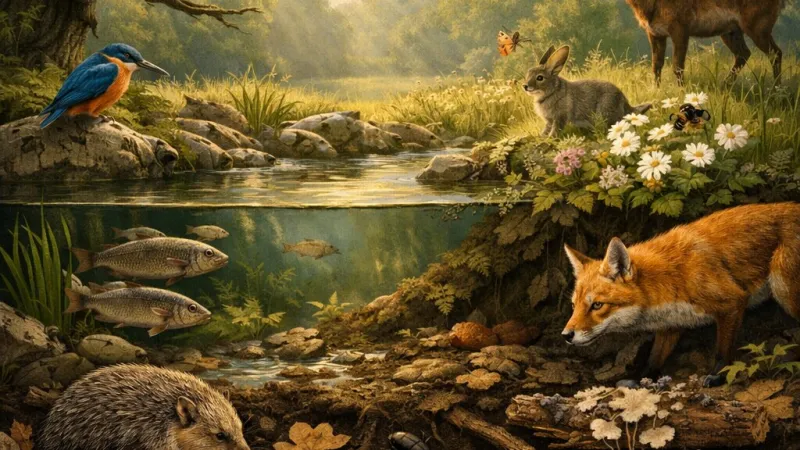
Unlike plants, animals cannot manufacture their own food. Instead, whether grazing sheep on the Yorkshire Dales or predatory sparrowhawks in the hedgerows, they rely on consuming other organisms. Heterotrophs make up the vast majority of the animal kingdom. Herbivores such as the red deer feast on grasses and leaves, while carnivores like foxes hunt smaller mammals and birds. Detritivores—beings like woodlice—break down decaying matter, feeding indirectly on the productivity of autotrophs.At the base of it all, decomposers—principally bacteria and fungi—return nutrients to the soil by breaking down dead organic matter. Without them, woods, fields and even our compost heaps would soon choke under a blanket of debris, and plants would run short of the vital elements needed to grow afresh.
Interconnected Feeding Relationships
While textbooks may begin with neat, linear food chains—grass feeds rabbit, rabbit feeds fox—the truth is far messier. Real ecosystems are tangled webs where one species may depend on many others, and the fate of each is tied to the fortunes of those around it. When a disease devastates ash trees due to dieback in the UK, for instance, it affects countless other organisms: insects that rely on the tree’s leaves, birds that nest in their branches, fungi living in the bark. It is a chain reaction, illustrating the deep interdependence in the natural world.---
The Roles and Types of Organisms in Ecosystems
Producers
Producers, overwhelmingly plants and algae in terrestrial and aquatic environments, are the ultimate converters of the sun’s energy to a form usable by all other life. In forests such as the New Forest or the beechwoods of the Chilterns, they provide shelter, food and oxygen. They are crucial to the carbon cycle, capturing carbon dioxide and releasing the oxygen upon which all aerobic life depends. Their disappearance would send shockwaves through entire ecosystems.Consumers
Consumers are categorised according to their diets. Herbivores, such as rabbits or cows, are the primary consumers, absorbing the energy stored in plants. Secondary consumers—think of stoats or sparrowhawks—feed on herbivores. Tertiary consumers, such as owls or foxes, may eat both. Omnivores like badgers or humans eat at various levels.Each group displays a wealth of adaptations: the beak shapes of finches to crack seeds or the long digestion tracts of grazers for tough pasture grass. In the UK’s rockpools, for example, the periwinkle graze on algae, while predatory crabs hunt both molluscs and smaller crustaceans.
Decomposers and Detritivores
Decomposers—principally fungi and bacteria—perform the vital task of recycling. Consider a fallen oak leaf in autumn: fungi and bacteria break down its tissues, releasing nutrients like nitrogen and phosphorus back to the soil. Detritivores such as earthworms help in this process, physically breaking leaves into smaller pieces and enriching the earth. Without these humble organisms, fertile British soils would be a thing of the past.Mutualism and Other Symbiosis
Not all interdependence relates directly to food. Mutualism—the classic example being bees pollinating apple blossom—sees both participants benefit. The bee receives nectar, while the tree’s pollen is spread to ensure fruit and new generations. Some relationships are more one-sided. For instance, barnacles riding on whales (commensalism) benefit without harming the whale. In parasitism, such as the tapeworm in a fox, one thrives at the expense of its host.---
Energy Flow and Biomass Transfer
Food Chains versus Food Webs
Simple food chains explain the order of energy transfer—plant to insect to bird. Yet, such linear diagrams do not capture the full complexity; a single blue tit may eat insects, seeds, and spiders. Food webs present a truer picture, mapping these myriad dependencies.Pyramids of Numbers and Biomass
Ecologists use pyramids to visualise relationships between organisms. Pyramids of numbers show the count of individuals at each trophic (feeding) level, but can be misleading; one massive oak tree may support thousands of caterpillars. Pyramids of biomass, representing the mass of living matter at each stage, are more reflective of energy transfer. On chalk grasslands or in a Scottish loch, these pyramids can sometimes invert—many fast-growing algae but few large predators.Energy Loss and Efficiency
As energy flows up the trophic levels, most is lost—used for movement, growth, heat or lost as waste. Only around 10% of the energy in one level is available to the next. This is why large predators are rare and ecosystems can only support so many. It is also why human diets focusing directly on plants are considered more sustainable, as there is less energy lost along the way.---
Ecological Interdependence in the 21st Century
Effects of Human Activity
Modern life exerts profound pressure upon traditional webs of interdependence. The draining of wetlands to build new housing, the spraying of pesticides on farmland, and the introduction of non-native species—such as grey squirrels outcompeting native reds—have changed the face of British countryside. These modifications can cause cascading effects: the loss of water voles due to mink predation, for example, demonstrates how one species’ introduction disrupts many more.Climate Change and Balance
Altered rainfall, rising temperatures and extreme weather events are already shifting habitat ranges. Migratory birds such as swallows now arrive earlier in spring, partly in response to climate-driven changes in insect emergence. Not every organism can adapt at the same pace, risking mismatches that further destabilise local food webs.Conservation and Restoration
Recognising the importance of ‘keystone species’—organisms like beavers or oaks upon which many others depend—has led to coordinated restoration projects. In Scotland, beavers have been reintroduced to help restore wetland systems; here, their engineering provides conditions which benefit an array of wildlife. Programmes such as the rewilding of Knepp Estate in Sussex are testament to the value of understanding and nurturing interdependence.Sustainable Practices
British farmers increasingly turn to more ecologically sensitive methods. Crop rotation and intercropping support soil life, while wildflower margins encourage pollinators and predators of pests, lessening reliance on chemicals. These steps reflect an understanding that continued productivity depends on healthy ecosystems.---
Applications: Why Understanding Interdependence Matters
From predicting the dangers of species extinction to designing nature reserves that effectively protect interconnected species, knowledge of interdependence is crucial. In agriculture, encouraging ladybirds to keep aphids in check is only possible in healthy, balanced systems. Similarly, understanding decomposers helps maintain rich soils.Moreover, as zoonotic diseases—those that jump from animals to humans, such as avian flu—become common, it is ever more important to recognise how weakening one part of our ecological web can have direct consequences for human health.
Education, too, plays a vital role. By nurturing ecological literacy in UK schools, from primary ‘mini-beast hunts’ to GCSE Biology, we prepare future generations to value, protect and restore their own local environments.
---
Conclusion
To summarise, the interdependence of living organisms—rooted in the sun’s energy, expressed through the roles of producers, consumers and decomposers, and made manifest in the transfer of energy and nutrients through ecosystems—is fundamental to life. As we move further into the twenty-first century, confronted by environmental change, the careful maintenance of these networks becomes ever more significant. Ultimately, humanity’s continued survival and wellbeing is bound up in the health of these relationships. Each person, whether student, farmer, or policymaker, has a part to play in supporting the mosaic of interdependence that sustains the living world.The tapestry of life, once unravelled, is not easily rewoven. Therefore, let us step forward as guardians rather than mere users of nature, recognising in every wildflower, worm and wasp a share in our own fate. The future of the planet, and our place within it, depends upon this understanding.
Rate:
Log in to rate the work.
Log in