Cultural Revolution 1966–1976: Causes, Course and Lasting Consequences
This work has been verified by our teacher: 6.02.2026 at 11:38
Homework type: History essay
Added: 4.02.2026 at 6:35
Summary:
Explore the causes, key events, and lasting consequences of the Cultural Revolution 1966–1976 to understand this pivotal period in Chinese history.
History – The Cultural Revolution & Aftermath, 1966-76: A Critical Assessment
The Cultural Revolution, launched in 1966 under the leadership of Mao Zedong, was a seismic event in the landscape of twentieth-century China. In the years leading up to it, the People’s Republic, established in 1949, had undertaken colossal social and political transformation, yet by the mid-1960s, scars lingered from the Great Leap Forward—an ambitious venture to modernise agriculture and industry, which instead led to catastrophic famine and economic setbacks. At this pivotal juncture, Mao’s authority was in jeopardy, prompting a radical campaign ostensibly designed to purge ‘bourgeois’ elements and reinvigorate Communist ideology. Yet behind these overt intentions lurked palpable currents of political rivalry, personal ambition, and ideological zeal. This essay will investigate the multifaceted motivations driving the Cultural Revolution, scrutinise its unfolding, and appraise its enduring consequences—culturally, politically, and socially—drawing comparisons to formative upheavals more familiar within British collective memory, such as the English Civil War or the protests of the 1960s.
Ideological Foundations and Motivations
The ideological fervour that propelled the Cultural Revolution cannot be disentangled from Mao’s unique reinterpretation of Marxist doctrine. While orthodox Marxism-Leninism emphasised economic class struggle as a progressive historical force, Mao postulated the necessity of ‘perpetual revolution’. As he declared, “bombard the headquarters”—a metaphor that encapsulated the endless war against complacency and suspected reaction. Contrasted with postwar Britain, where the consolidation of the welfare state signalled an urge for social stability, Mao championed perpetual unrest to forestall regression into pre-revolutionary habits.Central to the Revolution was the attack on the ‘Four Olds’: old customs, culture, habits, and ideas. In practical terms, this translated into a wholesale assault on China’s historical legacy. Temples, artefacts, ancient texts, and even traditional attire came under threat as emblems of a feudal, oppressive past. It is evocative to imagine, for instance, if a campaign in post-war Britain had targeted Shakespearean theatre or the traditions of Oxford University for eradication—so profound was the cultural rupture in China.
The power dynamics within the Communist Party further inflamed the movement. Following the debacle of the Great Leap Forward, Mao’s grip had visibly weakened. His rivals, particularly Liu Shaoqi and Deng Xiaoping, adopted pragmatic approaches that seemingly diverged from revolutionary ideals. The Cultural Revolution thus served as a double-edged sword—mobilising mass participation while enabling Mao to marginalise opponents and re-establish his hegemony.
The Opening Salvos (1966-1968): The Rise of the Red Guards
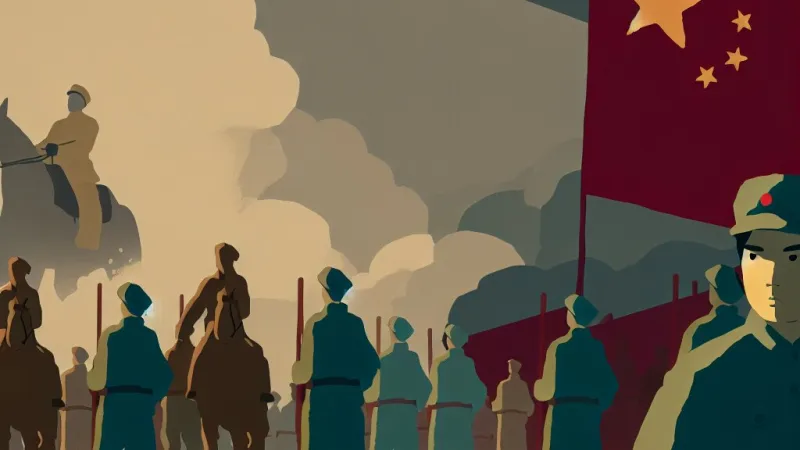
Mao’s dramatic swim in the Yangtze River in 1966 served as a symbolic resurrection, much in the way Prime Ministerial returns can dominate British headlines today, sending instant ripples through both popular and political spheres. This moment, coupled with the circulation of the 16-Point Directive, rallied the embers of revolutionary sentiment. Notably, culture became a battleground: the play ‘Hai Rui Dismissed from Office’ was seized upon as allegorical dissent, implicating writers and intellectuals in counter-revolutionary plots.The Red Guards, predominantly made up of secondary and university students, materialised as principal agents of upheaval. Motivated variously by personal belief, a desire for social advancement, familial loyalties, or mere thrill, they appropriated Mao’s Little Red Book and took to the streets in wild, zealous waves. British parallels might be drawn to the radical student movements at the London School of Economics or anti-nuclear protests, though the Red Guards’ capacity for disruption was far greater and more violent.
Red Guards assaulted those accused of reactionary tendencies—teachers, bureaucrats, artists—subjecting them to “struggle sessions” involving public humiliation, beatings, and forced confessions. The fate of cultural figures such as Lao She, a celebrated novelist who perished following persecution, exemplifies the human cost. Ancient heritage sites, libraries, and family heirlooms—all were liable to devastation, their loss echoing the burning of the British Library during the Blitz, yet enacted by a generation supposedly tasked with building a utopian future.
Social, Cultural and Economic Impacts
The trail of devastation left by the Cultural Revolution is most visibly marked in China’s cultural memory. Centuries-old relics, Buddhist temples, and rare manuscripts were destroyed. The Dalai Lama—already in exile—watched as Tibetan monasteries fell in the crossfire, reminiscent of Cromwellian iconoclasm in the English Civil War, when stained glass and ancient shrines in British cathedrals were shattered in the name of a higher cause.Education sustained a crippling blow. Schools and universities closed, their staff derided and driven away or worse. The ‘Down to the Countryside’ movement saw millions of urban youth resettled in rural hinterlands, their aspirations thwarted by years of menial farm labour and isolation—a lost generation with similarities to Britain’s ‘school leavers’ crisis’ of the 1980s, but with immensely graver consequences. The systematic suppression of intellectual debate precipitated a pall of intellectual stagnation. Science and the humanities alike suffered, as expertise became suspect and critical thinking was discouraged.
Economically, the period further derailed industrial and agricultural recovery. Amid the chaos, initiative faltered, and resources were diverted from production to revolutionary activity. Paralleling the downturn Britain experienced during the 1970s three-day week, China endured inefficiency and unpredictable shortages, but here imbued with an acute sense of political threat.
Power Struggles within the Party
If the Cultural Revolution was envisaged as a mass movement, it unfolded just as much as a ruthless contest at the pinnacle of Chinese power. Key leaders—Liu Shaoqi and Deng Xiaoping most prominently—were purged and publicly denigrated, forced into ignominious exile or imprisonment. Jiang Qing, Mao’s wife, along with her associates, soon to be dubbed the ‘Gang of Four’, emerged as radical enforcers, manipulating cultural and political orthodoxy to shore up their own influence.Revolutionary Committees supplanted conventional governmental and party organs, ushering in a chaotic system where loyalty to Mao and revolutionary purity eclipsed expertise or established protocol. The period’s atmosphere, charged and paranoid, echoes the witch-hunting tendencies of Tudor England under Mary I, where proximity to the monarch dictated survival.
Yet instability eventually exhausted itself. By the early 1970s, the mounting disorder—variously expressed in strikes, violence, and economic decline—forced even Mao to reinstate pragmatists such as Zhou Enlai and, later, Deng Xiaoping, in recognition that governance required more than perpetual turmoil.
Aftermath and Historical Legacy
Mao’s death in 1976 marked a decisive watershed. In short order, the Gang of Four was arrested, signalling the restoration of order, and the Party began to slowly rehabilitate countless victims. Deng Xiaoping, himself twice purged, ultimately emerged triumphant, initiating a period of pragmatic reform and economic modernisation. The so-called ‘Boluan Fanzheng’ (uprooting chaos and returning to order) saw public condemnation of Cultural Revolution policies and an effort to correct historic injustices.This process, however, has been fraught with ambivalence. While the Communist Party now officially denounces the Cultural Revolution’s ‘grave errors’, serious public reckoning remains limited. Many survivors refrain from open discussion; their trauma, like that experienced by British soldiers and civilians after the Blitz, forms part of a difficult, partially repressed national memory.
Historiographically, the Cultural Revolution continues to provoke intense debate. Was it primarily the bitter personal crusade of an ageing leader, or did it reflect deeper tensions in the quest to build a socialist society? Official Chinese narratives insist on its aberration from a broader arc of progress, yet many intellectuals, both inside and outside China, detect its connection to the cycles of political conformity and social upheaval that remain part of the society’s texture.
Rate:
Log in to rate the work.
Log in