Examining the Causes of the 1450 Rebellions in London
This work has been verified by our teacher: 1.03.2026 at 16:59
Homework type: History essay
Added: 27.02.2026 at 9:19
Summary:
Explore the causes of the 1450 rebellions in London, uncovering the political, economic, and social factors that sparked unrest in this pivotal history essay.
Why London Was Full of Rebels in 1450
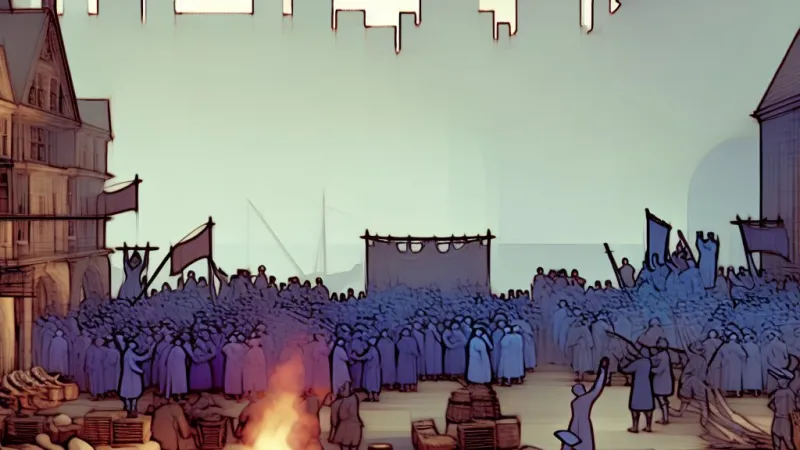
The middle years of the fifteenth century stand out as one of the most turbulent periods in English history. In the wake of the Hundred Years’ War, England was beset not only by military setbacks but also by deep internal malaise. London, the throbbing heart of the kingdom, became the epicentre of discontent in 1450, when thousands of rebels took to its streets. These uprisings were not the result of a single cause, but rather a tangled interplay of political, economic and social factors. Examining the local grievances that inflamed the countryside, the national crises shaking the legitimacy of the monarchy, the role of leadership in mobilising the dissatisfied, and the broader consequences, enables us to understand why London became awash with rebellion. This essay explores these themes, drawing on a blend of historical narrative and critical evaluation, to illuminate the significance of the rebellion that swept London in 1450.
---
England and London in the Mid-15th Century
Political Instability and Decline
The end of the Hundred Years’ War, rather than ushering in peace, brought a sense of national humiliation to England, especially after the humiliating loss of Normandy in 1450. The monarchy, under Henry VI, proved incapable of holding onto what his father Henry V had so brilliantly conquered. Henry’s reign was marked by indecisiveness and the manipulation of the throne by self-interested advisers, leading to rampant factionalism. The king’s youth and weakness—shunned even by his own nobility—created a vacuum at the heart of English government. Such instability at the top inevitably trickled down, fuelling resentment among those at the bottom who felt unprotected and voiceless.Economic and Social Pressures
Economic hardship was deeply felt in this period. Long years of warfare had drained the realm’s coffers, and to pay for continuing costs, the Crown imposed heavy taxes, the effects of which reverberated most painfully among commoners. Trade disruptions hurt merchants and craftsmen throughout London and the southeast. The prosperity of England’s cloth towns, from Maidstone to Southwark, faded, leaving weavers and fullers jobless. Farmers, too, staggered under the weight of falling crop prices and rising rents.London, with its reliance on imported grain and goods, felt shortages keenly. Chroniclers such as those behind the “Great Chronicle of London” note a city burdened with hunger and increasing crime. Society at large grew suspicious of the elite and government officials, whose luxurious lifestyles contrasted starkly with rising poverty.
Public Distrust of Authority
As hardship mounted, faith in the state and its adult supervision crumbled. Rumours of corruption among royal officers—bribery, rigged parliamentary elections, and gross mismanagement—ran rampant. Parliament’s Commons’ petitions bristled with complaints about unjust taxation and extortionate fines. London, as the seat of government and the kingdom’s commercial hub, provided a unique stage for such grievances to crystallise. The air was heavy with frustration—a city and kingdom ready to ignite at the slightest spark.---
Local Catalysts for Rebellion
Resentment Against Local Officials
Nowhere was anger more palpable than in Kent and the Home Counties surrounding London. The Duke of Suffolk, William de la Pole, became a convenient scapegoat for national humiliation, accused in popular rumour of plotting to sell out England’s fortunes to the French. Figures like Lord Saye and Crowmer, two local officials, were widely viewed as venal, inventing spurious fines and wielding the king’s authority for personal enrichment. Their actions did not go unnoticed. Complaints against such men pepper surviving petitions, which demanded their removal and punishment. The erosion of trust extended from the local manor court to the heart of Westminster.The Murder of Suffolk
The summary execution of the Duke of Suffolk in May 1450 electrified Kent. Set upon and murdered by vengeful sailors—allegedly with the tacit support of those he had wronged—his death sent shockwaves throughout the Southeast. The Crown’s apparent inability or unwillingness to protect even the highest among its officials convinced many that law and order had collapsed. The men of Kent, suspecting that royal vengeance would fall anew on their heads, were panicked into action. Suffolk’s death was the torch to a pyre waiting to blaze, but the discontent predated his demise.The Economic Plight of the People
By 1450, commoners saw only decline. The price of wheat and basic foodstuffs soared, while cloth—the backbone of both local and export economies—was in freefall. Labourers faced destitution, with some contemporary chronicles describing beggars and vagrancy on a scale unseen since the days of the Black Death. Hunger gnawed, and tales of families ruined by landlords and tax gatherers multiplied. With nothing to lose, thousands answered the call to rebel.---
Expanding the Rebels’ Ambitions
From Local to National Demands
While local grievances served as the initial spur, the rebellion unfurled into demands for national reform. In petitions addressed to King Henry VI, the rebels professed unswerving loyalty yet bitterly attacked his council, accusing “false and evil” advisers of misleading the monarch “as lambs to the slaughter.” Their demands—removal of corrupt officials, an end to unjust taxes, and restoration of honest governance—reflected not only parochial annoyance but a yearning for a new contract between ruler and ruled.Attacking the Royal Council
Repeatedly, the rebels pointed not at the King himself, whom they viewed with a mixture of pity and hope, but at those who manipulated him. Their rhetoric, recorded in sources like “Cade’s Manifesto”, was steeped in appeals to justice, not revolution. The movement’s energy came largely from a belief that the realm could be rescued from decline if the king were freed from the grip of his “covetous” counsellors. The rebels therefore cast themselves as patriots, not traitors, taking up arms for Crown and realm.---
Leadership and Organisation
The Figure of Jack Cade
John Cade, calling himself ‘John Mortimer’ to hint at a possible Plantagenet connection, emerged as the focal leader—a man of mysterious background but apparent military experience. His oratory and charisma drew thousands from Kent and beyond, swelling his camp at Blackheath. Cade’s men were armed and drilled in the military fashion, donning thick jackets (hence the later term ‘Jack Cade’s Rebellion’) and showing formidable discipline. Cade’s claim, continually reiterated, was not to kingship but to justice on behalf of “the poor commons of England”.Strategy and Entry into London
Tactically, the rebels showed cunning. By massing at Blackheath, Cade controlled the principal approach to the capital. When royal troops attempted to quell the uprising, Cade’s men ambushed and scattered them. In early July 1450, as chronicled by Stow, the rebels marched into London, symbolically behaving “as if they were the King’s men,” asserting legitimacy. For a brief instant, the city seemed to be theirs.Relations with Londoners
Many Londoners at first welcomed the rebels, if only out of shared anger at the Crown’s abuses. But the violence and looting that followed—some committed by opportunists rather than Cade’s core followers—rapidly undermined popular support. When shopkeepers and apprentices began to suffer, the tide turned. On 9 July, city authorities rallied, citizens blocked the bridges and streets, and the rebels, caught between the militia and the Crown’s men, found themselves isolated.---
The Government’s Response
Negotiation and Military Response
Initially, the government sought parley, perhaps hoping to deflate the rebellion with words. Cade, however, rebuffed offers which failed to address his central demands. Henry VI fled to the Midlands, fearful for his safety, while faint-hearted nobles hedged their bets. Only when the rebels’ discipline wavered did the Crown regain its nerve, sending in soldiers to drive the rebels back and terrorise the ringleaders.Londoners Strike Back
The pivotal moment came when London’s own citizens arose. The closing of the gates, the bloody fighting on London Bridge (a moment evocative of Shakespeare’s later account of Cade’s end in “Henry VI, Part 2”), and the deaths on both sides, signalled a turning point. The rebels, denied sanctuary and supplies, melted away, their momentum collapsing.The End of Cade
Jack Cade himself fled, only to be captured by the Sheriff of Kent. His body was paraded through London—head stuck on a pole, in a gruesome warning—while his surviving followers faced execution or humiliating pardons. The state was reasserting itself, but the grievances that fuelled Cade’s rebellion remained unresolved.---
The Significance of the 1450 Rebellion
Immediate Aftermath
Order was restored, but only superficially. Some corrupt officials, scapegoated for convenience, paid with their lives, but many merely withdrew temporarily from public view. The fear of further uprising led to a slight easing of oppression, yet the deeper causes of unrest—economic hardship, poor governance, endemic corruption—persisted. The London chronicles record an uneasy calm, not reconciliation.Long-Term Political Impact
Cade’s rebellion left an unmistakable scar on English politics. The Crown learned reluctantly that popular unrest, if ignored, could threaten royal authority itself. Some efforts at constructive reform were made, but as the decades unfolded, persistent factionalism and misrule precipitated the Wars of the Roses. Cade’s ghost haunted the courtrooms and parliaments of late medieval England as a warning of what could happen when government lost the trust of its people.Social and Cultural Legacy
The events in London in 1450 brought simmering discontent to national attention. The popular petitions, with their demands for justice and honesty, reflected an emerging political consciousness among commoners—something remarkable for late medieval England. London’s role as a crucible for political protest grew, setting precedents for protest and representation that would echo down the centuries.---
Conclusion
In sum, London’s streets teemed with rebels in 1450 not simply due to spontaneous anger, but because a convergence of local grievances, national failures, economic destitution, and determined leadership destabilised the very fabric of English society. The rebellion that ensued was not a bid for revolution, but a powerful statement of discontent within a loyalist framework, seeking redress and reform. It encapsulated the deep tensions of late medieval England—tensions that would flare dramatically in the years to come. The events of 1450 invite us to consider how, in times of crisis, the fate of a nation can hinge on the interplay between government authority, economic fortune, and the collective voice of its people.Further study might compare Cade’s revolt with peasant and urban uprisings elsewhere in Europe, or explore its long-term impact on London’s urban society—a city that, even now, remains at the heart of protest and change in England.
Rate:
Log in to rate the work.
Log in