Northern Ireland Troubles: A Historical Overview of Conflict and Peace Efforts
This work has been verified by our teacher: 20.03.2026 at 13:42
Homework type: History essay
Added: 18.03.2026 at 7:13
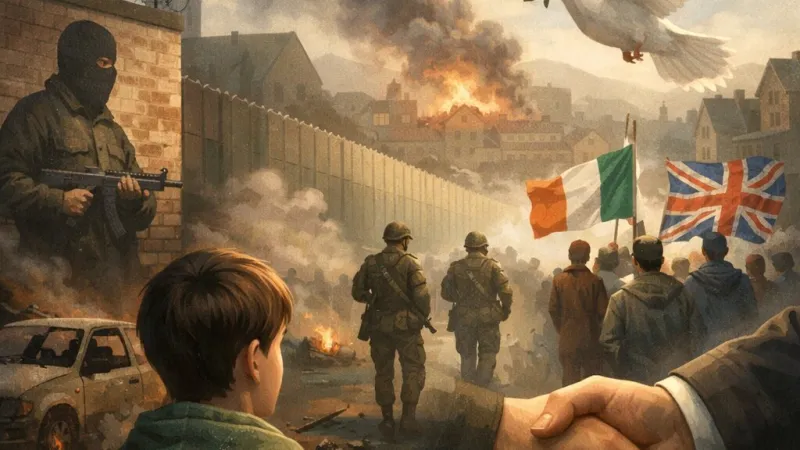
Summary:
Explore the Northern Ireland Troubles with a clear overview of the conflict, key events, and peace efforts to understand this complex historical period.
The Troubles in Northern Ireland: History, Conflict, and the Long Road to Peace
For three tumultuous decades, Northern Ireland endured a dark period of violence, fear, and division now known as the Troubles. More than a simple clash between two communities, the Troubles exposed the profound rifts embedded in questions of national identity, religious allegiance, and civic equality. Existing within the United Kingdom yet distinct in its own social and political makeup, Northern Ireland became synonymous with bombings, army patrols, and peace walls separating neighbour from neighbour. This essay seeks to untangle the complex history and legacy of the Troubles, examining their roots in partition and discrimination, the course of civil rights activism and communal violence, the interventions of government and paramilitaries, and the halting movement towards political resolution and reconciliation. In doing so, it will explore both the decisions of statesmen and the lived experience of divided communities, looking towards the lessons that Northern Ireland’s story offers for peace-building in divided societies everywhere.
---
I. Historical Background and Origins of the Troubles
The conflict in Northern Ireland cannot be understood without looking back to the early twentieth century, particularly the Partition of Ireland in 1921. The Government of Ireland Act 1920, passed in Westminster, sought to resolve rising tensions by meaningfully splitting Ireland into two self-governing entities. In practice, it created Northern Ireland—a region covering six counties in the north-east, remaining part of the United Kingdom and containing a Protestant majority who largely identified as British unionists. The rest of Ireland moved towards independence, eventually becoming the Irish Free State and later the Republic of Ireland, rooted in Catholic, nationalist aspirations.As partition lines solidified, they fixed demographic and cultural divides. In Northern Ireland, the majority Protestant community tended towards unionism, fearing loss of identity and economic security if absorbed into a Catholic-dominated Irish state. Catholics, meanwhile, often found themselves associated with Irish nationalism and regarded as outsiders within the new Northern Ireland order. Unlike the rest of the UK, where religious tensions had largely receded by the postwar period, in Northern Ireland, church, culture, and politics remained tightly interwoven. The new Stormont Parliament, based in Belfast, quickly became a bastion of unionist political dominance, as Protestant interests prevailed in almost every sphere of influence.
---
II. Societal and Institutional Discrimination
The institutional structures of Northern Ireland served, over decades, to marginalise the Catholic/nationalist minority in social and civic life. Discrimination found its most visible expression in allocation of public housing, contracting, and access to secure employment, particularly in industries like shipbuilding and public service, which were traditionally unionist strongholds. Councils were routinely accused of giving preference to Protestant families, while Catholics languished on waiting lists and faced chronic overcrowding.Electoral manipulation—or gerrymandering—was another weapon. Rather than drawing constituency boundaries along logical or demographic lines, unionist authorities redrew districts to exaggerate Protestant representation, even in Catholic-majority towns like Derry. Local government therefore provided little redress for nationalist grievances, and the Royal Ulster Constabulary (RUC), the police force, was viewed by many Catholics as partial or even hostile.
This systemic discrimination bred not only socioeconomic deprivation but also a deepening sense of alienation. As poets such as Seamus Heaney wrote, the landscape itself seemed divided “by spatters of gunshot on the windows,” with everyday injustices fraying any sense of belonging or hope of reform within established structures.
---
III. The Emergence of the Civil Rights Movement
Amid the social grievances, a new generation of activists began to look outward, drawing inspiration from the broader civil rights movements of the 1960s—from Martin Luther King’s campaign in the United States to protests against apartheid in South Africa, and anti-racist marches in the UK. In 1967, the Northern Ireland Civil Rights Association (NICRA) was founded, seeking not the dissolution of the state but basic reforms: fair housing allocation, equal voting rights (ending the property-based system that diluted Catholic votes in local elections), and an end to job discrimination.Initial NICRA marches were peaceful, with organisers carefully modelling themselves on non-violent protest traditions. However, they quickly drew the attention—and often the ire—of both the RUC and hard-line unionists. The events of October 1968, when a civil rights march in Derry was violently dispersed by police batons, were captured by television cameras and relayed across Europe, bringing Northern Ireland’s “domestic” troubles into international consciousness. Peaceful campaigners found themselves sandwiched between a security state unwilling to countenance reform and loyalist protestors who viewed any concession as a mortal threat.
---
IV. Escalation to Violence and the Rise of Paramilitaries
A crucible was reached in the late 1960s and early 1970s. What began as calls for moderate reform spiralled quickly into communal violence, as riot and counter-riot flared in flashpoints across Belfast, Derry, and smaller towns. In the summer of 1969, the Battle of the Bogside erupted, with Catholic residents mounting barricades in Derry’s nationalist heartland to resist the RUC and Protestant mobs. These clashes left homes in ruins, dozens injured, and marked the point at which the British government intervened directly, deploying army regiments to separate the warring communities.For a brief period, some Catholics initially welcomed the British Army as a neutral force. However, hopes soon faded as army tactics, including house-to-house searches and curfews, alienated the population. Meanwhile, new paramilitary groups—most notably the IRA, which split into Provisional (committed to armed struggle) and Official wings, and on the unionist side, organisations such as the Ulster Defence Association (UDA)—gained ground. Bombings, shootings, and tit-for-tat reprisals became common currency.
The policy of internment without trial, introduced in August 1971, proved disastrous. Under suspicion of paramilitary involvement, hundreds were imprisoned—predominantly, and often arbitrarily, from Catholic communities. Far from quelling unrest, internment fuelled resentment, increased IRA recruitment, and further polarised opinions.
The infamous events of Bloody Sunday in January 1972, when soldiers from the Parachute Regiment shot dead 14 unarmed civilians during a protest in Derry, marked a nadir. The episode confirmed the worst fears of nationalists about the British state, and gave fresh impetus to the IRA’s campaign, while hardening unionist fears of “surrender to republicanism.”
---
V. Political Attempts at Resolution
Faced with an apparently intractable conflict, successive British governments oscillated between security crackdowns and attempts at conciliation. In March 1972, as violence raged, the Stormont Parliament was suspended and direct rule from Westminster imposed. For many unionists, this felt like the loss of self-determination; for nationalists, it barely altered their status as second-class citizens.The Sunningdale Agreement of 1973 was the first substantial attempt at a cross-community government. It created a power-sharing executive alongside a Council of Ireland intended to foster cooperation between North and South. Yet unionist opposition proved unyielding. A mass strike led by the Ulster Workers’ Council—paralysing electricity and essential services—forced the initiative’s collapse after just a few months.
Although violence persisted, the late 1980s and 1990s brought new diplomatic efforts, including the Anglo-Irish Agreement (1985) and ultimately, in 1998, the Good Friday (Belfast) Agreement. The latter established a devolved power-sharing Assembly, cross-border institutions, and crucially, principle of consent—Northern Ireland’s status would change only if a majority wished it. While implementation has faced setbacks, the Agreement stands as the foundation for the (relative) peace of the last quarter-century.
---
VI. Social and Human Impact of the Troubles
Throughout these years, ordinary people paid the highest price. Around 3,600 died—over half of them civilians—and tens of thousands more were wounded. Whole neighbourhoods fragmented: “peace walls,” erected to prevent sectarian clashes, often separated Protestant and Catholic streets for decades. Schools, social clubs, and even sports teams (with the notable exception of rugby and boxing) became identified with one side or the other, breeding a culture of suspicion.The psychological scars endured long after the last bombs detonated. Survivors carried memories of bereavement, displacement, or simple grinding anxiety; children grew up with a divided sense of place, learning to avoid “the wrong areas.” Literary voices such as Bernard MacLaverty and Anna Burns have recorded lives marked by both quiet endurance and deep wounds. Even with processes of reconciliation, the generational legacy of trauma continues to shape attitudes and, to an extent, voting patterns.
---
VII. Lessons and Legacy
Peace in Northern Ireland is neither perfect nor complete. While open violence has been largely quelled, the society remains marked by “interface zones” and ongoing debates over flags, parades, and constitutional status—revealed yet again in the context of Brexit and disputes around the Northern Ireland Protocol. At the same time, grassroots initiatives—from integrated education programmes to community theatre, like the Derry Playhouse’s productions—have promoted dialogue and mutual understanding, demonstrating the power for civil society to lead where politicians sometimes falter.What lessons does this troubled history offer others? At the very least, it warns against the costs of institutional exclusion, and demonstrates that identity conflicts, once inflamed, are hard to contain. Equally, it reveals the value of inclusive governance, the importance of upholding human rights, and the potential of dialogue—even after decades of mutual fear and hatred. A fragile peace, after all, is infinitely preferable to sustained violence.
---
Rate:
Log in to rate the work.
Log in