The Cultural Revolution: China's Political and Social Upheaval Explained
This work has been verified by our teacher: 24.03.2026 at 9:29
Homework type: History essay
Added: 23.03.2026 at 16:28
Summary:
Explore the Cultural Revolution’s impact on China’s politics and society, understanding the causes, key events, and lasting legacy of this radical upheaval.
The Cultural Revolution: A Radical Experiment in China’s Political and Social Transformation
The Cultural Revolution, launched in 1966 and lasting roughly a decade, stands as one of the most tumultuous periods in twentieth-century Chinese history. To understand its significance, it is vital to consider the context of post-1949 China, where the Chinese Communist Party (CCP), led by Chairman Mao Zedong, governed the People's Republic of China. In the years preceding the Cultural Revolution, divisions simmered within the Party between those fiercely loyal to revolutionary ideals and more pragmatic figures concerned with economic stability. These internal rifts and the spectre of lost revolutionary momentum help to explain why the Cultural Revolution erupted so fiercely. Far more than a mere struggle for political power, it sought to dismantle centuries of tradition, reorder society, and remodel the collective mind of a nation. As this essay will argue, the Cultural Revolution was a multifaceted movement — part ideological crusade, part personal vendetta, part utopian experiment — which unleashed chaos on China’s people, leaving a legacy still fiercely debated both in China and abroad.
Origins of the Cultural Revolution: Political and Ideological Fault Lines
To grasp why the Cultural Revolution began when it did, one must look closely at the leadership conflicts within the CCP. After the catastrophic failures of the Great Leap Forward (1958–62), which resulted in millions of deaths through famine, the authority of Mao Zedong was at its lowest ebb. Figures such as Liu Shaoqi and Deng Xiaoping, both prominent in UK academic works on modern China, stepped in with practical, moderate measures intended to restore some measure of normality and economic growth. The split between Mao’s ideological purity and the pragmatism of others forms a central thread in the events that followed. The earlier Socialist Education Movement had exposed the limits of the moderates’ ability to control stirring unrest, and Mao increasingly worried that the revolutionary spirit was fatally waning.As historian Rana Mitter points out in many UK university texts, Mao’s fear of “peaceful evolution” — the slow drift away from revolutionary socialism — prompted him to challenge not only capitalist influences but also the “bourgeois” tendencies he believed were corrupting the CCP from within. In this climate, Mao saw that launching a dramatic, mass-scale campaign would allow him both to regain control from his party rivals and to rejuvenate the revolution through a direct appeal to the youth. Thus, with one eye on political necessity and another on ideological purity, Mao launched the Cultural Revolution in 1966, urging people to “Bombard the Headquarters!” in a dramatic attack on both traditional culture and his critics within the Party.
Mobilising the Youth: The Red Guards and Revolutionary Fervour
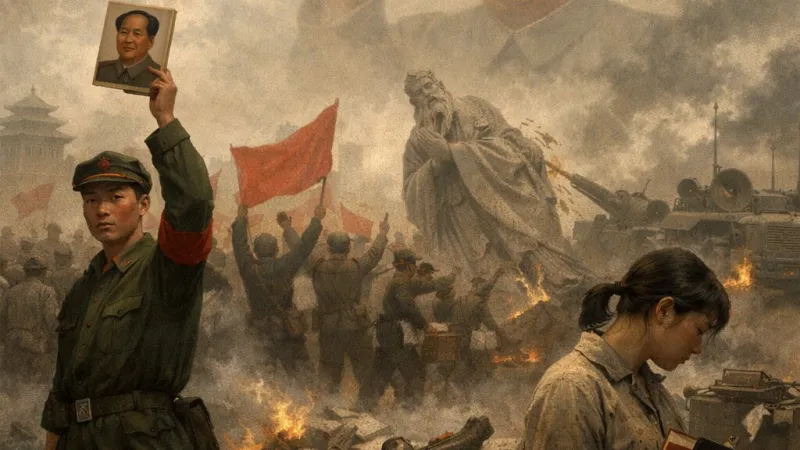
Perhaps one of the most distinctive features of the Chinese Cultural Revolution was its mobilisation of young people, most famously in the form of the Red Guards. British educational discussions of the period, such as those found in OCR and Edexcel A Level textbooks, often stress the sudden atmosphere in universities and middle schools as groups of students, encouraged by Mao, organised themselves into the vanguard of the movement. Clutching their copies of the ‘Little Red Book’ — the widely distributed Quotations from Chairman Mao Zedong — these youths lauded Mao as the great helmsman and set about sweeping away anything deemed “old” or “counter-revolutionary”.For many young participants, involvement brought not just revolutionary zeal, but also unprecedented opportunities. The rigid traditional hierarchy — where one’s “class background” determined educational and career prospects — was suddenly upended. Many Red Guards denounced not only teachers and school administrators, but even their own parents, echoing Mao’s transformative message that loyalty to the Party must transcend all other bonds. The encouragement of students to challenge all forms of authority, advertised through mass rallies in places such as Tiananmen Square in 1966 (where a million young people reportedly gathered) lent the movement both scale and spectacle.
It is striking, as touched upon in Chinese literature such as Jung Chang’s “Wild Swans”, how some found a sense of empowerment and almost intoxicating freedom in taking part, while others, caught in the crossfire, were left frightened and isolated as social relationships fractured.
The Assault on the "Four Olds": Cultural Upheaval and Historical Erasure
At the heart of the Cultural Revolution was an effort to cleanse China of its “Four Olds” — old customs, old culture, old habits, and old ideas. These were, in Maoist orthodoxy, barriers to socialist progress and had to be eradicated. Educational resources in the UK frequently emphasise the feverish destruction that followed: temples and shrines desecrated, ancient works of art and literature burnt, street names changed, and traditional festivals suppressed. Even Confucius, whose teachings had underpinned Chinese society for centuries, was not spared; his hometown of Qufu saw enormous material and symbolic destruction.Religion was another early victim: churches, mosques, and temples were shuttered, their clergy publicly humiliated, imprisoned, or worse. A void was left where rituals, ceremonies, and cultural artefacts had once tied communities together. Instead, the Party promoted itself as the new central force in people’s lives; school textbooks and public broadcasts declared that “parents may love you, but not as much as Chairman Mao”. For many families, this rupture was deeply traumatic, as children were encouraged to inform on elders for “backward” attitudes. The result was not only profound distress but a sense of cultural dislocation that would take generations to heal.
British literary observers often compare this sense of enforced social amnesia to the loss experienced during the dissolution of the monasteries under Henry VIII — another historical instance where a ruling power stamped out existing cultural networks to consolidate authority.
Violence, Terror, and Anarchy
Though the Cultural Revolution began as an ideological campaign, it quickly descended into an orgy of violence. Intellectuals, teachers, and suspected “class enemies” — including those branded as former landlords or “rightists” — were dragged into public humiliation rituals, or “struggle sessions”, where they might be beaten, tortured, or even killed. Official figures remain disputed, but some academic studies suggest that in provinces like Guangxi, thousands perished. These brutalities, according to scholars such as Frank Dikötter (frequently referenced in UK curriculum), were not merely incidental; they were intentionally cultivated as a means of breaking down all opposition and instilling fear.The Red Guards, initially allowed to operate with near-total impunity, soon fragmented into competing factions, each proclaiming itself the truest voice of Maoism. In cities such as Shanghai, open street battles erupted between rival groups, plunging urban centres into chaos. At first, Mao and the central leadership provided inconsistent signals: one moment encouraging further radicalism, the next moving — via the People’s Liberation Army — to rein in the worst excesses. Attempts to establish order, such as the “January Storm” in Shanghai (1967), brought only temporary respite.
While the human cost in deaths is still debated, the psychological scars of the period have been widely documented. Survivors have described a society gripped by suspicion; neighbours, friends, even relatives were potential informants. Trust and communal life were shattered.
Political Purges and Restructuring: Winners, Losers, and the Future of the Party
Parallel to the social and cultural turmoil, the Cultural Revolution also wrought dramatic changes at the top of the CCP. Liu Shaoqi, once President of China, was branded a “traitor” and subjected to relentless degradation before dying in captivity in 1969. Deng Xiaoping, later to become China’s paramount leader, saw his family targeted and was himself sent into internal exile. Only Zhou Enlai, through cautious political manoeuvring, managed to survive relatively unscathed, maintaining a precarious balance between left and right within the party.One notable beneficiary in the early period was Lin Biao, a military figure whom Mao nominated as his official successor in the CCP constitution of 1969. Lin’s subsequent downfall — he died in a mysterious plane crash in 1971 after his alleged plot against Mao was discovered — further illustrates the deadly uncertainty of revolutionary politics.
To assert more control, the CCP established new bodies, including the Central Cultural Revolution Group, designed to direct radical elements and sideline “bourgeois” mandarins. Yet, the purges crippled effective governance, as experience and expertise were stigmatised as signs of reactionary thinking. The disruption of institutional life proved long-lasting, complicating future attempts at reform and reconciliation.
Conclusion
The Cultural Revolution’s origins lay in the insecurities and ambitions of Mao Zedong and the wider Communist Party establishment. Driven by fears of ideological decay, Mao harnessed the fervour (and resentment) of millions, unleashing a decade of upheaval. The movement saw youth rise against authority, cultural legacies obliterated, and violence normalised on a vast scale. Party structures were remade via terror and purges, the effects of which would reverberate for decades.Yet, if the Cultural Revolution succeeded in one sense — temporarily restoring Mao’s dominance and enforcing a new ideological orthodoxy — the deeper costs were immense: broken families, a battered intelligentsia, and a society learning to live in the ruins of its own past. Contemporary China still grapples with how to remember or forget these events; official memory is sanitised, while dissenting voices seek ways to articulate the pain endured.
Ultimately, as both British and Chinese historians have shown, the Cultural Revolution remains a reminder of the perils of unchecked authority wedded to rigid ideology. Like other episodes of enforced social reordering in history — from Cromwell’s Commonwealth to the French Revolution’s Reign of Terror — it demonstrates the fragility of tradition, the dynamism (and danger) of youth when harnessed to a cause, and the deep wounds that can result when the state turns against both its past and its people.
Rate:
Log in to rate the work.
Log in