Exploring Winston Churchill's Perspectives on India and Empire
This work has been verified by our teacher: 4.04.2026 at 9:11
Homework type: History essay
Added: 3.04.2026 at 11:55
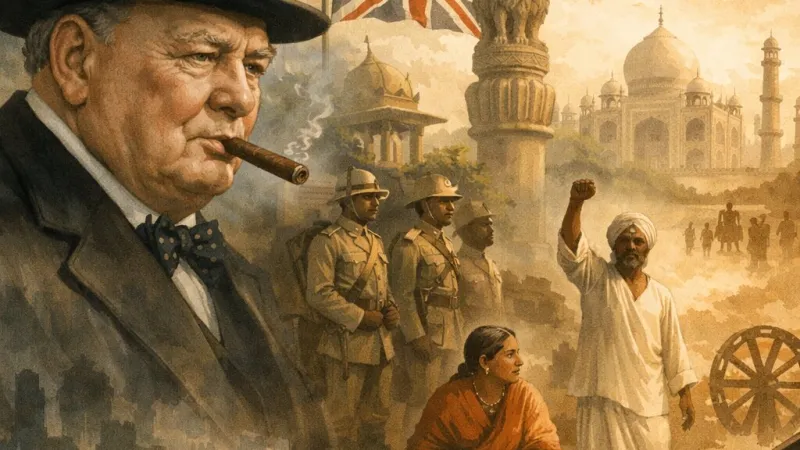
Summary:
Explore Winston Churchill’s complex views on India and empire, uncovering historical context and his impact on British colonial policies and Indian self-rule.
What Were Churchill’s Views on India?
Winston Churchill ranks among the most celebrated and controversial figures in British history, indelibly shaped by an era when the British Empire still stretched across a quarter of the planet. Though he is commonly remembered as the indomitable leader who stood firm against Nazi aggression, Churchill's political career spanned tumultuous decades in which British authority in India was constantly challenged and ultimately unravelled. His outlook on India, formed through both personal experience and political calculation, offers key insights not only into his own character but also into the mindset of a generation that saw imperial rule as both a duty and a right. This essay seeks to unravel Churchill’s ideas and prejudices about India—politically, culturally, and racially—placing them firmly within their historical context, and critically assessing both the convictions and contradictions that underpinned his lifelong opposition to Indian self-determination.
Churchill’s Early Contacts with India: Experience and Attitude Formation
Churchill’s relationship with India began not in the hallowed corridors of Westminster but on the dusty frontiers of the subcontinent. As a young cavalry officer stationed in Bangalore and later in the volatile North-West Frontier, Churchill witnessed firsthand the complexities and brutalities of colonial rule. His subsequent writings, such as “The Story of the Malakand Field Force”, bristle with the attitudes typical of Victorian soldiers: a determination to impose order, disdain for local resistance, and a conviction that British presence was a civilising necessity.These early experiences embedded in Churchill a loyalty to the imperial project. The late Victorian period—marked by Queen Victoria’s assumption of the title “Empress of India”—was one in which the empire was not merely a political possession, but flaunted as an emblem of Britain’s global purpose. The doctrine of the ‘white man’s burden’, first articulated by Rudyard Kipling, found ample resonance in Churchill’s world. He absorbed, almost unquestioningly, the beliefs that British administration brought progress, and that any hint of Indian political aspiration must be taken as childlike folly or dangerous disorder.
Churchill’s Imperial Worldview and Notions of Superiority
At the heart of Churchill’s attitude to India lay his deep-seated imperialism, animated by a belief in British benevolence and destiny. To Churchill, the empire was not only an institution but a symbol of Britain’s international standing and moral duty. In parliamentary debates and public addresses—even as anti-colonial sentiment mounted in the interwar years—he depicted the British as torchbearers of stability and reason, with India portrayed as a teeming, chaotic subcontinent in need of steady, paternalistic governance.Underlying this faith in the imperial mission was a pronounced bias in favour of British, and more specifically Anglo-Saxon, superiority. For Churchill, the British stock possessed a unique aptitude for government, character, and civilisation. He famously described Hindus as “a beastly people with a beastly religion”, an attitude that encapsulates the deeply racial hierarchy embedded in his thinking. Such views were not uncommon among his contemporaries—figures like Lord Curzon, Viceroy at the turn of the century, displayed similar attitudes—but Churchill clung to them even as they became increasingly out of step with the currents of history.
Churchill’s emphasis on the civilising role of British rule meant he credited the empire with ending practices he deemed barbaric, such as sati and thuggee, and introducing railways, law codes, and a unified administration. Yet this narrative, which denied the legitimacy and sophistication of ancient Indian civilisations, bore little tolerance for dissent from within the subcontinent itself.
Churchill, Indian Nationalism, and the Question of Self-Rule
By the twentieth century, winds of change were blowing through India. The rise of the Indian National Congress, together with the swelling popularity of Mahatma Gandhi’s campaigns of civil disobedience, demanded a reappraisal of the imperial relationship. Churchill, however, was among the most vociferous opponents of concessions to Indian self-government.Perhaps most emblematic of his attitude was his contemptuous portrayal of Indian political leaders. He described Gandhi as a “seditious Middle Temple lawyer, now posing as a fakir of a type well-known in the East”. Churchill genuinely feared that Indian self-rule would mean not liberation but disaster: he predicted factional strife, economic collapse, and domination by Hindu elites over Muslims and other minorities. This perspective was evident in his interventions regarding the Government of India Act of 1935, which he strenuously opposed, arguing that the reforms gave undue credence to an unrepresentative Indian political class.
At moments when others within the British establishment began tentatively to entertain the possibility of a future independent India, Churchill preferred robust repression. He derided measures like the Montagu-Chelmsford reforms as dangerously naive, instead urging the maintenance of firm British control to prevent the “break-up of the native society” and the loss of imperial prestige.
Clashes, Crises, and Churchill’s Racial Worldview
Churchill’s handling of moments of acute crisis in British-Indian relations laid bare the intransigence of his convictions. The Amritsar Massacre of 1919—when General Dyer’s troops killed at least 379 unarmed protestors—met with complicated reactions from him. Though he called the attack “monstrous” during a Commons debate, his principal concern remained the maintenance of order and British authority, and his criticisms were ultimately muted by broader anxieties about imperial security.During the Second World War, Churchill’s position hardened still further. As Prime Minister, he faced Indian demands for constitutional progress and independence, symbolised by the Quit India movement of 1942. His reaction—imprisoning nationalist leaders and resisting all calls for a timetable for independence—displayed his unwillingness to adapt to rapidly shifting realities. Indeed, the Bengal Famine of 1943, in which millions died, revealed the moral blindness of his approach: requests for food relief from India were dismissed, and Churchill placed blame on ‘the Indians breeding like rabbits’, a remark that underscored the racial condescension at the heart of his worldview.
Criticisms, Contradictions, and Churchill’s Legacy
Indian nationalists and sympathetic Britons repeatedly castigated Churchill for his stubbornness and racial prejudices. Gandhi called British rule “a curse”, while Congressmen like Jawaharlal Nehru regarded Churchill’s statements as proof of the bankruptcy of imperial moral claims. Figures within Churchill’s own party, such as Leo Amery, sometimes whispered that his opinions on India bordered on the unhinged, warning that refusal to accept colonial decline would ultimately damage Britain as well as India.Modern historians are divided as to whether Churchill’s inflexibility was simply characteristic of a man of his era or marked him out as especially reactionary. Scholars like Anita Anand and Shashi Tharoor have situate his legacy at the heart of the more malign aspects of British imperialism—racism, arrogance, and refusal to yield to the principle of self-determination. Yet in the popular British memory, Churchill’s image as a war hero has sometimes overshadowed or excused the damage done to Britain’s imperial relations by his conduct during the twilight of colonial rule.
The Wider Impact: From Policy to Collective Memory
Churchill’s steadfast refusal to contemplate Indian independence left tangible marks on British policy through the 1930s and beyond. His influence helped stiffen resistance to constitutional reform within Conservative circles, lengthening the delay before India’s eventual independence. This, in turn, inflamed nationalist sentiment on the subcontinent and deepened the bitterness with which Britain was viewed in Indian nationalist circles.In Britain, the consequences of Churchill’s attitude are still present in debates over historical memory. Statues of Churchill stand in Parliament Square, but opinion remains polarised: for many, he is the saviour of democracy; for others, his imperial legacy—including his views on India—casts a long, uncomfortable shadow over British and global history. The disconnect between commemorative pride in Churchill’s achievements and more critical reckoning with the realities of colonial rule is an ongoing source of cultural reflection, not least as calls for decolonising the curriculum gather strength in British universities.
Conclusion
Winston Churchill’s views on India were deeply rooted in his formative years in the empire, underpinned by a profound faith in imperial power and shaped by the racial attitudes of his time. His steadfast opposition to Indian self-rule was not simply political expediency but reflected a world-view in which British supremacy and imperial benevolence were taken for granted. If at times he professed a belief in the welfare of his Indian subjects, in practice he prioritised the maintenance of British dominance and dismissed Indian aspirations as either premature or dangerous.The complexity of Churchill’s position lies in these contradictions—pride at supposed improvement and modernisation, but unwillingness to recognise Indian agency; condemnation of brutal reprisals, but support for the repressive machinery of empire. Analysing Churchill’s legacy is both a historical task and a moral challenge, forcing a confrontation with the imperial assumptions that have shaped Britain’s recent past. In grappling with Churchill’s attitudes toward India, we are also confronting deeper questions about history, memory, and the path to mutual understanding between Britain and its former colonies.
Rate:
Log in to rate the work.
Log in