Medicine and Medical Advances during the Renaissance Era (c.1500–1800)
This work has been verified by our teacher: 18.04.2026 at 12:25
Homework type: History essay
Added: 17.04.2026 at 6:51
Summary:
Explore key medical advances during the Renaissance era (c.1500–1800) and learn how new discoveries shaped modern medicine in the UK and beyond.
Medicine and Medical Understanding in the Renaissance Period (c.1500–1800)
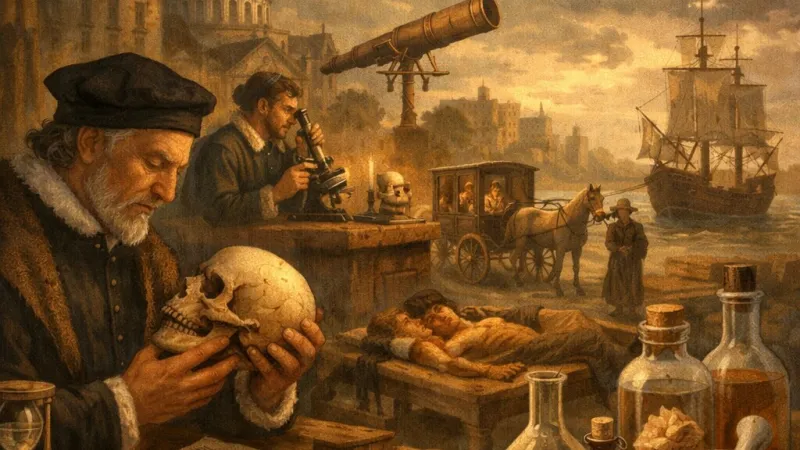
The Renaissance, spanning roughly from the early 16th to the late 18th century, stands as one of history’s most profound periods of upheaval, renewal, and intellectual blossoming. Traditionally defined as a rebirth of classical knowledge and creative energy, the Renaissance transformed not only the arts and philosophy, but also the very framework of scientific thought. This sea-change is especially evident in the advance of medicine—a field previously dominated by ancient texts and unquestioned authorities, which began instead to favour direct observation, methodical investigation, and experiment. Nowhere is this shift more striking than in the evolution of anatomical study, the understanding of human physiology, surgical practice, and the approach to disease. Yet, the era was not marked by immediate progress, but rather by the coexistence, and often collision, of old beliefs and innovative ideas. Through an exploration of the period’s major medical developments and responses to public health crises, especially in the context of the United Kingdom, it becomes clear that the Renaissance prepared the ground for modern medicine, however haltingly and incompletely.
Revolution in Anatomical Knowledge
One of the Renaissance’s hallmark contributions to medicine was the reinvention of anatomical study. In medieval Europe, medical students and practitioners were bound to the writings of Galen, a second-century Roman physician whose works, translated into Latin in monasteries, achieved the level of near scriptural authority. Galen’s descriptions—many of which derived from dissections of animals instead of humans—were accepted uncritically. To challenge Galen was, in essence, to challenge a whole order of inherited truth.The Renaissance spirit, however, was restless and questioning. By the 16th century, a swelling tide of scholars felt emboldened to test received wisdom for themselves. Among the boldest was Andreas Vesalius, whose career encapsulates the period’s transformation. Discontent with abstract lectures, Vesalius carried out direct dissections of executed criminals—a risky but vital source of knowledge, given the church’s restrictions on disturbing the dead. Through these painstaking studies, Vesalius discovered numerous inaccuracies in Galen’s treatises. He demonstrated, for instance, that the human lower jaw is a single bone, not two, and that the breastbone is made up of three parts instead of Galen’s seven. Perhaps most significantly, Vesalius found no holes in the septum of the heart—undermining the prevailing theory of blood flow.
The impact of Vesalius’ discoveries was magnified by his groundbreaking book, ‘De humani corporis fabrica,’ lavishly illustrated and distributed thanks to the advent of the printing press. For the first time, students across Europe could compare accurate diagrams to real-life dissections. In the medical schools of England—at Oxford, Cambridge, and later Edinburgh—dissection became an integral part of training, marking a clear departure from the tradition of didactic, text-based tuition. Nevertheless, while Vesalius transformed knowledge of the body’s structure, practical advances in treating illness lagged behind. Understanding anatomy did not immediately translate into improved therapies—infections and diseases continued to baffle physicians, highlighting a recurring renaissance paradox: knowledge raced ahead of effective practice.
Understanding Human Physiology: William Harvey and Blood Circulation
No less transformative than the anatomical revolution was the new understanding of how the body functioned. For centuries, the medical world adhered to Galen’s theory that blood was created in the liver, transported through invisible pores in the heart’s septum, and consumed by the body’s organs in an endless cycle. Although the Arab physician Ibn al-Nafis had gestured towards pulmonary circulation several hundred years earlier, it was in the England of the 17th century that the true nature of circulation was definitively established by William Harvey.A fellow of Gonville and Caius College, Cambridge, and physician to King Charles I, Harvey was steeped in both classical learning and the empirical spirit of his age. Rejecting passive acceptance, he embarked on systematic experiments to elucidate the workings of the heart and blood vessels. By rigorous measurement, Harvey showed that the volume of blood pumped by the heart each hour far exceeded the body’s capacity to absorb or generate it anew—proving that blood must circulate around the body in a closed system. His observations of one-way valves in veins provided clear anatomical evidence for this theory.
Despite the elegance and simplicity of Harvey’s explanation, it encountered passionate resistance from many quarters. Universities clung to established texts, and Harvey’s detractors accused him of heresy, charlatanry, or mere absurdity. The ancient authority of Galen did not cede its place easily; it took over half a century for Harvey’s ideas to enter mainstream medical teaching. Harvey himself suffered professionally—some patients reportedly forsook him for more orthodox physicians.
In the long view, however, Harvey’s work laid foundations that would sustain countless future discoveries. Without a precise understanding of circulation, developments such as effective drug delivery, vaccination, or even modern surgery would have been impossible. Later, Italian physician Marcello Malpighi would confirm Harvey’s theories by observing blood capillaries through a microscope, showing the connections between arteries and veins. Harvey’s legacy in method was as important as his scientific conclusion: he established observation, measurement, and hypothesis-testing as central to medical science.
Advances in Surgery and Practical Medicine: Ambroise Paré
If advances in anatomy and physiology owed much to the university and teaching hospital, the domain of practical surgery was often the preserve of those with hands-on experience. Ambroise Paré, a Frenchman but deeply influential in Britain, began his career as a barber-surgeon. Long considered an inferior class compared to university-trained physicians, barber-surgeons occupied a humble yet vital position, dealing with wounds and traumas, especially in military campaigns.Paré’s innovative methods were rooted in necessity. On the battlefield, he observed that the brutal practice of cauterising wounds with boiling oil or searing irons often worsened suffering and did little to prevent infection. When supplies ran short, he improvised a soothing ointment of egg yolk, rose oil, and turpentine; to his surprise, patients treated with this mixture fared far better than those subject to cauterisation. Furthermore, Paré advocated tying off blood vessels with ligatures rather than burning them. This reduced immediate agony but, in the absence of knowledge about germs, increased the risk of deadly infection.
Paré’s improvements in artificial limbs and prosthetics also demonstrated a shift toward rehabilitation, not just life-saving. Over time, British and European surgeons recognised that the barber-surgeon’s art could, with training and innovation, be as scientific as any other branch of medicine. Nonetheless, surgeons continued to work without effective anaesthesia or antiseptics. Their fate—clearing the path for modern surgery, but limited by contemporary science—epitomises the Renaissance’s mixture of progress and constraint.
Medical Treatments and Remedies in the Renaissance
Despite new vistas opening in anatomy and physiology, everyday treatments often reflected older traditions. The humoral theory, inherited from antiquity, held the body in delicate balance between four “humours”: blood, phlegm, black bile, and yellow bile. Illness was thought to arise from imbalance, so bleeding, purging, and emetic therapies remained in vogue. Notables such as King Charles II fell victim to such overzealous treatments, underlining the persistence of dogma even amidst scientific ferment.Beyond the doctor’s chamber, households relied extensively on herbal and folk remedies. Women, especially, acted as unofficial healers, using honey for wounds, willow for pain, and a multitude of herbs for digestive complaints—knowledge passed through generations and increasingly disseminated by printed herbals like Nicholas Culpeper’s ‘The English Physician’.
The period’s reach extended beyond the local. Spices, medicines, and “curatives” arrived via expanding European trade networks. Rhubarb, imported from China, was prized as a purgative; Peruvian cinchona bark offered one of the few effective treatments for malaria. Opiates saw increasing use as pain relief, but addiction and dangerous dosing loomed as ever-present risks.
However, Renaissance medicine was plagued by charlatans and quack doctors, who peddled questionable remedies from town to town, exploiting the public’s desperation for cures. The line between innovation and fraud was sometimes thin, as genuine doctors experimented while trying to distinguish trustworthy from deceptive novelty. Regulation was weak, and patients often suffered as a result.
Public Health and Epidemic Responses: The Case of the Great Plague
If the Renaissance saw intellectual and practical advances, it also revealed the limits of contemporary understanding in the face of epidemic disease. The Great Plague of 1665, which swept through London and other English cities, was a catastrophe comparable only to the Black Death in its psychological and societal devastation. Cities remained breeding grounds for infection—crowded, dirty, with little understanding of sanitation or disease transmission.Explanations for the plague’s causes drifted between religious and proto-scientific. Sermons presented the plague as divine punishment for sin; at the same time, the theory of miasma—‘bad air’—offered a more naturalistic, if still flawed, explanation. Plague doctors equipped themselves for battle in theatrical costume: long coats, gloves, boots, and a beaked mask stuffed with aromatic herbs such as lavender or rosemary, believed to filter and purify the air. Amulets, prayers, and quarantines became common, illustrating the desperate fusion of superstition, faith, and emergent public health policy.
Treatment, meanwhile, remained largely ineffective: bleeding and purging were practised with deadly enthusiasm. Mass graves, social distress, and the abandonment of sufferers all left profound marks on the national psyche. Yet, in the midst of disaster, there were stirrings of modernity: attempts at quarantine, observation of patterns of spread, and the germ of epidemiology.
Conclusion
The Renaissance was thus a great age of contradiction and transformation in medicine. Luminaries such as Vesalius, Harvey, and Paré pried open the body’s secrets with observation and daring, even as daily medical practice remained ensnared in tradition. Advances in anatomy and physiology moved the discipline closer to science, while surgery and treatments walked a line between innovation and hazard. Epidemics laid bare the limits of understanding and galvanised early efforts at public health.Crucially, the Renaissance forged habits of inquiry, critical thinking, and experiment in British medical education and practice. It taught that truth must be discovered, not simply inherited. The willingness to question received authority and embrace the evidence of one’s own eyes now lies at the heart of all scientific medicine—a precious inheritance, painstakingly won.
As the curtain fell on the 18th century, the stage was set for fresh revolutions in medicine. If the Renaissance did not cure all ills, it nonetheless broke the shackles of intellectual stagnation and opened the way for the extraordinary advances of the centuries to follow. The medical knowledge we rely on today stands on the shoulders of these early pioneers, whose courage and curiosity transformed suffering and superstition into the promise of science and healing.
Rate:
Log in to rate the work.
Log in