Edward VI and the Tudor Transformation: Impact of England’s Child King
This work has been verified by our teacher: 3.05.2026 at 17:35
Homework type: History essay
Added: 30.04.2026 at 13:49
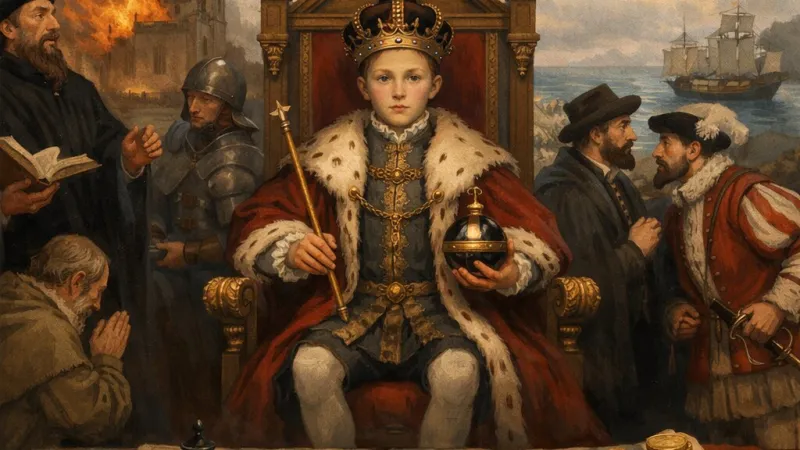
Summary:
Explore how Edward VI’s brief reign shaped Tudor England’s religion, politics, and foreign relations during a time of major transformation and minority rule.
Edward VI: A Child on the Throne and the Transformation of Tudor England
The figure of Edward VI, Henry VIII’s only legitimate son, occupies an intriguing—if somewhat overlooked—place in the Tudor pantheon. While his reign was brief and dominated by the figures guiding him, its impact on English religion, politics, and relations with Europe was pivotal. The boy king’s ascent was laden with the hopes and anxieties of a nation torn asunder by reform, yet still tethered to tradition. His rule would not only further the Protestant cause, but also expose the complications inherent when sovereignty rested with a minor. This essay examines the multiple currents at play during Edward’s government: the challenges of a regency, relentless religious innovation, fraught foreign policy, and the lasting legacy of a reign marked as much by those who ruled in his name as by the king himself.The Peril and Power of Minority Rule
Unlike the sturdy, imposing monarchs of popular imagination, Edward VI ascended the throne in 1547 as a frail nine-year-old, his very youth serving as both a symbol of fissure and opportunity. The last of Henry VIII’s offspring to inherit the English crown, Edward’s accession reignited a dormant problem for the Tudors: how to ensure stable rule when the sovereign was a child. In earlier times, child kings had proven the undoing of dynasties; the fate of Edward V in the Tower of London cast a menacing shadow.To forestall disaster, Henry VIII’s elaborate will provided for a Regency Council, designed to represent a spectrum of interests—Protestant and Catholic, traditionalist and reformer. However, in reality, such balanced committees are rarely workable. The council’s initial attempts at collective rule soon yielded to the dominating personality of Edward Seymour, Duke of Somerset, who was Edward’s maternal uncle. He assumed the unique title of “Lord Protector,” effectively taking command of the kingdom, aided by allies such as Archbishop Cranmer and Sir William Paget.
Somerset’s tenure was fraught with the endemic perils of regency: factions vied for the ear of the king, and personal ambition often blurred the borders between governance and greed. Family rivalry added to the turbulence, as Somerset’s own brother, Thomas Seymour, sought to undermine the Protector’s authority, plotting boldly but ultimately ineptly for influence. This culminated in Thomas’s arrest and execution, a case illustrative not just of personal vendetta but of the instability befalling any regime where so much power clustered around a vulnerable figurehead.
As Somerset’s policies sowed both hope and discontent, his brusque style and failure to broker compromise led to his downfall. The Duke of Northumberland (John Dudley, previously Viscount Lisle) awaited in the wings, orchestrating Somerset’s arrest and establishing his own domination. The swift, ruthless transitions among protectors reflected the perennial anxiety that shaped any English minority rule—especially in a nation still haunted by memories of civil war.
Religious Transformation and the Strains of Reform
If dynastic politics created unease, religious upheaval sent deeper shockwaves through mid-Tudor England. Under Henry VIII, the break with Rome had begun, but many of the forms and rituals of Catholicism endured. Edward’s reign, orchestrated by influential reformers around him, was the crucible in which the English Reformation hardened from royal schism into an unmistakably Protestant project.Edward VI himself was raised with Protestant tutors (notably Richard Cox and Sir John Cheke), and his protectors generally favoured reform. Somerset was no zealot, viewing religious change as both a point of conviction and a useful means to secure his rule. The England Edward inherited was fractured: northern and midland shires tended towards conservative, ‘old religion’ loyalties, while the southeast and London increasingly embraced Protestant books and foreign reformers.
Early statutory changes, such as the 1547 Chantries Act, dissolved masses for the dead, not only extinguishing Catholic customs but also seizing their resources for the Crown, in part to pay for war. Soon afterwards, Parliament commissioned a visitation to assess the state of the Church, exposing abuses but also alarming traditionalists.
Press censorship was eased, and a flood of Protestant pamphlets and imported sermons emboldened radicals. The 1549 Act of Uniformity, one of the reign’s most momentous laws, mandated the use of services in English and gave the laity both bread and wine at communion—radically altering the nature of worship. Thomas Cranmer’s Book of Common Prayer was intended as a moderate compromise, yet its ambiguous phrasing delighted few: reformers wanted swifter change; conservatives balked at anything that smacked of heresy.
Responses varied strikingly by region and social class. For many parishioners, reforms seemed to come at a dizzying and unsettling pace. The Western (Prayer Book) Rebellion in Devon and Cornwall, with rebels famously demanding the restoration of ‘the old religion,’ brutally revealed the dangers of pressing too far, too quickly. Parliamentary inquiries and the destruction of images shocked those for whom sacred spaces and inherited rituals provided order and consolation. Simultaneously, expectations of ministers now included the ability to preach and read fluently, thereby raising the bar for literacy both among clergy and congregations.
Foreign Policy in the Shadow of the “Boy King”
While domestic affairs convulsed with novelty and resistance, England’s foreign adventures continued, yet rarely smoothly, throughout Edward’s reign. Henry VIII’s death bequeathed not only a fragile succession but also unfinished business on the northern border. The “Rough Wooing”—an attempt to impose an Anglo-Scottish marriage alliance by force—became a drain on the Crown’s already-strained finances.Somerset pressed the campaign, hoping to marry young King Edward to Mary, Queen of Scots. The English won a decisive victory at the Battle of Pinkie in 1547, but failed to secure lasting control. Scottish resistance, allied to resolute French intervention, soon saw Mary spirited away to France, where arrangements were made for her betrothal to the French Dauphin. The fruits of victory proved bitter: English garrisons in Scotland were overextended, costly, and vulnerable. Northumberland, learning from these failures, finally abandoned many fortresses, but even so, war debts piled up.
Further afield, England’s diplomatic position was perilous. European powers, notably France and the Holy Roman Empire, took only limited interest in aiding a Protestant regime led by a child. The crisis exposed both the logistical limits of a kingdom dependent upon a minority sovereign and the risks inherent in entangling continental ambitions.
Legacy: Edward VI’s England and Its Long Shadow
Though Edward’s life was cut tragically short in 1553—with what most now believe to be tuberculosis—his reign left a profound imprint that belied its brevity.Politics and Governance: The prolonged dominance of protectors underscored how easily power drifted from the monarch in times of minority, with dangerous consequences. The precedent empowered leading nobles, but also sowed mistrust and factionalism, contributing to the subsequent instability of the succession. Northumberland’s later attempt to institute Lady Jane Grey as Edward’s successor, bypassing Elizabeth and Mary, was rooted in the audacious wielding of quasi-royal authority established during Edward’s childhood.
Religious Change: If Henry VIII’s reign severed English Christianity from Rome, it was under Edward VI that Protestantism took root institutionally. The Book of Common Prayer endured across centuries—even surviving Mary I’s attempts at Catholic restoration, to re-emerge as a cornerstone of Anglican identity. Yet Edward’s rapid, top-down reforms also left a legacy of polarisation. Anglican settlement under Elizabeth I would be, in part, a response to the intractable divisions that first became apparent in Edward’s days—exacerbating fault lines between regions, classes, and confessions.
Social and Cultural Ripples: With the destruction of saints’ shrines, suppression of traditional holy days, and the abrupt halt to many charitable foundations (chantries, monasteries), the social safety net for the poor shrank, even as expectations for literacy and engagement with scripture rose. The roles of church and congregation changed fundamentally, laying foundations for the later English obsession with Bible-reading and local governance.
Foreign Policy: Failures in Scotland and with continental alliances taught a hard-won lesson about the limitations of English military power—a lesson which Elizabeth I, more cautious in her interventions, would heed in her dealings with Europe.
Conclusion
Edward VI’s reign, standing on the fault-lines of mid-Tudor England, illuminates the perils and promises of minority rule. While the king himself—pious, thoughtful, yet physically delicate—exercised little direct agency, the force of events that swept through his government transformed his shadowy reign into an era of unprecedented change. The age of somber council chambers, surging iconoclasts, and embattled garrisons marked England’s decisive step away from its medieval past.Edward’s government did not fully resolve the dilemmas of authority, faith, or diplomacy it confronted, yet it propelled England onto a new path—the consequences of which would only be fully revealed under Queen Elizabeth. It is in the contests and compromises of these six turbulent years that we witness the forging of modern English identity: fractured yet resilient, nostalgic yet restlessly innovative, always mindful of the lessons—sometimes dearly bought—of its history.
Rate:
Log in to rate the work.
Log in