Key Cold War Crises: Examining Korean War, Berlin, and Cuba
This work has been verified by our teacher: 9.05.2026 at 11:07
Homework type: History essay
Added: 8.05.2026 at 12:39
Summary:
Explore key Cold War crises including the Korean War, Berlin Blockade, and Cuban Missile Crisis to understand their impact on global diplomacy and conflict.
Cold War Crises
The Cold War, spanning from the aftermath of the Second World War in 1947 until the collapse of the Soviet Union in 1991, stands as one of the most defining periods of modern international relations. Unlike preceding wars, it was characterised not by direct military confrontation between the rival superpowers—the United States and the Soviet Union—but by ideological rivalry, diplomatic manoeuvrings, and a perennial threat of nuclear catastrophe. Within this fraught context emerged a series of ‘Cold War crises’—episodes where diplomatic tensions and military brinkmanship threatened to escalate into open conflict, either regionally or worldwide. These crises, such as those in Korea, Berlin, and Cuba, both revealed the volatility of global politics and had profound consequences for shaping the post-war world order.
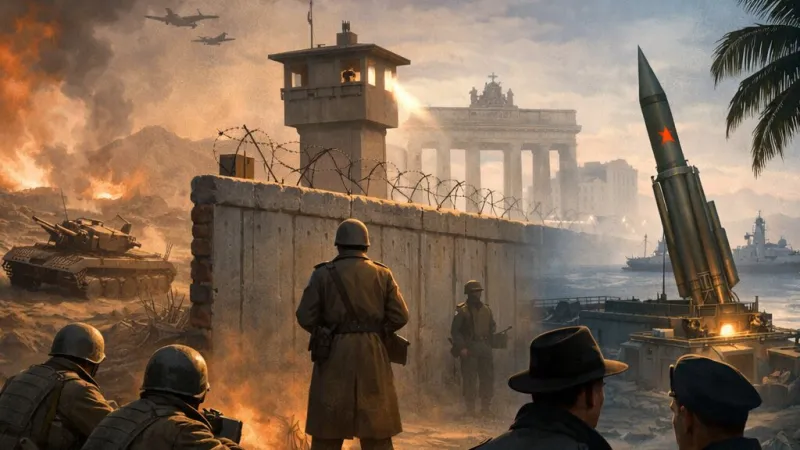
This essay will focus mainly on the Korean War of 1950–1953 as a pivotal Cold War crisis, while drawing comparative insights from other key events including the Berlin Blockade and the Cuban Missile Crisis. Through analysis of the causes, the unfolding of events, and the international responses, the essay will consider how such crises not only reflected the wider ideological and strategic contest between East and West, but also set precedents for conflict management and global diplomacy in an atomic age. Understanding these crises is not just an exercise in historical curiosity; it illuminates the precarious balance between peace and war, order and chaos, which still frames international relations today.
---
I. The Origins and Nature of Cold War Crises
A. Post-World War II Geopolitical Landscape
The grandeur of Allied unity, as embodied in the Yalta and Potsdam conferences, was short-lived. As Europe emerged from the ashes of total war, it swiftly fractured along ideological lines, with the Soviet Union asserting control over Eastern Europe, and the United States shaping the reconstruction of the West. The famous Iron Curtain, as first coined by Winston Churchill in his 1946 speech at Fulton, signified not just the physical division of Germany and central Europe, but a deeper schism in worldview. Britain’s own experience, torn between imperial commitments and financial exhaustion, mirrored the wider uncertainties of this new era.Instead of cooperation, mutual suspicion and the desire to secure spheres of influence prevailed. In Asia, similar processes unfolded, with defeated Japan occupied and reconstructed primarily by the United States, while neighbouring territories became arenas for superpower competition. The very fabric of international politics was re-woven with competition, laying the foundation for a series of crises wherever East met West.
B. Ideological Polarisation and Its Implications
The Cold War’s underlying fuel was ideological dogmatism. On the one side stood advocates of capitalist democracy, promoting individual freedoms and market economies; on the other, defenders of centralised, state-led communism, promising equality and social justice. The British Labour government under Clement Attlee, although socialist in some ambitions, firmly aligned with the Western bloc, encapsulating the breadth of the anti-communist coalition in Europe.Ideological differences shaped not only grand strategy but also local politics, as superpowers sought loyal client regimes. Proxy conflicts in Greece, Iran, and later Malaya (where British forces fought communist insurgents) demonstrate how Cold War rivalries played out in diverse cultural and geographic contexts.
C. Mechanisms of Crisis Escalation
The development of military alliances such as NATO (North Atlantic Treaty Organisation, founded in 1949) and the later Warsaw Pact (1955) formalised opposing camps and raised the stakes in any confrontation. Espionage, propaganda, and covert interventions further eroded trust—the Cambridge Five, famously recruited at British universities such as Trinity College, Cambridge, typify the entangled loyalties of the period.Technology added another destabilising dimension: nuclear weapons. The Soviet test of an atomic bomb in 1949 ended America’s monopoly, inaugurating an arms race where both sides perceived overwhelming destruction as possible and, paradoxically, as a form of mutual restraint.
---
II. The Korean War (1950–1953): A Defining Cold War Crisis
A. Background to the Korean Divide
Korea, long under Japanese colonial rule, found itself abruptly divided at the end of the Second World War—the South occupied by American troops, the North by Soviet forces. Out of these occupation zones emerged two governments: the Democratic People’s Republic of Korea led by Kim Il-Sung in the North, and the Republic of Korea under Syngman Rhee in the South. Both claimed legitimacy, and the 38th Parallel formalised a highly volatile border.B. Outbreak of Hostilities and Initial Developments
On 25 June 1950, North Korean forces launched a sudden and overwhelming attack across the 38th Parallel. The North’s army, well-supplied with Soviet weaponry, rapidly pushed southwards, overwhelming South Korean defenders and threatening the complete collapse of Rhee’s government. For both the USSR and China, a communist victory in Korea appeared to consolidate the security buffer around their borders; the US, meanwhile, feared a ‘domino effect’, with Asian states succumbing to communism one after another.C. International Responses and the United Nations’ Involvement
President Truman, conscious of both the lessons of appeasement in the 1930s and the newly articulated policy of ‘containment’, moved rapidly. The United States secured an emergency resolution at the United Nations, which—thanks to a Soviet boycott over the issue of Chinese representation—passed without veto. A United Nations Command, led by the US but including British, Australian, Turkish, and other allied contingents, was established. Harold Macmillan, then British Minister of Defence, supported British military involvement, keen to maintain international influence and alliance solidarity.D. Military Campaigns and Turning Points
The initial months were marked by disaster for UN forces, who found themselves encircled at the so-called ‘Pusan Perimeter’. However, in September 1950, a daring amphibious landing at Inchon, masterminded by General Douglas MacArthur, turned the tide, enabling the recapture of Seoul and the drive towards the Chinese border. Britain’s 27th Brigade, including the Gloucestershire Regiment, fought with distinction alongside Commonwealth allies.However, this advance alarmed Mao Zedong, who, fearing encirclement and the undermining of China’s revolution, ordered hundreds of thousands of ‘volunteers’ across the Yalu River. The resulting counter-offensive pushed UN forces back below the 38th Parallel, transforming the war into a bloody stalemate.
E. Conflict Stalemate and Armistice
The war became a brutal, attritional conflict, typified by desperate trench warfare and enormous civilian suffering. Disagreements over strategy erupted amongst the UN command, culminating in President Truman’s decision to dismiss MacArthur for insubordination—a notable event illustrating the limits of military initiative under civilian control.Armistice talks dragged on for two long years, with issues such as the exchange of prisoners causing protracted deadlock. On 27 July 1953, an armistice was finally signed at Panmunjom. The peninsula remained divided; families separated, cities devastated, and no peace treaty ever formally ended the conflict—a sore point that persists into the present day.
---
III. Broader Implications of the Korean War and Other Cold War Crises
A. Impact on US–Sino Relations
Korea marked the arrival of the People’s Republic of China as a major regional actor. The war poisoned relations with the United States, which refused to recognise the new communist government and instead backed the Nationalists in Taiwan, a stance that would not change until the 1970s rapprochement initiated by President Nixon and, crucially, facilitated by Britain’s own diplomatic contacts.B. Soviet–American Relations during and after the Korean War
For the Soviets, indirect intervention in Korea set a pattern for future engagements—supporting friendly regimes without openly committing Soviet troops. Yet Stalin’s death in 1953, and the subsequent ‘Thaw’ under Khrushchev, did introduce a period of cautious dialogue and cultural exchange, although proxy wars remained a recurrent feature.C. Lessons from the Korean War for Crisis Management
If the Korean War demonstrated anything, it was the importance of securing international legitimacy—a lesson not lost on British and American policymakers in later decades. The UN’s role, although imperfect, created a framework for collective security (contrasting with the later Suez Crisis, where Britain’s lack of UN blessing led to disaster). Yet the risks of escalation—including Chinese or even Soviet intervention—highlighted the limits of military solutions in a nuclear age, a sobering lesson when later crises arose.D. Comparative Case Studies
Britain and its allies soon confronted further flashpoints. The Berlin Blockade of 1948–49 tested Western commitment to the divided city, resulting in a massive airlift operation that circumvented Soviet obstruction. The Cuban Missile Crisis in 1962 represented perhaps the closest point to nuclear armageddon. Here, careful negotiation and a willingness to make secret concessions averted catastrophe—a testament to the lessons drawn from earlier miscalculations. The beginnings of the Vietnam War, albeit less directly involving British forces, showed the persistence of proxy conflict logic.---
IV. How Cold War Crises Shaped the International Order
A. Formation and Evolution of Military Alliances
The lasting significance of these crises was not confined to their immediate causes or outcomes. NATO, incorporating Britain and other Western European nations under collective defence, provided a framework for stable, if tense, peace. The Warsaw Pact entrenched divisions, while regional pacts such as SEATO extended confrontation to the Far East.B. Influence on Diplomatic Norms and International Law
Cold War crises elevated the role of the United Nations, but also exposed its weaknesses—especially when major powers clashed. The development of doctrines such as Mutually Assured Destruction embodied both fear and restraint, reflecting what some historians term the ‘long peace’: the avoidance of direct US–Soviet war despite hundreds of local conflicts.C. Socioeconomic and Human Costs
The human toll was enormous. Estimates suggest over two million civilians died in the Korean War alone; many more were uprooted. Post-war Britain, while spared domestic violence, nonetheless faced significant political and social strains, as the costs of international policing and the tensions of alliance management weighed on successive governments.---
Conclusion
In reflecting upon Cold War crises, the Korean War stands as a compelling study of how global rivalries and local grievances intertwine to produce devastating, unpredictable events. These crises, by testing the resolve and restraint of the superpowers, exemplified the dangers of ideological polarisation and the perils of military adventurism. Yet, they also catalysed innovations in diplomacy—constructing a fragile but effective system for crisis containment that, despite all odds, kept full-scale war at bay.For students and citizens alike, the lessons endure: international institutions matter, communication is crucial, and war—especially in the nuclear age—must be seen only as the last, worst resort. The Cold War is now history, but its crises haunt the present, reminding us of the need for vigilance, prudence, and, above all, a commitment to peace in a divided world.
Rate:
Log in to rate the work.
Log in