Key Political and Social Changes in the Gulf Region from 1970 to 2000
This work has been verified by our teacher: 18.04.2026 at 17:04
Homework type: History essay
Added: 17.04.2026 at 11:40
Summary:
Explore key political and social changes in the Gulf from 1970 to 2000, learning how events in Iraq, Iran, and Kuwait shaped the region’s history and identity.
Events in the Gulf, 1970–2000: A Critical Analysis
The Gulf region, a crossroads of historic civilisations, has been a stage for momentous political, social, and economic upheavals in the closing decades of the twentieth century. Nowhere else has the contest for power, resources, and ideological dominance so sharply interacted with international interests and internal divisions. From the tumultuous revolution in Iran to the iron grip of Saddam Hussein in Iraq, and from Kuwait’s rapid modernisation to its sudden occupation, the years 1970 to 2000 forged the contours of today’s Gulf. These decades witnessed a relentless interplay of nationalism, identity struggles, resource conflicts, and foreign intervention. This essay examines the principal events and transformations during this period, focusing on Iraq, Iran, and Kuwait, while situating their experiences within the wider web of local, regional, and global forces that have left a lasting mark on the region’s present identity and future prospects.
---
I. Deep Roots: Pre-1970 Foundations
The aftermath of the First World War radically reconfigured the political map of the Gulf. Following the Ottoman Empire’s collapse, several Gulf states came under the shadow of British mandates and protectorates. The borders that emerged, often cutting through tribal lands and mixing religious sects, were shaped less by local realities than by the calculations of colonial officials. The result was the birth of vulnerable monarchies and brittle republics, overlaid with grievances about self-determination. As petroleum’s value soared, contests over oil exploration rights—visible in the disputes between the Iraq Petroleum Company and local leaders—augmented nationalist sentiment and fostered bitter disputes about sovereignty. By 1970, the Gulf’s societies were already marked by a mix of old loyalties, new ideologies, and foreign entanglements. The stage was thus set for decades of internal volatility and external interference, as embattled ruling families, ambitious republics, and global powers jostled for advantage.---
II. Iraq: Authoritarianism, War, and Social Contradictions
A. Ba’athist Ascendancy
Iraq emerged as a laboratory for the ambitions of Arab nationalism, particularly through the Ba’ath Party which seized power definitively in 1968. The Ba’athist ideology, amalgamating socialist principles with a vision of pan-Arab unity and anti-imperial rhetoric, initially held some appeal for various communities feeling the sting of British domination. Yet, the reality often diverged from the ideal; Iraq’s ethnic and sectarian diversity meant that monumentally centralised authority only deepened divisions. The Revolutionary Command Council (RCC), dominated by Sunni Arab officers, became the crucible for state policy, where dissent was rapidly crushed.B. Saddam Hussein’s Rule
Saddam Hussein, although not the initial architect, rapidly became synonymous with Ba’athist power. His rise through the party’s ranks—from his early days of political activism, imprisonment, and periods in exile to his eventual monopoly over the levers of state—illustrates both the opportunities and perils of revolutionary regimes. By 1979, Saddam had become President, Commander-in-Chief, and head of the party, consolidating his dominance through sweeping purges, fear, and the deliberate creation of a personality cult. Museums, murals, and titles celebrated Saddam, but dissent—sometimes real, often imagined—was met with incarceration, torture, or death at the hands of ever-vigilant secret police forces.C. Socio-Economic Transformations
Despite his repressive approach, Saddam attempted to underpin his rule through economic modernisation, fuelled by the nationalisation of the oil industry in 1972. The windfall of rising oil prices in the mid-1970s allowed for major investments in health, education, and physical infrastructure. Programmes promoting adult literacy and the expansion of schools were rolled out, women gained new legal rights in family law and the workplace, and new towns arose almost overnight. These reforms, reminiscent of Egypt’s earlier Nasserist policies, were as much about tightening regime support as genuine progress. As the 1980s progressed, these advances plateaued and eventually collapsed under the weight of protracted warfare and sanctions.D. Enduring Challenges
Iraq’s mosaic of communities—Sunni, Shia, Kurd, Turkoman—meant the state’s unity was always fragile. The regime’s answer to Kurdish and Shia uprisings, particularly after the Iran-Iraq War, was overwhelming violence; the chemical attacks on Halabja in 1988 became a notorious emblem of this ruthlessness. External conflicts compounded internal woes: eight years of brutal war with Iran (1980–1988) devastated the economy and decimated a generation of young men. Within barely two years, Saddam’s bid to annex Kuwait in 1990 provoked a catastrophic Western-led intervention and the imposition of harsh sanctions. Little wonder, then, that the 1990s saw a marked decline in living standards, the halting of social reforms, and a return to tribal alliances as state capacity crumbled.---
III. Iran: Revolution and Reassertion
A. From Monarchy to Islamic Republic
If Iraq embraced a secular experiment, Iran embarked on a religious renaissance. The Shah’s bid for top-down modernity—with British and later American backing—brought economic growth but also fostered resentment for his autocracy and disregard for Islamic tradition. The 1979 Revolution, driven by a broad coalition from bazaar merchants to students to clerics, toppled the monarchy in a rare feat of popular upheaval. Ayatollah Khomeini’s subsequent return from exile, a moment celebrated in posters and tapes circulated among the opposition, saw the declaration of the Islamic Republic. This new order placed clerical authority, expressed in the concept of velayat-e faqih, at the heart of state power—a dramatic break with the secular ambitions of the Shah.B. Iran-Iraq Rivalry and Gulf Impact
The rivalry between Iran and Iraq exploded in September 1980, when Saddam’s forces crossed into Iran. Ostensibly about border disputes and contending claims over the Shatt al-Arab waterway, the conflict quickly became a bloody stalemate, marked by trench warfare, chemical attacks, and the use of child soldiers. The war’s economic and human toll was staggering—half a million dead and vast tracts in ruins—while its effect on regional stability was profound. For Gulf monarchies, the spectre of Shia revolution stoked fear, prompting them to rally around US patronage. In the aftermath, Iran’s leaders tightened domestic control, suppressed dissent, and sought to foster sympathetic movements across the Islamic world, further alarming neighbouring states.---
IV. Kuwait: Prosperity and Peril
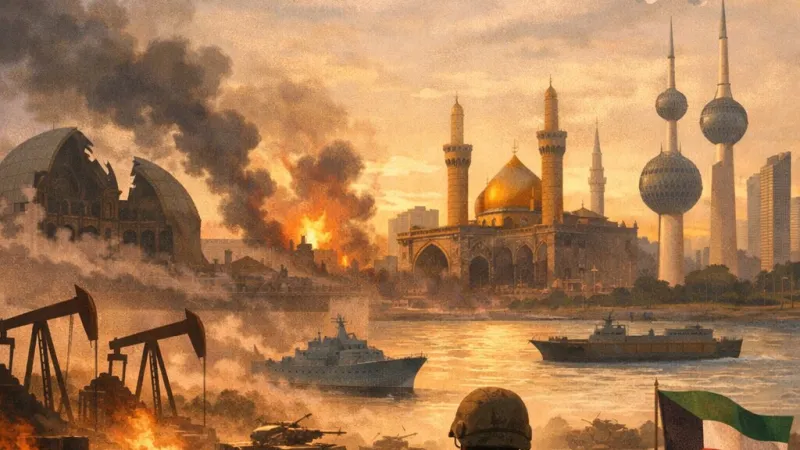
Kuwait’s journey through this tumultuous period is striking in its contrasts. Once a small trading port under British protection, independence came in 1961, triggering immediate threats from Iraq. Nonetheless, the kingdom became a byword for oil-fuelled prosperity. Its revenue underwrote some of the Gulf’s most advanced welfare systems and enabled a cosmopolitan, if carefully managed, public sphere, complete with a partially elected parliament. However, this prosperity became a curse in 1990, when Saddam invaded, claiming historic rights over Kuwaiti territory and seeking to solve his post-war debt through annexation. The world’s swift response—organised through Operation Desert Storm and led militarily by the US with British support—preserved Kuwait’s sovereignty but left the security architecture of the Gulf irrevocably altered. The experience sealed Kuwait’s dependence on Western military guarantees and energised the Gulf Cooperation Council (GCC) as a regional bloc.---
V. Forces from Afar: Global Powers and Regional Alignments
Great power involvement was a constant refrain in the Gulf. Britain’s formal withdrawal east of Suez in 1971 did little to erode its commercial interests, while America’s increasing reliance on Gulf oil led to deeper entanglement, evident in the tacit support for Iraq during the Iran-Iraq War and in the robust intervention of 1991. Cold War rivalry made the region a chessboard, with the USSR providing arms and support to leftist and Ba’athist circles—including Saddam himself. The end of Soviet influence in the late 1980s removed any counterweight to Western military presence, ushering in a new era of unipolar intervention. Within the region, the ideological currents of pan-Arabism, Islamic identity, and simmering sectarianism (Sunni-Shia) provided a ready soil for conflict and shifting alliances; religious leaders—such as Iran’s Khomeini or Iraq’s Najaf clerics—were sometimes as influential as any general or king.---
VI. Society and Economy: Booms and Burdens
The oil boom of the 1970s transformed the Gulf’s cities and social hierarchies; education expanded rapidly, with universities proliferating across Iraq and Kuwait, and new opportunities opened up for women, particularly in the public sector, as in Saddam’s Iraq. Still, gains remained uneven. Longstanding traditions and social conservatism proved resilient, and in many cases, regressive policies returned as regimes faced new pressures. War’s ravages and the resulting population upheavals were immense: millions of Kurds, Marsh Arabs, and others were displaced by government campaigns, while the wars caused cross-border flows of refugees and disrupted regional labour markets. The presence of British and other expatriates remained a hallmark of economic life, particularly in Kuwait and other Gulf kingdoms, sometimes fuelling resentment and debates over national identity.---
Conclusion
Between 1970 and 2000, the Gulf underwent a series of seismic changes that continue to underpin its complexities today. The region’s experience offers sobering lessons: how the pursuit of order can breed violence, how external alliances can both protect and compromise sovereignty, and how oil remains both a blessing and a curse. Amidst revolutions, wars, and fleeting booms, the Gulf societies have endured extraordinary disruption, leaving a legacy of unresolved rivalries, authoritarian entrenchment, and fragile prosperity. Understanding this period is not only essential for grasping the headline events of the present—from the instability of Iraq to the assertiveness of Iran—but also for appreciating the deeper tensions and aspirations that animate modern Middle Eastern politics.For British students, the Gulf’s twentieth-century turbulence is no distant saga: it is closely intertwined with the story of British diplomacy, global energy security, and contemporary debates about intervention, nation-building, and cultural pluralism. True engagement with this history demands not just a recounting of events but a critical appreciation of their roots, their mechanisms, and above all, their continuing aftershocks in regional and world affairs.
Rate:
Log in to rate the work.
Log in