The History of Public Health and Social Change in Britain
This work has been verified by our teacher: today at 12:48
Homework type: History essay
Added: 11.05.2026 at 13:05
Summary:
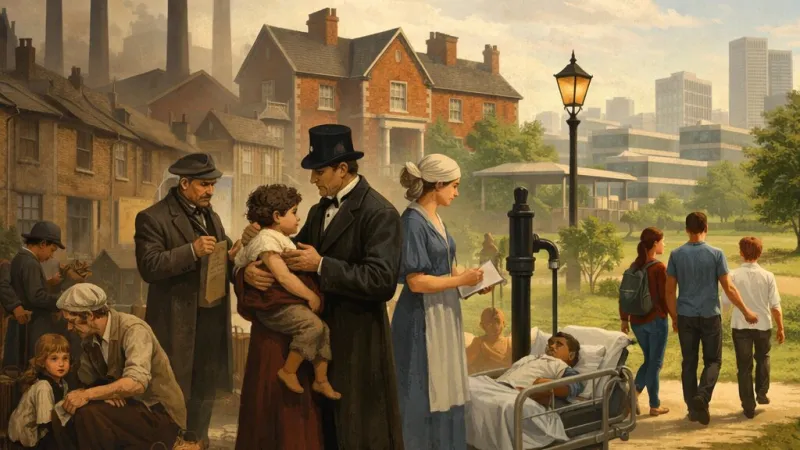
Explore the history of public health and social change in Britain to understand how industrialisation and reforms reshaped health and wellbeing across society.
History – Public Health: The Evolution of Wellbeing in Britain
Public health has long stood at the intersection of science, society, and government, shaping and shaped by the changing circumstances of the British people. Defined as the collective efforts to prevent disease, promote health, and increase life expectancy among whole populations, public health has often proved a mirror for wider social values and inequalities. Its history in Britain is deeply entwined with the nation’s journey through industrialisation, urban transformation, and political reform. This essay will examine the dire conditions faced during the 19th century, the prevailing attitudes that shaped response, the crucial role played by reformers and pioneering scientists, and the lasting legacy of these changes on modern health standards in the United Kingdom.---
The Social and Environmental Landscape of Nineteenth-Century Britain
The Victorian period in Britain is often celebrated for its industrial ingenuity and urban expansion, yet for many, this age of progress heralded suffering rather than prosperity. The Industrial Revolution, with its relentless demand for labour, brought millions from rural parishes to growing towns and cities such as Manchester, Leeds, and Birmingham. The swelling throngs found work amidst the chimneys and mills, but their arrival quickly outstripped the pace of urban planning and infrastructure.Inhabitants of the burgeoning “rookeries” or slums contended with housing that was both cramped and structurally unsound. A typical dwelling in a city like London’s St Giles might shelter an entire family—sometimes two—in a single, damp room. Facilities that we take for granted, such as flushing toilets and piped water, were almost entirely absent. Instead, cesspits overflowed behind houses, refuse seeped onto the streets, and water sources were frequently contaminated by human waste.
Overcrowding made the rapid spread of infectious diseases inevitable. The residents’ proximity, combined with squalid conditions, created the ideal incubator for outbreaks. Yet, the science of the period was woefully unprepared: the dominant theory to explain disease transmission was “miasma”—the belief that foul air or poisonous vapours were to blame. Although this idea led to a focus on cleanliness, it ignored the crucial connection between filth, contaminated water, and infection.
Mortality rates among the urban poor soared. Cholera, typhoid, and tuberculosis claimed thousands each year, with Victorian graveyards filling at alarming rates. Middle- and upper-class Britons were not immune to epidemic disease, but their better housing and access to cleaner water provided a level of insulation. Inequality underpinned differing life expectancies: while a rural squire might expect to live into comfortable old age, many city children never reached adulthood.
---
Early Government Attitudes: Laissez-Faire and Limited Political Will
Against such a stark social backdrop, one might expect urgent, centralised intervention. In reality, the prevailing mood among the governing elite was cautious, even indifferent. Before the Reform Acts of the 19th century, the right to vote—and with it, genuine influence over policy—was tightly circumscribed, restricted to male property owners. The “unrepresented many” suffered most from public health neglect, yet had little voice in shaping state responses.The guiding philosophy was that of “laissez-faire,” a French term encapsulating the idea that government interference should be minimal, both in commerce and in social affairs. Poverty and ill-health, according to this doctrine, were natural conditions, the result of individual failings rather than collective misfortune; thus, relief should be local, private, or charitable—not a function of the Treasury. Such beliefs legitimised inaction, and in many cases, local corporations and vestries actively resisted calls for public investment in sanitation or waterworks, citing fears of higher rates (local taxes) and the undermining of self-reliance.
---
The Spark of Reform: Exposure and Activism
A decisive moment arrived in 1842, when Edwin Chadwick, a lawyer and tireless campaigner, published his landmark “Report on the Sanitary Condition of the Labouring Population of Great Britain.” Drawing on testimonies, statistics, and harrowing descriptions, Chadwick laid bare the reality of urban life for the working classes. He argued that poor sanitation and filth were not just morally indefensible but economically imprudent, suggesting that healthier workers would yield higher productivity and impose less strain on the Poor Law.Chadwick’s recommendations were revolutionary for their time. He called for a system of drains and sewers, the provision of clean water, and the appointment of local health officials empowered to enforce standards. His insistence that the state had a role to play in public health was contested: the initial 1848 Public Health Act, inspired by his report, stopped short of compulsion. Local authorities could adopt it—but few saw the financial or political incentive to do so. Even so, with each fresh cholera wave and high-profile death, the pressure mounted for meaningful transformation.
---
Building the Framework: Legislation and Reform
Gradually, piecemeal reforms gave way to a more systematic approach. After the tepid start of 1848, a succession of Acts addressed the various threats to public health. The Nuisance Removal Acts targeted offensive trades and overcrowding in homes, the Factory Acts imposed standards for ventilation and cleanliness in workplaces, and the Rivers Pollution Prevention Act (1876) sought to safeguard public water from industrial waste.Significantly, the Public Health Act 1875 heralded a new era of compulsory intervention. Local authorities were now required, not merely permitted, to provide adequate drainage, ensure refuse removal, and regulate water supply. This decisive step reflected several trends: voting reforms had enfranchised more of the working class, who demanded healthier living conditions; scientific discoveries (most notably germ theory) provided irrefutable justification for action; and social reformers persisted in their efforts to expose and address urban squalor.
---
Pioneers of Progress: Science, Government, and Philanthropy
Science was a crucial driver of change. In 1854, the physician John Snow dispelled the miasma illusion by mapping cholera cases in Soho, London, ultimately tracing the outbreak to a single contaminated water pump on Broad Street. His intervention demonstrated not only the importance of clean water but also the value of evidence-based medicine. Although initially doubted by many, Snow’s work laid groundwork for later acceptance of germ theory—spearheaded by Louis Pasteur and embraced by British scientists like Joseph Lister.Municipal leadership also made a difference. As Mayor of Birmingham, Joseph Chamberlain in the 1870s overhauled the city’s approach to public utilities, acquiring the water supply for public ownership, spearheading slum clearance, and constructing new, healthier markets and streets. His visionary projects inspired imitation across Britain, even as they sometimes posed difficult questions about what should happen to those displaced from razed tenements.
Reform also came from the business world. Model villages such as Bournville, created by the Cadbury family, and Port Sunlight, established by the Lever brothers, reimagined the possibilities for working-class life. Instead of grim barracks, workers could inhabit spacious, light-filled cottages with gardens, schools, and community halls. Though limited in scale, these philanthropic experiments proved that housing and social amenities made a tangible difference to wellbeing.
---
Evidence, Advocacy and New Understandings of Poverty
Academic investigations powerfully shaped public understandings of health and inequality. Charles Booth’s exhaustive mapping of London’s poverty, and Seebohm Rowntree’s ground-breaking study of York, revealed a simple, devastating truth: many worked tirelessly yet languished in ill-health and misery due to wages too low to secure basic necessities. Their evidence shifted debate, making plain that the cycle of poverty and disease could not be broken by effort or thrift alone, but required structural interventions.The poor state of public health was further dramatised by the Boer War (1899–1902), when it emerged that vast numbers of British recruits were unfit for service, suffering stunted growth and chronic disease. This national embarrassment gave rise to renewed insistence that a healthy populace was not merely a matter of private concern but a crucial component of the nation’s strength and future.
---
The Lasting Legacy: From Victorian Streets to the Modern NHS
The reforms of Victorian and Edwardian Britain laid the foundation for the public health system enjoyed by citizens today. By the early 20th century, all towns and cities were required to employ Medical Officers of Health, oversee vaccination campaigns, and enforce standards in food hygiene and consumption. Legislation and municipally owned services continued to proliferate, culminating in the creation of the National Health Service in 1948—a radical commitment to comprehensive, free healthcare for all.While the context has changed, the underlying tensions endure. Socio-economic status remains closely tied to health outcomes, as illustrated by persistent inequalities in life expectancy, infant mortality, and chronic illness. History insists that vigilance is always necessary, especially in responding to emergent challenges such as pandemics, environmental degradation, or new forms of poverty.
---
Rate:
Log in to rate the work.
Log in