Exploring the Impact and Causes of China’s Cultural Revolution
This work has been verified by our teacher: 10.05.2026 at 10:59
Homework type: History essay
Added: 7.05.2026 at 6:13
Summary:
Discover the causes and impact of China’s Cultural Revolution, exploring Mao’s motivations, youth mobilisation, and the lasting effects on Chinese society and history.
The Cultural Revolution: Ideology, Power and The Unravelling of China
The story of China in the decades following the creation of the People’s Republic in 1949 is one of stunning transformation—and staggering turmoil. After years of civil war and the defeat of the Kuomintang, Mao Zedong’s Chinese Communist Party embarked on a radical programme to reshape village, city, and self. Yet, by the early 1960s, the initial revolutionary promise had faltered. The disastrous outcomes of the Great Leap Forward—famine, economic regression, and millions of lives lost—left the Party shaken and Mao’s own authority diminished. It was against this fractured backdrop that the Cultural Revolution (1966–1976) erupted.
At first glance, the Cultural Revolution appears as a period of frenetic ideological campaigning, but this would be an insipid reading. Its origins, methods, and consequences are best understood as a high-stakes interplay of personal power, party rivalry, generational fervour, and the struggle for China’s soul. This essay will examine Mao’s multiple motivations; the Red Guards and youth mobilisation; factional strife at the heart of the Party; the violence and chaos unleashed; the shifting role of the military; and the legacy—both immediate and long-lasting—of a campaign whose reverberations still echo today.
---
Mao Zedong’s Motivations and the Quest for Revolutionary Purity
A growing unease festered within Mao Zedong by the mid-1960s. The Communist edifice, far from embodying robust socialism, seemed to be drifting towards the technocratic, bureaucratic, and “capitalist” tendencies Mao most despised. Veterans of Stalinist purges may recognise in this episode a familiar impulse—the revolutionary’s paranoia about losing momentum, losing their purity, and losing control. In China, this was amplified by palpable threats on several fronts.Mao, scarred by the fallout from the Great Leap Forward, saw his influence wane as more pragmatic colleagues such as Liu Shaoqi and Deng Xiaoping steered economic policy towards recovery and stabilisation, favouring incentive-based agricultural reform and limited market mechanisms. For Mao, such “revisionism” risked transforming the Communist Party into its reactionary opposites, as he observed with contempt the Soviet Union’s retreat from Stalinist orthodoxy.
Thus, the Cultural Revolution was born as a “struggle” to recapture revolutionary spirit. Mao’s famous dictum, “It is right to rebel,” became a rallying cry—recasting social friction as a virtue. Party factionalism in this period was not merely a clash of ideas—it represented existential conflict between hardliners, pressing for renewed class struggle, and moderates, intent on consolidating previous gains. Internationally, the split with the Soviet Union and disputes over the true path of communism lent urgency and rhetorical fire to Mao’s campaign at home. But at its core, Mao’s project was as much about reaffirming his pre-eminence as it was about debates over socialist doctrine.
---
Youth in the Vanguard: The Red Guards and Cultural Iconoclasm
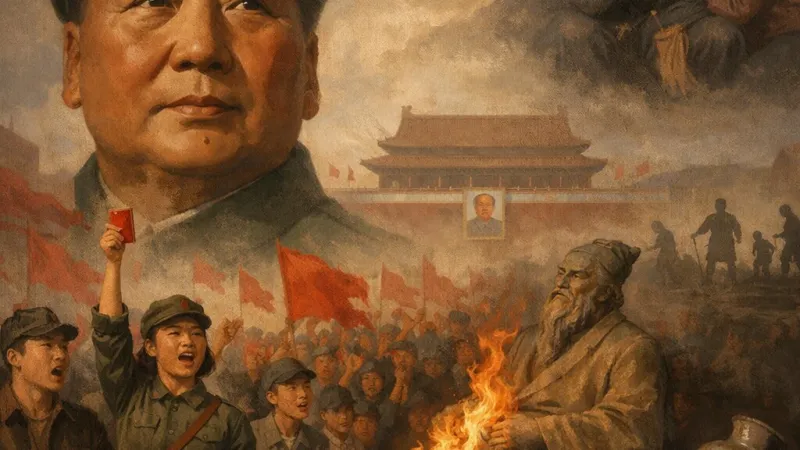
No story of the Cultural Revolution can escape the image of the Red Guards—young men and women brandishing The Little Red Book, chanting slogans, and wreaking havoc in classrooms and city squares. These were the “children of new China,” who had been raised under a fiercely ideological system. Through endless “study sessions” and mass campaigns, schools taught not merely literacy but dogma; in fact, one could say their education was as much political theatre as it was scholarship, a process reflected in the rituals and routines that came to dominate state life—from “loyalty dance” to self-criticism.Mao harnessed this raw energy by issuing a clarion call: to attack the “Four Olds”—old customs, culture, habits, and ideas. Students, eager to prove their fervour, leapt into action, sometimes with devastating results. The Red Guards, for a tantalising moment, were made to feel that standing against a teacher or a parent was not deviant, but heroic. Such inversion of traditional authority found echoes centuries earlier in the English Civil War’s radical Diggers and Levellers, where calls for “levelling” upended established order, but in China it unfolded on a terrifyingly mass scale.
Psychologically, adolescence is invariably a period of testing boundaries; in 1960s China, this natural rebellion was weaponised. As school assemblies mutated into struggle sessions and literary societies became battlegrounds, young people became both the spearhead and the casualties of Mao’s campaign.
---
Political Purges: How the Party Devoured Its Own
To secure his project, Mao required more than slogans. He moved swiftly against “capitalist roaders” within the Communist Party itself. High among the victims of the first wave was Liu Shaoqi, once Mao’s ally, now denounced as “China’s Khrushchev” for his perceived betrayal of ideological purity. Public spectacles were made of senior figures: Liu was not only stripped of his positions but subjected to humiliating struggle sessions, his wife publicly vilified, his name erased from Party ephemera.Deng Xiaoping, later to become China’s paramount reformer and architect of the post-Mao economic revival, too fell foul of Mao’s condemnation. Their crime? Attempting modest market reforms, addressing local corruption, and prioritising stability after the chaos of the Great Leap Forward. In this sense, the Cultural Revolution recapitulated a motif familiar from Soviet purges, but it also recalled the fate of Thomas More or Archbishop Laud in English history—a warning to those who attempted moderation during ideological storms.
These purges became grotesque theatre, with victims often forced to confess to outlandish crimes, paraded before thousands, and in many cases sent to prison—or worse. Those who survived could often count shattered careers, families, and minds as the price.
---
The Machinery of Destruction: Violence and the Unmaking of the Past
If the political heart of the Cultural Revolution was in Beijing, its most visible effects were nationwide: a frenzy of destruction, iconoclasm, and persecution. From priceless Buddhist sculptures such as those at the Longmen Grottoes to the records of Confucian temples, artefacts were smashed with a zeal reminiscent of Oliver Cromwell’s iconoclasts versus Catholic imagery during the English Reformation. Favourite targets were teachers, intellectuals, former landowners, and “bad elements” of every stripe—many millions subjected to physical assault, arbitrary detention, or death.Red Guards seized control of railways, factories, and radio stations, broadcasting revolutionary rhetoric from loudspeakers mounted throughout towns. Big-character posters, wall newspapers splashed with denunciations, and public shaming became ubiquitous. The vocabulary for violence and self-critique became so routine that for a generation, the ability to remain silent became a kind of survival tool.
As civil society collapsed, the traditional bonds between parent and child, teacher and pupil, were upturned. Makeshift prisons sprang up even within schools; “class enemies” could be detained for minor infractions or for the mere misfortune of being born into the wrong background. For the hundreds of thousands who died—and the millions more whose educations and lives were permanently derailed—the era left deep psychological scars.
---
Martial Law: The Army’s Role and the End of the Red Guard
The People’s Liberation Army (PLA) stood initially aside, allowing the chaos to serve Mao’s interests in undermining bureaucratic opponents. However, by 1967–68, China teetered on the verge of anarchic collapse. Then, as swiftly as they had been unleashed, the Red Guards found themselves swept aside, packed onto trains heading to the countryside in the so-called “Down to the Countryside” campaign. This recall was both a tool of punishment and a political maneuver—an echo, perhaps, of Cromwell’s purge of the Rump Parliament, but conducted on a much vaster, more brutal scale.Within the Party itself, a further round of purges targeted not only “capitalist-roaders” but now those accused of covert “ultra-leftism.” The “Cleansing the Class Ranks” campaign, especially between 1968 and 1971, bled into open massacres; local committees, in their zeal, sometimes exceeded the violence even of their central directives.
The PLA’s loyalty, however, was not unshakeable. The complex fate of Lin Biao—initially Mao’s chosen successor, later accused of “counter-revolutionary” plotting and dying in a mysterious plane crash in Mongolia—highlighted the risks of making the military a major instrument of political infighting. Mao, wary of any potential Bonaparte, reined in the PLA’s independence as the movement’s violence subsided.
---
Consequences and the Shadow of History
China emerged from the Cultural Revolution economically dislocated and socially traumatised. Several years’ worth of school and university cohorts were lost; expertise in science, medicine, and literature had been hounded into silence or into the countryside. The generation that came of age in those years—often called the “Lost Generation”—grew up haunted by memories of betrayal, ideological mania, and family rupture. Parallels might be drawn with postwar experiences in Britain: the “Windrush generation” endured their own kind of marginalisation; British society too, in the 1970s, was forced to reckon with generational disaffection, though in far less violent terms.Politically, the Cultural Revolution destroyed the last vestiges of collective leadership within the CCP, paving the way for the rise of Deng Xiaoping. Under Deng’s guidance, China would pivot towards economic reforms, openness to foreign trade, and a retreat from ideological dogmatism—though never a reckoning with the era’s crimes on the scale of de-Stalinisation in the USSR. Even so, some of the Party’s current caution about political liberalisation may be traced to the memories—and traumas—of the Cultural Revolution.
Historiographical debates in Britain have also reflected on these questions—scholars such as Rana Mitter, Julia Lovell, and Timothy Brook have weighed the extent to which the Cultural Revolution was top-down manipulation or a warning about the volatility of untethered youth movements. As in the analyses of British revolutions and purges, the challenge is to balance the motives of leaders with the agency of ordinary people, and to understand unintended consequences.
---
Rate:
Log in to rate the work.
Log in