Queen Elizabeth I's Final Years: Leadership, Challenges and Enduring Legacy
This work has been verified by our teacher: 21.05.2026 at 11:17
Homework type: History essay
Added: 19.05.2026 at 11:57
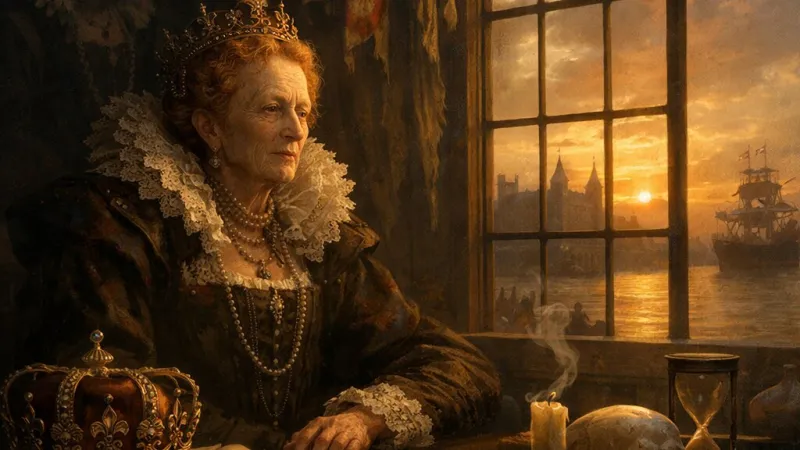
Summary:
Explore Queen Elizabeth I’s final years, her leadership challenges, and enduring legacy in this detailed history essay for UK secondary students.
Elizabeth’s Last Years: Governance, Challenges and Legacy
The final years of Queen Elizabeth I's reign, spanning roughly from the early 1590s until her death in 1603, marked the end of an era often celebrated for its grandeur yet fraught with profound challenges and anxieties. The once-vigorous “Virgin Queen” now ruled over a kingdom beset by external threats, internal unrest, and gnawing uncertainty as the Tudor dynasty drew to a close. This period, traditionally viewed through the golden lens of Shakespearean drama and High Renaissance achievement, was in fact characterised by acute political problems and deep-rooted instability simmering beneath the surface.
This essay explores how Queen Elizabeth’s complex machinery of governance—especially her deft use of the Privy Council and Parliament—enabled her to steer the English state through stormy waters in her last years. Special attention is paid to the shrewd counsel of key individuals such as William Cecil, the mounting financial and religious tensions of the realm, and the way Elizabeth’s personal leadership style shaped posterity’s view of her regime. Ultimately, while Elizabeth’s formidable will and astute statesmanship preserved stability amid crisis, her unresolved legacies—most pressingly that of succession and fragile finances—would leave a thorny inheritance for her Stuart successors.
The Structure and Role of the Privy Council in Elizabeth’s Later Reign
At the heart of Elizabethan government stood the Privy Council, a select group of advisers central to the formulation and execution of royal policy. Unlike the unwieldy fifty-strong body of Queen Mary I’s reign, Elizabeth deliberately pruned her council to a core of roughly a dozen men by her twilight years. This contraction was no mere accident of attrition; it reflected Elizabeth’s wish to streamline administration, cut out intrigue, and assert greater personal command over state matters. Despite the shrinking numbers, the council still retained key representatives from England’s powerful nobility and landed gentry—concessions aimed at staving off discontent and harnessing local loyalty. Figures such as Robert Cecil (William Cecil’s son), Charles Howard, and Walter Raleigh each reflected the need to balance regional interests and maintain surveillance over troublesome factions.The workload borne by this compact group surged noticeably as the century drew to a close. While earlier in Elizabeth’s reign the council had assembled perhaps three times a week, the mounting crises of war and religious threat saw councilors summoned almost daily. Their responsibilities were daunting and far-reaching: not only did they supervise the implementation of national policy down to the shires, but they acted as a high court, dispensing royal justice, and oversaw England’s stretched finances in close coordination with the Lord Treasurer and Exchequer. The threat from Spain and the risk of domestic rebellion required a vigilant hand over the realm’s defences—the council held the critical task of mustering local militias and fortifying the coast.
Perhaps the council’s thorniest challenge was in policing the national church settlement. With the constant menace of Catholic recusancy and an ardent Puritan wing within the country, the council acted as enforcers, working with bishops and magistrates to ensure outward conformity to the Act of Uniformity. Finally, they functioned as the primary interface with Parliament: crafting legislative agendas, managing MPs, and rallying support for the Queen’s initiatives. Despite the council’s collective character, ultimate authority always rested with Elizabeth. She wielded her right of veto over their decisions, deftly managed internal quarrels, and was unafraid to rebuke even her oldest advisers when it suited her interests. This dance of counsel and command encapsulated Elizabeth’s style: the council was an engine of state, but she ensured its destination was always of her choosing.
Elizabeth and the Parliament: A Complex Relationship
Parliament, whilst a vital component of Tudor governance, was not the powerful, independent assembly later imagined by Whig histories. Composed of some 462 Commons members and a smaller but socially exalted House of Lords, Parliament was a creation of Crown and landowner patronage rather than a true expression of popular will. Sessions were short and infrequent—a mere thirteen in forty-four years, typically lasting for just ten weeks—demonstrating Elizabeth’s preference to govern through her council and on royal prerogative.Elizabeth viewed her parliaments primarily as instruments for legalising her will and extracting vital subsidies. The Queen carefully circumscribed debate, exploiting her right to veto bills and, on occasion, ordering the imprisonment of particularly insistent MPs. Matters considered the Queen’s prerogative—her marriage, nomination of a successor, and substantial reforms to the church—were strictly off-limits. Nevertheless, Parliament provided a platform for towns and counties to air grievances, pushing back against unpopular policies such as the proliferation of crown-granted monopolies.
The famous monopolies crisis of 1601 stands out as a rare moment in which Parliament gained the upper hand. With the financial burden of near-constant war against Spain and enclosure riots agitating the countryside, MPs roundly criticised the sale of monopolies—exclusive rights to produce or sell certain goods—accusing them of fuelling inflation and corruption. The Commons organised petitions and debated with an unusual unity of purpose, culminating in Elizabeth’s so-called “Golden Speech,” wherein she agreed to withdraw some of the most egregious monopolies but retained her financial requests. The episode encapsulated the delicate ballet of power: Parliament could, under extraordinary circumstances, force royal concessions, yet on fundamental issues, Elizabeth rarely yielded ground.
Historians remain divided over the true significance of Parliament during these years. The older “Puritan Choir” argument, proposed by Neale, held that an emerging group of activist MPs pushed for reform against royal intransigence, while Elton and others have re-emphasised the ascendancy of the Lords and the long shadow of Crown patronage. Modern interpretations strike a balance, recognising that although Parliament sometimes played a pivotal role, such moments were exceptional rather than routine; the Elizabethan “balance” was always weighted firmly in favour of the monarch.
William Cecil: The Principal Secretary and Lord Treasurer
No single individual better illustrates the machinery of late Elizabethan government than William Cecil, Lord Burghley. Appointed principal secretary at the beginning of the reign and later promoted to Lord Treasurer, Cecil’s influence spanned four decades, earning him a unique position at the heart of power. Through wars, plots, and controversies, Cecil was Elizabeth’s most valued advisor, a relationship built on trust, mutual respect, and pragmatic alliance even when interests diverged.Cecil’s significance can hardly be overstated. He orchestrated the daily work of the Privy Council, navigated fraught relations with Parliament over supply and taxation, and managed Crown finances, the latter a Sisyphean task as war, poor harvests, and inflation battered the exchequer. To maintain stability, Cecil skillfully incorporated rival factions and powerful families into government, smoothing over personal animosities when possible. His balancing of the likes of Robert Dudley, Earl of Leicester, and Thomas Howard, Duke of Norfolk, embodied his broader gift for managing both the old nobility and the energetic new men rising in Elizabethan England.
Cecil’s guidance was instrumental in steering policy through religious and political shoals. He was pivotal in responding to missionary Catholic threats after the papal bull of excommunication in 1570, and coordinated the state’s response to Spanish aggression after the Armada in 1588, as well as later raids and conspiracies. By the time of his death in 1598, Cecil’s son Robert had begun to assume his mantle. Yet even strong leadership could not resolve every crisis, and the last government under Elizabeth increasingly felt the strain.
Key Challenges and Issues in Elizabeth’s Final Years
The closing years of Elizabeth’s reign were marked by mounting difficulties. The most pressing of these was the question of succession. Throughout her life, Elizabeth refused to designate a clear heir, creating an atmosphere of anxiety at court and throughout the nation. Fear of civil war, as seen in the Wars of the Roses, haunted the political imagination. Foreign courts, not least that of James VI of Scotland, watched closely, hoping for opportunity.Financially, the country was stretched to breaking point. Decades of conflict against Spain and involvement in Ireland, coupled with recurrent bad harvests, increased the Crown’s reliance on parliamentary grants and dubious sources of income such as monopolies. Economic hardship was not felt at court alone; poor relief and social unrest became recurring issues in towns and countryside. The monopolies crisis reflected widespread discontent and highlighted the limits of royal innovation in the face of fiscal crisis.
Religious controversy, never fully absent, resurfaced in the face of a new Puritan agitation and the persistence of Catholic “recusants.” Enforcement of conformity became more severe, yet outright repression risked stoking further unrest. The near-success of the Gunpowder Plot just two years after her death suggests the depth of simmering resentment.
Internationally, Elizabeth’s England faced ongoing threats from Spain and unrest in Ireland (most notably the Nine Years’ War under Hugh O’Neill). National defence became a constant preoccupation—coastal fortifications were strengthened, and militias kept in readiness, but the strain on resources was palpable. These mounting pressures reinforced a sense that the Tudor “golden age” was, in reality, a precarious balancing act.
Elizabeth’s Personal Leadership Style and Political Legacy
Elizabeth’s genius lay in her uniquely personal approach to monarchy. While jealously protective of her prerogatives and often authoritarian in tone, she rarely ruled by force alone, instead using her wit, charm, and presence to maintain authority. The Queen’s use of symbolism—the “mask of youth,” the pageantry of her progresses, her famed eloquence—helped unify her people at a time when other monarchies sank into tyranny or anarchy.Her handling of the most powerful men in the realm—managing their ambitions, encouraging their rivalry, and extracting the best from their service without surrendering ultimate authority—was itself a political masterstroke. Through careful control of Parliament and the Privy Council, Elizabeth maintained national stability even as popular grievances grew. Her insistence on personal oversight meant government retained direction, while her ability to compromise, as seen in the 1601 monopoly disputes, forestalled deeper rupture.
The legacy she left was profound yet problematic. The compact, effective Privy Council set a model for future governance, as did the evolving relationship between crown and Parliament. Yet the failure to resolve the issue of succession or the mounting debts of the Crown exposed structural weaknesses. The ‘Golden Age’ image, immortalised in theatre and literature, masked these difficulties; the Stuart monarchy would soon discover how fragile the Elizabethan settlement truly was.
Conclusion
In summary, the closing chapter of Elizabeth I's reign saw government and nation stretched to their limits. Through astute manipulation of her council, prudent (if sparing) use of Parliament, and the enduring partnership of ministers like William Cecil, Elizabeth managed to stave off immediate collapse. Yet, the interconnected problems of succession, strained finances, and religious division spoiled any sense of perfect harmony. Parliament, while mostly subordinate, occasionally exerted rare but telling influence—sign of evolving pressures to come.Elizabeth’s last years thus represent not only the end of a dynasty but also the transformation of English governance. They stand as a revealing window on the early modern state: one foot in the old world of monarchical privilege, the other edging towards the constitutional crises that would characterise the seventeenth century. To study these turbulent years is to appreciate both the enduring power of Queen Elizabeth’s political artistry and the fragility of the legacy she bequeathed.
Rate:
Log in to rate the work.
Log in