Elizabeth I: The Queen Who Shaped England’s Golden Age (1533–1603)
This work has been verified by our teacher: 19.04.2026 at 12:54
Homework type: History essay
Added: 17.04.2026 at 13:59
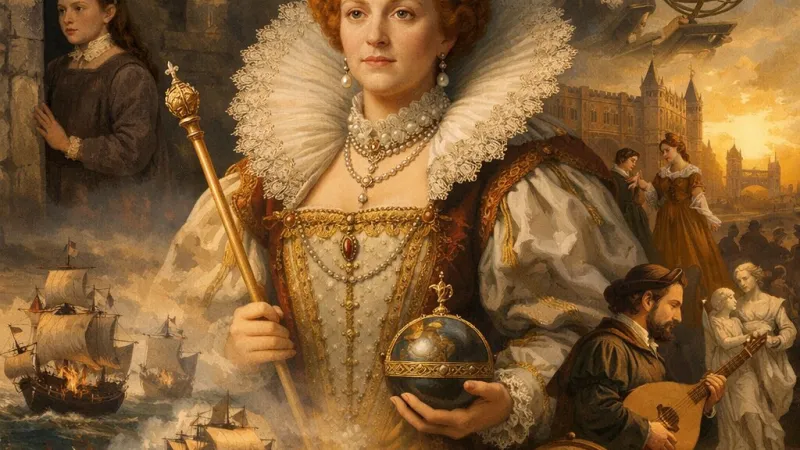
Summary:
Explore Elizabeth I’s role in shaping England’s Golden Age, from her early life challenges to political and cultural achievements that defined her reign.
Elizabeth I (1533–1603): Architect of an English Golden Age
Few figures rival Elizabeth I in shaping the narrative of England’s past. Her portrait endures not only in the elaborate paintings that adorned her courts but in the collective memory of a nation forged by crisis and creativity. Her reign—from the uncertainties of succession to the glories of the Elizabethan cultural renaissance—marked a transformative epoch in British history. Known variously as the ‘Virgin Queen’ and ‘Gloriana’, Elizabeth presided over an age distinguished by relative political stability, religious reformation, artistic blossoming, and the first beats of empire. This essay will examine Elizabeth’s early life and turbulent path to the throne, her navigation of religious and political turmoil, her deft management of foreign threats, the flourishing of culture under her patronage, and the enduring ambiguities of her legacy.Early Life and Shifting Fortunes
Elizabeth Tudor was born at Greenwich Palace in 1533, the daughter of King Henry VIII and his second wife, Anne Boleyn. Her entrance into the world was greeted with a mixture of expectation and disappointment: Henry, ever desperate for a male heir, found his ambitions thwarted by the birth of a daughter. Nevertheless, Elizabeth's arrival signified much more than mere dynastic anxiety. The precarious union of her parents represented the seismic rift with Rome resulting from Henry’s quest for annulment and subsequent break from the Catholic Church—a schism that would haunt Elizabeth’s own reign.Elizabeth’s early childhood was shadowed by turmoil. In 1536, when she was only three, her mother was executed on charges of treason and adultery. In a moment, Elizabeth was declared illegitimate and removed from the line of succession, her position at court uncertain and her personal security fragile. Contemporary chroniclers, such as the ambassador Eustace Chapuys, noted the “pity” surrounding her sudden fall from grace. Yet, Elizabeth’s fortunes shifted again through a series of statutes restoring her to the line, albeit never far from suspicion. Her relationship with her half-siblings—Edward, the son of Jane Seymour, and Mary, daughter of Catherine of Aragon—was influenced by both shifting royal policies and the broader religious transformations convulsing Tudor England.
What set Elizabeth apart, even in youth, was her formidable intellect. Placed in the care of learned tutors such as Roger Ascham, she was imbued with the tenets of Renaissance humanism, excelling in Latin, Greek, French, and Italian. Ascham remarked on her sharpness and application, comparing her favourably with the finest scholars of Cambridge. This education not only augured her future as a monarch fluent in diplomacy and statecraft but allowed her to engage in the intellectual currents of her day.
Path to the Throne: Obstacles and Early Tests
Elizabeth’s teens and twenties were anything but serene. The passing of Henry VIII in 1547 saw her young brother, Edward VI, ascend the throne. The kingdom lurched towards Protestant reform under Edward’s guardians—reforms that Elizabeth outwardly accepted whilst keeping her own counsel. Edward’s early death in 1553 triggered a brief, unsuccessful attempt to install Lady Jane Grey, before Elizabeth’s elder half-sister, Mary I, claimed the crown.Mary's reign was marked by a determined effort to undo the Protestant changes of her predecessors. Her fervent Catholicism led to a campaign of persecution—memorialised by John Foxe’s "Book of Martyrs"—and by suspicion towards her Protestant sister. In 1554, Elizabeth found herself imprisoned in the Tower following Wyatt’s Rebellion, accused of conspiring against the crown. The shadow of execution loomed but was averted—perhaps as much by public sympathy as by Mary's lack of evidence. Her release to house arrest at Woodstock, and then gradual return to favour, tested Elizabeth’s caution and resilience. She had learnt, by necessity, the arts of political self-preservation.
The death of Mary in November 1558 marked a watershed. Elizabeth was received joyously by a nation weary of religious strife and eager for stability. In her first speech to the Privy Council, she pledged to govern “with the advice of good counsellors”—a harbinger of her careful, pragmatic approach to power.
Governance and the Middle Way
One of Elizabeth’s foremost challenges was the settlement of England’s long-running religious tensions. The Elizabethan Settlement, shaped in 1559 by the Acts of Supremacy and Uniformity, was revolutionary in its cautious moderation. Elizabeth proclaimed herself Supreme Governor (not head) of the Church of England, reinstating some Protestant forms but retaining elements that would appease conservative Catholics.This careful balancing act was not without risk. Catholic dissent simmered underneath, sometimes erupting in plots such as the Ridolfi and Babington conspiracies. The Pope’s excommunication of Elizabeth in 1570 formally invited European intervention and deepened a sense of siege within the realm. Nonetheless, Elizabeth’s steady hand, refusal to succumb to either Puritan extremism or Catholic reaction, preserved relative internal peace, making England a study in religious compromise.
Politically, Elizabeth proved adept in her dealings with Parliament and the nobility. She used patronage strategically, maintaining a delicate equilibrium amongst powerful subjects. Her gender, at a time when rule was assumed to be masculine, was turned from vulnerability to asset: the imagery of the Virgin Queen, magnificently clad and untouchable, became synonymous with royal stability. The “cult of Gloriana” was burnished through masque, portraiture, and the calculated performance of majesty at court.
Economically, her era was mixed. The latter years of her reign saw inflation and poverty, prompting the passage of harsher Poor Laws (notably in 1601), which attempted to distinguish and punish the “idle” from the “deserving” poor. While these solutions were far from perfect, they established principles of communal responsibility that would echo throughout later centuries.
Foreign Affairs: Caution and Defiance
Elizabeth’s foreign policy was marked by pragmatic caution, shaped by the reality of England’s limited resources. She tread a volatile path between the two dominant Catholic powers, France and Spain. Mary, Queen of Scots, a Catholic rival with potent claims to the English throne, became a persistent source of anxiety; her imprisonment and eventual execution in 1587 strained relationships abroad but arguably secured Elizabeth’s regime at home.The greatest test came in 1588, with the attempted invasion by the Spanish Armada, unleashed by Philip II in retaliation for English support to Dutch rebels and privateers preying on Spanish treasure fleets. Elizabeth’s dramatic address to the troops at Tilbury—“I know I have the body but of a weak and feeble woman, but I have the heart and stomach of a king”—galvanised the country. The destruction of the Armada, aided by ‘Protestant winds’ and English seamanship, became a defining moment of national pride.
Simultaneously, English fortunes were increasingly tied to enterprise abroad. Elizabeth granted charters to explorers such as Sir Walter Raleigh and Sir Francis Drake, reflecting the dawning impulse for colonisation and adventurism. Roanoke and other colonial ventures were faltering steps, but they laid the foundations for later expansion, helped by the monarch’s willingness to seed rivalry with Spain overseas.
The Cultural Zenith: England’s Renaissance
No assessment of Elizabeth can ignore the luminous cultural landscape of her reign. As a patron of the arts, she presided over a flowering of drama, poetry, and music unique in English history. Theatres such as The Globe arose around Southwark, attracting crowds for the works of William Shakespeare, whose history plays often reflected themes of legitimacy, order, and the burden of rule—subtle studies resonant with Elizabeth herself.Philip Sidney, Edmund Spenser, and Christopher Marlowe enriched the fields of poetry and drama, often drawing explicit connections between the monarch’s virtues and England’s destiny. Court entertainments—performed by troupes like the Children of Paul’s and playwrights from the Inns of Court—strengthened the sense of a unified, cultured identity.
Education and inquiry flourished, too, with new schools, translations of classical texts, and advancements in navigation and astronomy reflecting both the optimism and the anxieties of the age.
The Enigma of Elizabeth: “Virgin” Queen and Succession
A singular, and much-debated, aspect of Elizabeth’s reign was her refusal to marry. From foreign princes (such as the Duke of Anjou) to English favourites like Robert Dudley, all were courted and dismissed, their prospects used as diplomatic currency. By remaining single, Elizabeth preserved her autonomy and exploited the notion of marital availability to her political benefit, though at the cost of succession anxiety. The question of an heir remained unanswered, looming over the latter years of her reign.Her virginity metamorphosed into a sort of national myth, reinforcing her uniqueness and projecting the image of England as a maiden realm, unconquered and whole. Court poets enshrined her as Astraea, the bringer of peace and justice, yet criticisms of self-indulgence and indecision—especially in later years—crept into some accounts.
Legacy: Between Myth and Reality
The legacy of Elizabeth I is intricate and contested. On one hand, she ensured a relative stability after the violent oscillations of her siblings’ reigns, cultivated a resilient national identity, and established an enduring religious settlement. The Church of England as it exists today owes much to her refusal to allow either Puritanism or Catholic restoration complete sway.Culturally, the Elizabethan Age is often depicted as a ‘golden era’—perhaps exaggerated, but indisputably significant in the birth of modern English literature and drama. Education, patronage, and enterprise all prospered under her guidance.
Yet, Elizabeth’s reign was not without shadows. The harsh suppression of dissent in Ireland, the execution of Mary, Queen of Scots, and the sometimes draconian enforcement of the religious settlement deserve serious criticism. For all her vaunted diplomacy, she could be indecisive or ruthless; for all the inclusivity of her ‘middle way’, she left the matter of succession dangerously unresolved. Historians such as Susan Brigden and John Guy have pointed both to her political ingenuity and her human failings.
Rate:
Log in to rate the work.
Log in