In-Depth Analysis of Themes and Characters in Othello Act 1 Scene 1
This work has been verified by our teacher: 20.04.2026 at 15:36
Homework type: Analysis
Added: 17.04.2026 at 16:51
Summary:
Explore key themes and character motivations in Othello Act 1 Scene 1 to boost your understanding and enhance your secondary school analysis skills.
A Comprehensive Analysis of *Othello* Act 1 Scene 1: Themes, Characters, and Dramatic Techniques
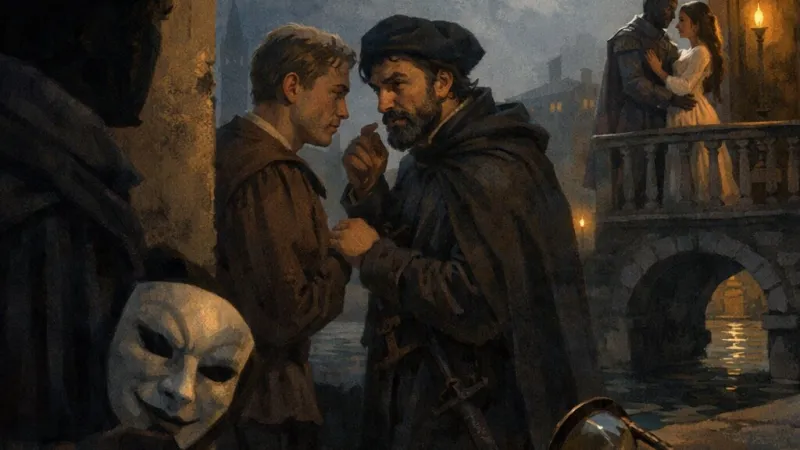
Among Shakespeare’s great tragedies, *Othello* is perhaps one of the most striking explorations of jealousy, deception, and the pernicious effects of prejudice. First performed in the early seventeenth century, its resonance continues to reverberate through British cultural discourse, from school classrooms to theatre stages. The play opens not with the titular character's arrival but rather in the midst of a tense and conspiratorial conversation, immediately thrusting the audience into an atmosphere thick with discontent and manipulation. Act 1 Scene 1 thus functions as an essential foundation, establishing character motivations, themes of deep social import, and dramatic tensions that will spiral towards tragic consequence. In this essay, I aim to dissect the ways in which Shakespeare uses this opening scene to set the tone for the play, employing skilful characterisation, veiled threats, and a calculated deployment of language to prime both narrative and audience for the drama that is to unfold.
Setting the Scene: Context and Significance of Act 1 Scene 1
Shakespeare’s Venice is not merely a picturesque backdrop of canals and grandeur, but a city synonymous with mercantile wealth, rigid hierarchy, and martial prowess. The opening of the play, set at night, signifies both literal and figurative darkness. Venice, for the Elizabethan audience, would have signified both sophistication and hidden vice—a city known for its cosmopolitanism, but also for its secretive dealings and political intrigue.From the very first exchanges, this world of apparent order is undercut by a sense of unrest. The character of Othello, rarely named in the opening scene but alluded to in racially charged and menacing terms, is both central to Venice’s security (as a general) and marginalised, as a Moor and a 'stranger' in a predominantly white, Christian society. The notion of Othello’s otherness is established through gossip and rumour rather than direct interaction; his voice is absent, almost as if the city can only speak about him, not to him. Thus, the play’s initial moments serve to position the audience as eavesdroppers on private grievances, immediately creating a mood of suspicion and unease. In dramatic terms, this scene operates as a classic exposition, revealing essential information through the bias and bitterness of other characters, rather than through Othello’s own perspective.
Character Analysis: Complex Introductions and Motivations
Iago: The Machiavellian AntagonistIf ever there were a character embodying Machiavellian cunning, it is Iago. He opens the play in mid-conversation, already spinning his web. Early modern English audiences, familiar with the trope of the 'stage Machiavel', would have recognised in Iago a master manipulator, unburdened by conscience. His discontent—a soldier passed over for promotion in favour of the more genteel Cassio—feeds a festering resentment that drives his actions. Iago’s motivations are presented as layered and complex: professional jealousy, a sense of personal insult, and perhaps even a delight in mischief for its own sake. Importantly, he plays the unreliable confidant, telling Roderigo (and therefore the audience) only what serves his current aim. 'I am not what I am,' he insists—a statement that becomes almost a refrain, underlining his duplicity and the gap between appearance and reality that pervades the play.
Roderigo: The Foolish Suitor
Roderigo, meanwhile, is depicted as weak-willed and easily led. Consumed by his infatuation for Desdemona, he is willing to exhaust both his purse and his dignity at Iago’s suggestion. His naiveté is the perfect foil for Iago’s cynicism; their exchanges reveal Iago’s skills as a confidence trickster, constantly extracting money and obedience from Roderigo with empty promises. Yet Roderigo serves a broader purpose within the exposition, functioning as a sounding board for Iago’s schemes and bearing witness to the antagonist’s calculated show of loyalty, as well as his carefully masked contempt for both Othello and Cassio.
Brabantio: The Authority Figure and Father
Brabantio’s introduction moves the action from private scheming into the domain of public outrage. As a Venetian senator and Desdemona’s father, Brabantio is the embodiment of patriarchal control and respectability. The news of his daughter's secret elopement with Othello is delivered not dispassionately, but with language designed to shock and offend. His immediate turn to accusations of witchcraft and theft reflects both personal affront and the broader social prejudices of the period. Brabantio, then, is not simply a wronged father but a mouthpiece for Venetian anxieties over race, status, and the perceived preservation of family honour.
Cassio: The Indirect Presence
Although Cassio does not appear in the scene, his ghost hovers over the exchange. To Iago, Cassio’s appointment is a symbol of rank injustice; he is dismissed as an inexperienced 'arithmetician,' unworthy of the position he holds. Cassio’s promotion is therefore the spark that ignites Iago’s envy and bitterness, and, through Iago’s tirade, the audience is prompted to view him with suspicion, even before he steps onstage.
Themes Introduced in Act 1 Scene 1
Jealousy and EnvyJealousy is seeded early in the play, primarily through Iago’s fixation on Cassio’s rise and Othello’s relationship with Desdemona. It is a corrosive force, depicted not yet as romantic jealousy (which will consume Othello later), but as professional and social envy—a powerful motivator in Renaissance society, as depicted in countless English morality plays of the period.
Manipulation and Deceit
Deceit is the lifeblood of Iago’s interactions. He is a consummate rhetorician, warping facts to shape reality according to his will, whether persuading Roderigo to finance his plots or inciting Brabantio to fury. His skill in manipulating others recalls the great deceivers of literature, such as Chaucer’s Pardoner, able to twist truth to their own purposes.
Race and Otherness
Race surfaces almost immediately, as Iago and Roderigo seek to inflame Brabantio’s fears using crude animalistic metaphors and references to Othello’s 'Moorish' identity. In a society obsessed with lineage and Christianity, Othello’s outsider status is leveraged against him before he has spoken a word—a powerful nod to social prejudices familiar to Shakespeare’s audiences.
Power and Social Status
This scene is suffused with questions of hierarchy and legitimacy. Iago rails against a system that rewards Cassio’s social graces over his own supposed merit. Meanwhile, the elopement threatens the outwardly stable social order, raising questions over who gets to choose their destiny—a subject of ongoing debate in an England wrestling with social mobility and new wealth.
Dramatic Techniques and Language Use
Dialogue and Dramatic IronyShakespeare crafts the dialogue to invite the audience into the conspiracy, letting us in on Iago’s true nature even as the other characters are beguiled. The contrast between Iago’s calculatedly brutal language and Roderigo’s fretful responses creates dramatic irony; the audience is privy to Iago’s duplicity, increasing our sense of foreboding.
Blank Verse and Prose
The stylistic shifts between blank verse and prose mark changes in tone and social status. Iago’s language is earthy and colloquial when speaking privately but assumes a formal register when required. This technique, common to Shakespeare’s work, subtly signals to the audience the dynamics between control and authenticity.
Imagery and Metaphor
Perhaps most vivid in this scene is the use of interlaced animal imagery—'an old black ram is tupping your white ewe'—which is deliberately calculated to both dehumanise Othello and provoke Brabantio to outrage. The blending of racial and sexual anxieties within these metaphors not only heightens the sense of threat but also reveals the deep-seated prejudices of Venetian society.
Tone and Mood
The moonlit setting and the low, urgent voices of conspirators create a stifling atmosphere of menace, secrecy, and unresolved tension. Shakespeare’s choice to keep Othello offstage heightens this tension; we are made to wait, our perception coloured by the prejudices and passions of other characters.
Stagecraft and Dramatic Tension
The frequent entrances and exits, the hurried whisperings in the night, and the movement from private street to Brabantio’s bedroom all serve to increase suspense. There is a sense of events spinning rapidly out of control, despite attempts to maintain order and decorum.
Plot Development and Foreshadowing
The Elopement Revelation and Its ConsequencesIt is Iago’s act of informing Brabantio that triggers the first crisis. What begins as private grievance quickly snowballs into a public scandal, propelling the narrative forward and setting up for further discord.
Establishing Iago’s Scheme
Iago’s manipulation of both Roderigo and Brabantio demonstrates his gift for playing people off against each other—a precursor to his later, more insidious manipulations of Othello and Desdemona.
Introduction of Central Conflict
Class, love, and power are instantly pitted against each other. The seeds of the tragic flaw—Othello’s trust and potential for jealousy—are sown, even if only by implication at this point.
Early Signs of Othello’s Tragic Flaw (Hamartia)
Although Othello’s hamartia is not yet evident to the audience, Act 1 Scene 1 establishes a context in which his later vulnerability can flourish. The suspicion, the talk behind his back, and the explicit othering lay the ground for insecurity.
Anticipation of Audience Reaction (Catharsis)
Shakespeare involves the audience emotionally by revealing Iago’s malice before Othello himself realises it. This anticipation nudges us towards catharsis, as we are helpless to intervene, watching the machinery of tragedy grind into motion.
Interpretation and Critical Perspectives
Iago as a Villain ArchetypeIago has been interpreted as the archetype of evil, groundlessly malevolent yet chillingly rational. Critics have compared his machinations to the devil-figures of medieval drama, though he is rendered more terrifying by his plausible, even mundane grievances.
Social Commentary on Race and Power
The play reflects both the anxieties of Shakespeare’s society and the tensions that still linger in discussions of race and integration within British culture. The readiness with which characters believe ill of Othello speaks to deep-rooted prejudice.
The Role of Women and Patriarchy
Desdemona’s agency is removed; she is discussed as property, her desires irrelevant to male quarrels. This reflects the gender politics of Renaissance England, where daughters were seen as vessels for family reputation.
The Scene’s Relevance to Contemporary Issues
Modern readers may reflect on the persistent dangers of rumour, the corrosive effects of envy, and the ways in which society marginalises outsiders. The scene’s concerns are, tragically, never entirely out of date.
Rate:
Log in to rate the work.
Log in