AQA 2011 pre-released poems: Comparing MacCaig's 'Aunt Julia' and Mukherjee's 'Memories'
This work has been verified by our teacher: 23.01.2026 at 17:23
Homework type: Essay
Added: 21.01.2026 at 16:54
Summary:
Explore the cultural identity and memory in AQA 2011 poems by comparing MacCaig’s Aunt Julia and Mukherjee’s Memories with insightful analysis.
Introduction
Poetry serves as a mirror reflecting the intricate silhouettes of our identities, communities and histories. More than merely personifying a single voice, it often draws upon the collective memory of cultures and generations. This layered relationship between the personal and communal is at the heart of the AQA 2011 “Poems from Different Cultures” selection, which invites students to traverse diverse landscapes and traditions through verse. Among the most compelling from this anthology are Norman MacCaig’s *Aunt Julia*—a poem rooted in Scottish Gaelic traditions—and Trilokesh Mukherjee’s *Memories*, which evokes the ambience of Indian heritage. Though set worlds apart geographically and culturally, these poems are connected by their exploration of how memory and cultural identity shape who we are and how we belong. Both MacCaig and Mukherjee employ vivid imagery, sensory detail, and varied emotional tones to express the persistence of ancestral influence. Yet, their outlook differs: MacCaig presents memory as tinged with loss and regret, whereas Mukherjee’s verse imbues remembrance with warmth, reassurance and connection. This essay will examine how both poets encapsulate the enduring presence of heritage and memory, analysing their poetic techniques and emotional impact, and drawing wider reflections on the preservation and transformation of cultural identity.I. Exploring Cultural Identity through Memory
Aunt Julia’s Embodiment of Gaelic Tradition
In *Aunt Julia*, MacCaig crafts a deeply affectionate portrait of his aunt—not just as a lively individual, but as the upholder of an endangered world. Aunt Julia, who “spoke Gaelic very loud and very fast”, is introduced as more than a relative; she is a living symbol of the poet’s ancestral culture. The prominence of the Gaelic language in the poem is significant. In the context of twentieth-century Scotland, Gaelic was (and remains) a minority language, often overshadowed by English. For MacCaig, the language gap between himself and Aunt Julia is not simply a familial impediment, but emblematic of a wider cultural chasm. Language, the conduit of stories, values and worldview, is shown here as both an identity marker and a source of separation—a duality that runs through the poem. Aunt Julia’s practical skills—the “drawing yarn”, the handling of peats, and the care of fowl—are depicted with a kind of reverent wonder. Domestic tasks and elements of the wild (the wind, the rain) become tokens of a communal way of life, long-rooted in the Western Isles. Even the detail of Aunt Julia’s “men’s boots” resists expected femininity, suggesting that traditional culture itself is neither static nor rigid; instead, it evolves to accommodate individuality and resistance. Thus, the poem positions memory as the carrier of cultural identity and underscores its vulnerability.Memories of Indian Heritage in Mukherjee’s Poem
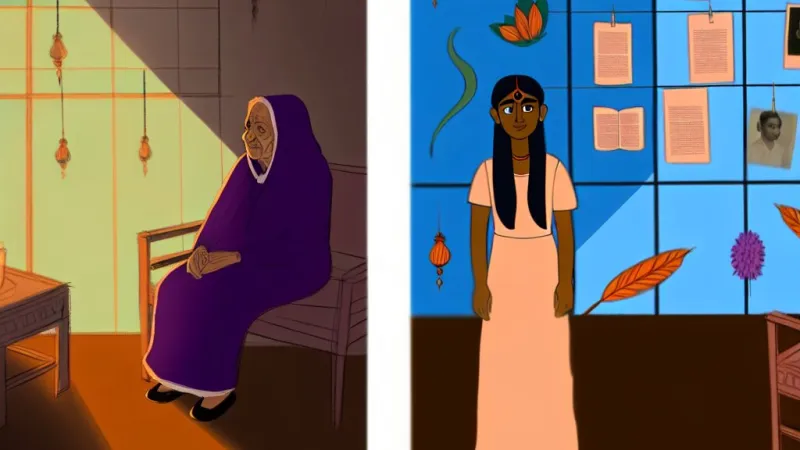
By contrast, Mukherjee’s *Memories* positions the grandmother as the heart of familial and cultural imagination. Instead of focusing on the barriers between self and tradition, the poem foregrounds the everyday rituals that nurture continuity—most notably, storytelling. The domestic sphere, with its “faint aroma of rice” and “echo of the night’s howling wind”, becomes saturated with sensory cues that root the speaker in his Indian upbringing. The grandmother’s tales are not mere diversion; they offer a passage into a “familiar yet unknown” realm, where myth and reality entwine. This oral tradition—so central to Indian culture—bridges generations, quietly ensuring that history and folklore persist even in the face of change. While explicitly celebratory, the poem is not naïve about the threat of loss. The reference to “our lost lives” hints at the near-forfeit of tradition in an age of migration and globalisation. Yet, Mukherjee’s depiction of memory is ultimately one of nurture and hope: identity is gently passed from one hand to another, less precarious than in MacCaig’s rendering.II. Use of Sensory Imagery and Sound to Evoke Memory and Place
MacCaig’s Sensory Detail to Vivify Memories
MacCaig excels in immersing the reader in a tangible world, pierced by conflicting sounds and textures. The “loud and very fast” cadence of Aunt Julia’s speech reverberates throughout the poem, bringing the vibrancy of Gaelic-orality to life. This energetic auditory imagery sharply contrasts with the quietude of other island sounds: “the crickets being friendly”, the hushed click of knitting needles, the slosh of water. The visual detail is equally evocative. We see Aunt Julia “drawing yarn marvellously out of the air”, an image that strays towards the magical, imbuing the mundane with mythic significance. This blend of realism and marvel not only conjures the aura of childhood but suggests that people like Aunt Julia are myth-makers—creators of the stories that bind cultures together. The roughness of the landscape and domestic space—wet feet, buckets and peats—further connect memory to place, implying that cultural identity is not just inherited, but physically experienced and performed.Mukherjee’s Auditory and Olfactory Imagery Enhancing Atmosphere
Mukherjee’s *Memories* leans even more deeply into sensory recall. Details such as the “hooting” of owls and the “howling” of wind plunge the reader into an Indian night, where the outside world is at once unsettling and comforting. The smell of “rice boiled on the hot earthen stove” not only conjures taste and scent, but also connotes hospitality and communal routine. The poem often mingles senses, creating a liminal, “half-awake” space—half memory, half dream—where stories linger even as consciousness fades. This is shown, for example, in the way that the grandmother’s voice becomes a presence that “watches over us” after lights go out. The effect is to emphasise that memory is less a simple photograph than a living, breathing sensation, pervading both waking and dreaming hours. Through this, Mukherjee reveals how culture endures quietly, in murmured stories and the scents of supper, rather than only in grand gestures.III. Emotional Tone and Poet’s Relationship to Cultural Heritage
MacCaig’s Ambivalence and Regret
The emotional register of *Aunt Julia* is complex. At its core lies a sense of love and admiration, but this is inevitably mixed with anxiety and regret. There is the obvious tenderness in lines describing Aunt Julia’s laughter and the playful wonder with which she is painted. Yet, what dominates the closing stanzas is a keen sorrow: “I could not answer her—I could not understand her.” The repetition here pounds home the poet’s regret at failing to bridge the gap created by language and, by extension, culture. Death compounds this loss: “She lay silenced in the absolute black / of a sandy grave at Luskentyre.” Here, the poet invokes the landscape (Luskentyre is a beach on the Isle of Harris), making the point that the Gaelic world’s physical and spiritual homes are vanishing together. The unanswered questions, the frustration, point not only to familial estrangement but to the breakdown of cultural lineage—personal loss standing in for collective dissolution.Mukherjee’s Warmth and Reassurance
Mukherjee’s poem, while not blind to loss, radiates reassurance and warmth. The grandmother’s presence runs like a golden thread through the poem, her stories acting as the “magic carpet” transporting children beyond the confines of immediate reality. There is sadness in the possibility of forgetting, yet the dominant mood is one of gratitude and continuity. The recurring image of dreams—of being watched over, of “wet eyelids” hinting at tears or sleepiness—suggests that identity is protected and renewed, even as times change. Mukherjee does not imply that culture is eternal or unchanging, but offers hope that, so long as stories are told, something essential will remain. Thus, memory is both caution and comfort, encouraging the young to claim their inheritance.IV. Symbolism and Metaphor: Cultural Identity as Fluid and Complex
Symbols in *Aunt Julia*
MacCaig’s poem is rich in symbolic resonance. Aunt Julia herself personifies the untamed spirit of a disappearing order—her “men’s boots”, active hands, and “flouncing” buckets all connoting resilience, vitality and adaptability. The recurring use of water and natural elements symbolises both the force and transience of culture: irrepressible, yet ultimately subject to time. The poet’s inability to communicate with Aunt Julia in her own tongue turns language into a two-way symbol: at once a secret richness and a gilded cage, isolating both speaker and listener from deeper intimacy. The mild “magic realism” in describing her spinning yarn “out of the air” elevates Aunt Julia to the status of folk legend, an embodiment of cultural imagination and endurance.Symbolic Elements in *Memories*
Similarly, Mukherjee’s grandmother becomes more than an individual; she is a vessel for the culture’s dreams, stories, and anxieties. The nocturnal setting functions as a borderland, where the known and the unknown meet, echoing the threshold between tradition and modernity. Tears or “wet eyelids” figure as emblems of vulnerability and sensitivity, integral to the process of receiving and passing on culture. Perhaps most enduring is the metaphor of dreams: as the children sleep, stories persist, and memory becomes embedded in their being—even if the conscious mind forgets. In this, Mukherjee suggests that cultural memory is not linear or always explicit, but diffuse and persistent, blossoming in imagination and sleep as much as in daily life.V. Comparative Reflection: Diversity and Commonality in Cultural Experiences
Though MacCaig’s and Mukherjee’s poems are shaped by their distinct backgrounds—one cast against the wilds of Gaelic Scotland, the other within the cosseted walls of an Indian home—they resonate with each other in compelling ways. MacCaig’s sense of cultural fragmentation, his longing for communion across the abyss of loss, contrasts with Mukherjee’s vision of togetherness and continuity. Yet, both poets are acutely aware of what is at stake: the inheritance and, potentially, the erosion of collective meaning. Whether through the regretful silence between MacCaig and his aunt or the whispered stories of Mukherjee’s grandmother, each poem lays bare the ways in which heritage can be both a source of strength and a site of anxiety. They both portray the universality of trying to rescue or reclaim what might otherwise be lost—be it through language, narrative, or simple acts of remembrance.Conclusion
In their distinct yet overlapping ways, Norman MacCaig’s *Aunt Julia* and Trilokesh Mukherjee’s *Memories* use poetry to make the past tangible, revealing how deeply current experience is entwined with ancestral echoes. Through rich sensory imagery, deft symbolic language, and emotionally resonant tone, both poets illuminate the richness and fragility of cultural identity. MacCaig’s elegiac focus underscored by loss and regret is balanced by Mukherjee’s tone of warmth and hope, reminding us that identity can be both threatened and preserved by memory. Ultimately, these poems stress the importance of recognising both our personal histories and our membership in wider communities. For students and readers alike, they offer a lesson in empathy and attentiveness—a call to listen more closely to the voices of the past, and to carry forward the traditions that give our present meaning.Frequently Asked Questions about AI Learning
Answers curated by our team of academic experts
How do MacCaig's 'Aunt Julia' and Mukherjee's 'Memories' explore cultural identity?
Both poems use memory and vivid imagery to highlight how cultural identity is preserved and shaped by family and tradition.
What key messages about heritage are in 'Aunt Julia' and 'Memories' from AQA 2011?
Heritage is shown as central to identity: 'Aunt Julia' reflects the fragility of Gaelic culture, while 'Memories' portrays Indian customs as nurturing and resilient.
How does family influence cultural identity in MacCaig's and Mukherjee's poems?
Family members, like Aunt Julia and the grandmother, are depicted as custodians of tradition, passing down values, language, and stories across generations.
What poetic techniques do 'Aunt Julia' and 'Memories' use to convey memory?
Both poems use sensory detail and imagery to evoke memories, with MacCaig emphasizing loss and Mukherjee highlighting warmth and reassurance.
How does the emotional tone contrast in 'Aunt Julia' compared to 'Memories'?
'Aunt Julia' is tinged with regret over lost connections, while 'Memories' offers a hopeful, celebratory view of identity surviving through shared stories.
Rate:
Log in to rate the work.
Log in