Wilde's Dorian Gray: Beauty, Desire and Identity in the Victorian Gothic
This work has been verified by our teacher: 12.02.2026 at 16:57
Homework type: Essay
Added: 9.02.2026 at 9:23
Summary:
Explore Wilde’s Dorian Gray to understand Victorian Gothic themes of beauty, desire, and identity, revealing the novel’s moral and psychological complexities.
The Picture of Dorian Gray: An Examination of Beauty, Desire, and Identity within the Victorian Gothic
Oscar Wilde’s *The Picture of Dorian Gray* stands as a provocative gothic novel that challenges and satirises the moral certainties of Victorian England. Written at a time of profound social constraint and preoccupation with respectability, the novel probes deeply into the allure of beauty, the intoxicating pull of sensual pleasure, and the entanglements of repressed personal identity. Wilde’s only novel, first published in 1890, generated shock and intrigue in equal measure, as its exploration of taboo subjects—including implicit homoeroticism and moral ambiguity—seemed to threaten the very fabric of polite Victorian society. This essay will explore the intricate ways in which Wilde interrogates beauty as both an ideal and a destructive force, navigates the shifting terrain of desire and pleasure, and probes the psychological and societal consequences of a split, hidden self. Ultimately, *The Picture of Dorian Gray* is not merely a portrait of its protagonist, but a haunting reflection on Victorian culture’s shadows, hypocrisies, and dangers.
---
I. The Supremacy of Beauty: Aestheticism and Its Dangers
In *The Picture of Dorian Gray*, the cult of beauty is raised to the status of a religion, underpinning the very fabric of the novel’s world. Wilde, writing in the wake of the Aesthetic movement—typified by figures such as Walter Pater and Algernon Charles Swinburne—presents beauty as the most exalted of ideals, but also as potentially ruinous.Basil Hallward’s infatuation with Dorian stems from what he perceives as the latter’s almost otherworldly charm, which inspires his finest work. Lord Henry Wotton, meanwhile, views youth and beauty as the only things worth possessing. “When your youth goes, your beauty will go with it,” he intones, catalysing Dorian’s spiral into despair at the thought of his own fading allure. Wilde constructs a world in which surface eclipses substance; Dorian’s flawless appearance becomes a shield behind which he commits ever-darker acts, untouched and unmarked—at least outwardly.
Yet this apparent elevation of beauty is laced with moral danger. The eponymous portrait, painted with Basil’s all-consuming devotion, soon becomes a grotesque register of Dorian’s inner corruption, even as Dorian himself remains physically untouched by vice. The portrait absorbs the stains of sin, cruelty, and debauchery: its initial radiance gives way to something monstrous. In this way, Wilde fuses the aesthetic with the gothic, using the supernatural as a metaphor for the psychological costs of vanity and self-obsession. This motif reflects a Victorian anxiety about the separation of appearance from essence—a concern evident in other contemporary works such as Stevenson’s *Dr Jekyll and Mr Hyde*.
Society’s obsession with appearance is further brought to life through vivid descriptions of Dorian’s milieu: costume balls, opulent furnishings, and rare artefacts all serve as extensions of his cultivated persona. These aspects, celebrated in Wilde’s lush prose, both dazzle and disturb. The characters’ dismissals of morality in favour of “new hedonism” are shown to be problematic; beauty, for Wilde, is not simple and not always benign.
---
II. Desire and Sensuality: The Allure and Corruption of Pleasure
Lord Henry Wotton emerges in the novel as the eloquent mouthpiece of a radical doctrine: one should yield to every impulse, experience every sensation, and shun the shackles of conventional morality. This philosophy, rooted in the hedonism of the late-Victorian ‘Decadent’ movement, is seductive to the naive Dorian, whom Lord Henry treats almost as an aesthetic experiment.The narrative abounds with sensual imagery—descriptions of opium dens cloaked in shadow, the exotic scents of rare perfumes, the silken textures of richly coloured fabrics, and the melancholy strains of forbidden music. Dorian assembles a personal museum of pleasures: from French tapestries and Eastern jewels to precious statuettes, all meticulously catalogued in the novel’s most baroque passages. This is not mere materialism, but a deliberate, almost spiritual pursuit of sensation, “new acrid pleasures,” as Wilde puts it. The reader senses both the liberation of self-discovery and the gradual numbing of conscience, as each fresh indulgence leaves Dorian more estranged from his former innocence.
And yet, if Lord Henry’s gospel of pleasure appears at first to promise an almost transcendental freedom, its actual workings are more ambiguous. Wilde hints, at times, that sensuality, far from being merely degrading, can lead to moments of heightened perception—what Pater called “moments as they pass, the finest fruit of life.” Dorian’s immersion in perfume, music, and art evokes a kind of rapture that borders on the religious. However, in a society where desire is closely policed and moral transgression is taboo, this quest ultimately breeds secrecy, alienation, and self-loathing.
When Sybil Vane, the young actress, is made to suffer by Dorian’s cruel withdrawal of affection, we witness the tragic cost of aesthetic detachment: he values her as an ideal performance, but cannot accept her fallibility as a person. Through Sybil’s fate and Dorian’s own emotional atrophy, Wilde exposes the limits of hedonistic philosophy and its toll on those held in thrall to its logic.
---
III. Homoeroticism and Veiled Desire
An essential, yet often understated, dimension of *The Picture of Dorian Gray* is its exploration of desire that dares not speak its name. While Victorian law—most notably the Labouchère Amendment of 1885—categorically criminalised homosexual acts, Wilde’s text is rich with coded language, suggestion, and emotional intensity that point towards same-sex attraction and anxieties.Basil’s infatuation with Dorian is first and foremost expressed through the medium of art, but it is also personal and impassioned. His reverence for Dorian’s beauty, the language of “worship” and “adoration,” and the portrait itself (described almost as a love letter in paint), all allude to desires that could not be spoken directly in Wilde’s England. Lord Henry’s own relationship with Dorian is layered with ambiguous intimacy and the thrill of influence and seduction, skirting the boundaries of social acceptability.
To Victorian readers, and to Wilde’s contemporaries in particular, these relationships would have been instantly recognisable as charged, even if never explicitly sexualised. The necessity of secrecy, the language of “shame,” “sin,” and “ruin,” are all part of the era’s coded discourse on sexuality. The fate of Alan Campbell—whose own veiled history with Dorian leads him to suicide when forced into complicity—is a chilling reminder of the dangers faced by those who did not conform. Indeed, Wilde’s own fall from grace, and his eventual imprisonment in Reading Gaol for “gross indecency,” would soon become emblematic of the perilous status of non-normative desire in fin-de-siècle Britain.
Thus, homosexuality in the novel is never named, but always present, a spectral undercurrent floating beneath the visible text. It invites an attentive, subversive reading, reminding us of the potent realities of repression and the ingenuity required to evade censorship.
---
IV. Identity, Secrecy, and the Cost of Repression
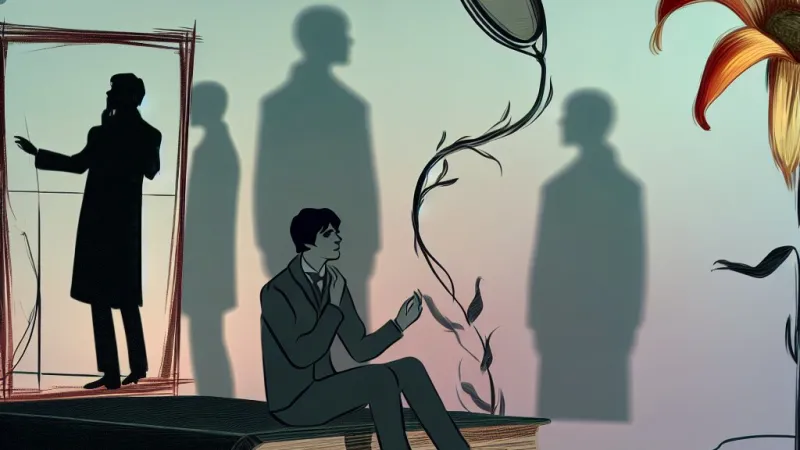
Perhaps the novel’s most enduring theme is the tragic conflict between self and society. Wilde’s tragic hero is a man divided: Dorian Gray’s public identity, untouched by time or scandal, masks a secret life of vice and corruption inscribed onto the hidden portrait in his attic. The portrait, “the most magical of mirrors,” becomes a gothic doppelgänger, bearing all that respectable society cannot see or would refuse to acknowledge in itself.This split self echoes a wider Victorian reality: the insistence on outward propriety and self-control—exemplified by the polite drawing rooms and elaborate rituals of London’s elite—contrasts with the tumultuous world of private impulses and forbidden desires. Dorian’s attempt to divide these realities through secrecy leads not to liberation, but to paranoia, self-loathing, and despair. His growing reliance on secrecy, his terror of discovery, and his ultimate disconnection from all genuine relationships are symptoms of a society that refuses to reconcile the “true” self with its public face.
Secrecy shields Dorian, enabling his public freedom, but it also traps him. The locked chamber and the veiled portrait are symbols of the inner life denied expression. This motif is familiar in Victorian literature—compare the hidden past of Dickens's Miss Havisham or the secret history of *Jane Eyre*’s Mr Rochester. But in Wilde’s novel, repression is not just personal; it is cultural, even systemic.
The ultimate tragedy is Dorian’s final attempt to destroy the portrait—an effort not to atone, but to obliterate evidence of wrongdoing. In trying to sever himself from his hidden self, he catalyses his own destruction, leaving a withered corpse in place of beauty and a restored, innocent-looking portrait. Wilde’s message is clear: the cost of living a divided life, demanded by a hypocritical society, is nothing less than the destruction of the self.
---
Conclusion
*The Picture of Dorian Gray* remains one of the most incisive critiques of Victorian society, weaving together the magnetic appeal of beauty, the allure and peril of sensual pleasure, and the traumas of hidden desire. Wilde demonstrates, through gothic symbolism and lush aesthetic prose, the ultimate cost of a world obsessed with surface, intolerant of difference, and blind to the destructive power of secrecy and repression. The novel is haunted by its historical moment, but also surpasses it; its insights into the complexities of identity, sexuality, and art continue to resonate for contemporary readers interested in the ways literature both mirrors and critiques culture. Wilde challenges us to look beyond the mask, to reckon honestly with the desires and truths that society would defer or deny. In doing so, he crafts a tale that is both shocking and enduringly humane—a gothic reflection of the self that, even in its darkness, invites compassion and understanding.---
*Word Count: ~1,500 words*
Rate:
Log in to rate the work.
Log in