Exploring the Significance of Going for Refuge in Buddhism
This work has been verified by our teacher: 19.02.2026 at 11:10
Homework type: Essay
Added: 18.02.2026 at 16:52
Summary:
Discover the significance of going for refuge in Buddhism and learn how the Three Jewels guide spiritual growth and ethical renewal in practice.
Going for Refuge in Buddhism: An In-Depth Exploration of the Triple Refuge
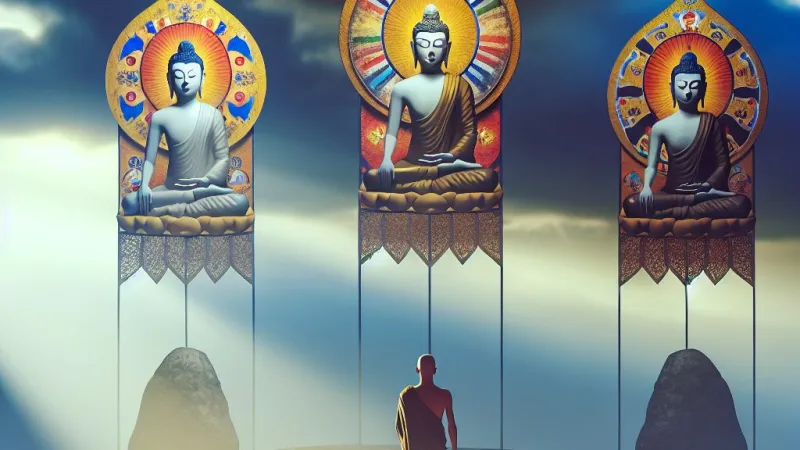
Within Buddhism, the act of “going for refuge” stands as both a profound commitment and the very gateway to the spiritual path. Central to this process are the Three Jewels: the Buddha (the Enlightened One), the Dharma (the teaching), and the Sangha (the spiritual community). Far from being a mere escape from worldly suffering or a place of withdrawal for the faint-hearted, refuge represents an active, transformative stance—one that fosters resilience, wisdom, and ethical renewal. Common misconceptions, particularly in the West, misconstrue “refuge” as a retreat into passivity, yet Buddhist tradition frames it as a movement towards strength, clarity, and freedom from suffering. This essay will examine the meaning and significance of taking refuge, detail the distinctive contributions each of the Three Jewels offers, and explore how this practice supports spiritual growth across diverse Buddhist traditions, both historically and in present-day Britain.
---
I. Understanding the Concept of Refuge in Buddhism
The notion of “refuge” in Buddhism evokes far more than a simple search for comfort. Rather, it signifies a sanctuary that fosters inner transformation—choosing to entrust oneself to sources of true safety amid the inherent uncertainty of existence. Unlike typical Western ideas of safety, which often focus on physical or psychological withdrawal from threats, Buddhist refuge is not about hiding or denial, but about facing the realities of suffering with courage and wisdom.From the time of the Buddha, “taking refuge” has served as the formal entry to Buddhist life. It is publicly declared through well-known phrases, recited in Pali or local languages: “To the Buddha for refuge I go, to the Dharma for refuge I go, to the Sangha for refuge I go.” This ritual, whether performed during ordination ceremonies or lay vows, demonstrates the aspirant’s conscious commitment to the Buddhist path. More than a verbal formula, the act has profound psychological import: it invites practitioners to relinquish reliance on the unreliable—fortune, relationships, material security—and place trust instead in the transformative potential of wisdom, ethical living, and spiritual friendship.
---
II. The First Refuge: The Buddha
The first agent of refuge is the Buddha, not simply as a historic person but as both an ideal and guiding inspiration. Siddhartha Gautama, revered as the original Buddha, embarked on a quest that led him from the shelter of princely life through the hardships of renunciation and finally to enlightenment beneath the Bodhi tree. His story, familiar to students across British religious studies syllabi, encapsulates qualities of perseverance, compassion, and profound insight. In becoming “awake” to the nature of suffering and its cessation, the Buddha demonstrated that liberation is humanly possible.Different Buddhist traditions interpret the Buddha's role with subtle differences. Theravāda, widespread in Sri Lanka and parts of Southeast Asia, often emphasises the historic Buddha’s life and teachings as singular. Here, the Buddha is the supreme teacher and human example, not a supernatural figure to be worshipped. By contrast, Mahāyāna traditions, prevalent in East Asia and among British convert communities, broaden the concept: they venerate countless Buddhas and bodhisattvas embodying limitless compassion and wisdom, symbolic of the boundless potential within all beings.
Crucially, the Buddha is more than an object of veneration—he is an exemplar. His mastery over greed, hatred, and delusion, his patient encouragement of his followers, and his steadfastness on the Middle Way (avoiding both self-indulgence and self-mortification) reveal a model for navigating the pitfalls and extremes that often characterise human life. British practitioners and students may see this paralleled in figures such as Mahatma Gandhi or Malala Yousafzai, though the Buddha’s scope is spiritual rather than political. In practical terms, contemplating the Buddha—through meditation, storytelling, or study—nurtures mindfulness, stability, and ethical clarity in daily living.
---
III. The Second Refuge: The Dharma
The Dharma, sometimes translated as “the teaching” or “truth”, provides the philosophical and practical framework of the Buddhist path. At its heart lie teachings such as the Four Noble Truths and the Noble Eightfold Path—archetypal features of the British GCSE and A-Level syllabi. Yet Dharma is more than an ancient body of scripture; it represents the continuing, living truth about reality, as discerned and transmitted by awakened beings.Early Buddhist communities transmitted Dharma orally, which later became the Pāli Canon, the oldest sustained Buddhist scripture extant. In time, as Buddhism spread across Asia, cultural diversity infused interpretation and practice. Mahāyāna Buddhists added new sutras, while Tibetan Vajrayāna incorporated Tantra and extensive commentarial literature. Zen, in the Japanese tradition, downplays scripture to champion “direct pointing at the mind,” encouraging practitioners to see the Dharma in everyday experience itself. This diversity is mirrored in British Buddhist settings: some follow rigid scriptural study, while others emphasise meditation and direct investigation.
Refuge in the Dharma serves both as map and motivation for practice. On the one hand, the teachings offer moral guidance—abstaining from harm, cultivating honesty and generosity—and blueprints for mental development through practices like mindfulness (sati) and loving-kindness (metta). On the other, the Dharma is subject to interpretation and debate—a tension especially visible between textualists and experiential practitioners. Most traditions balance both, while also recognising that the ultimate aim is to embody the Dharma through action, not merely to understand it intellectually. For British students, practical engagement might involve meditation in local sanghas, volunteering, or ethical reflection.
---
IV. The Third Refuge: The Sangha
The Sangha constitutes the spiritual community of those who travel the Buddhist path together. Traditionally, the Sangha refers to ordained monks and nuns, bound by the Vinaya (the monastic code), but it also expands to include lay followers who embody Buddhist principles in the lay world. Modern sanghas in Britain reflect this inclusivity; lay and monastic practitioners often learn and meditate side by side in city temples or university societies.A key function of the Sangha is to act as a source of encouragement, guidance, and accountability. Group meditation sessions, shared study, and rituals together strengthen resolve and help individuals withstand discouragement and doubt. The Sangha is sometimes referred to as a “field of merit”—supporting the good karma of its members.
The Buddhist parable of the elephant is often cited: a solitary wild elephant, separated from its herd, is more easily led astray, but in the company of good elephants, it remains steadfast. This vivid metaphor underlines how association with like-minded practitioners enables one to resist negative influences and cultivate virtuous conduct. British Buddhist communities, whether in London, Manchester, or smaller university chaplaincies, evidence the psychological benefits of group practice, mutual aid, and ethical shared life.
However, the Sangha is not without its challenges: conflict, ideological disagreement, or interpersonal tension can arise, requiring discernment and patience. Engaged Buddhists must walk the fine line between communal reliance and self-reliant effort—a challenge familiar in all faith communities.
---
V. Interconnection and Complementarity of the Three Refuges
The Three Jewels are frequently described as interdependent: the Buddha is the enlightened source, the Dharma is the truth he taught, and the Sangha is the community that preserves and realises both. Refuge, then, is not merely a one-off ceremonial act, but an evolving, dynamic process that unfolds throughout a practitioner’s life.Sincere going for refuge fosters ethical discipline (as undertaken by the Buddha), diligent mental development (as outlined by the Dharma), and emotional support (as provided by the Sangha). This structure underpins the journey toward enlightenment and provides resources for meeting life’s adversities with resilience and confidence. Rather than passive dependence, it is a synergy—a lived embodied practice.
---
VI. Contemporary Significance of Going for Refuge
In modern British contexts, going for refuge has adapted creatively. British Buddhists might recite the Three Jewels in English, or infuse ancient forms with new relevance—such as combining meditation retreats with social action. The rise of secular mindfulness has introduced aspects of the Dharma and Sangha to wider audiences, albeit shorn of explicit religious commitment.Furthermore, the idea of refuge resonates beyond Buddhism alone. Many religious and philosophical traditions—Christianity’s “sanctuary”, Sufism’s “companionship of seekers”, Humanism’s stress on shared values—suggest parallel commitments to guidance, ethical teaching, and supportive community. For Buddhists and non-Buddhists alike, refuge can serve as a psychological anchor and springboard for personal transformation.
For students in particular, reflecting on going for refuge can deepen critical understanding and prompt ethical questioning. It offers an opportunity to cultivate meaning and intentionality, rather than mere rote repetition—an ethos championed in the best of British education. It encourages exploration, openness, and a willingness to learn from tradition while forging a personally meaningful path.
---
Rate:
Log in to rate the work.
Log in